






Introduction
Social Media Screen Time Statistics: In 2025, social media’s impact on people’s lives cannot be measured by a single part; rather, it dominates their lives. It is a 24-hour activity for billions of people, who scroll, swipe, watch, like, comment, share, and reel through digital content nonstop. Social media has evolved from a mere communication channel to a major influencer in culture, commerce, politics, and mental well-being.
Moreover, the experts now believe that if mobile and social screen time is compared with traditional TV or offline activities, then the former will be a clear winner, leading to the conclusion that in 2025, one of the most significant global digital behavior indicators will be the statistics of screen time.
The article takes a comprehensive look at the latest social media screen time statistics, including average usage times, platform-specific statistics, age group behaviors, related health research, and economic implications, all supported by thorough research sources.
Editor’s Choice
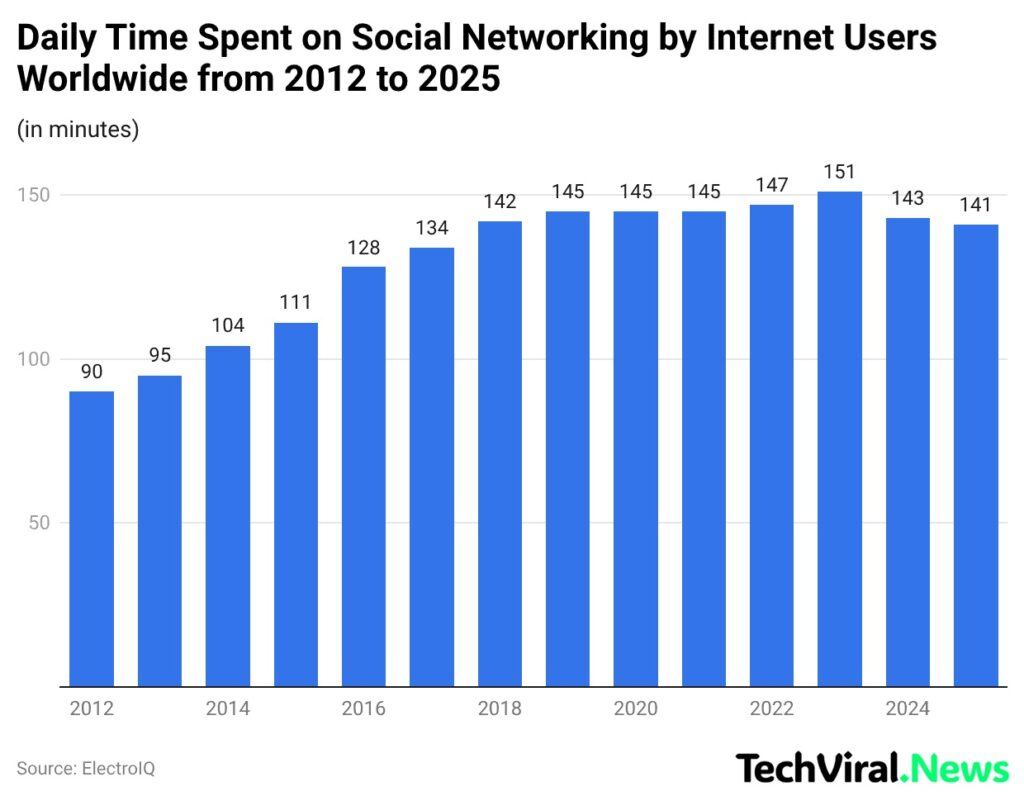
- Social media’s average global screen time was 141 minutes per day in February 2025, indicating a point of no further growth in usage.
- The global social media penetration rate is 62.3%, indicating widespread acceptance of the platform.
- Northern Europe has the highest social media penetration rate at 81.7%, indicating very high digital adoption.
- On average, U.S. teens aged 17 years old spend 5.8 hours per day on social media, which is a peak.
- Around 60% of teens use social media for more than four hours a day.
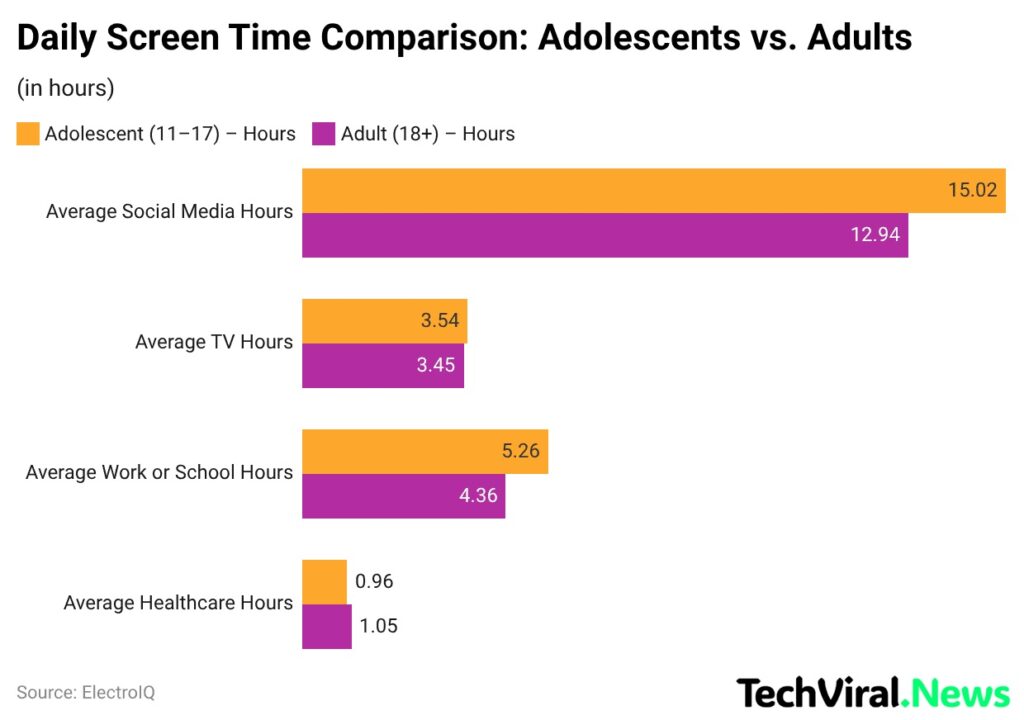
- Teenagers spend over 15 hours daily on all digital screen activities combined.
- Smartphones account for 92% of global social media screen time.
- Social media mobile apps take up nearly 2.5 hours of users’ daily time, who are already on the digital platform.
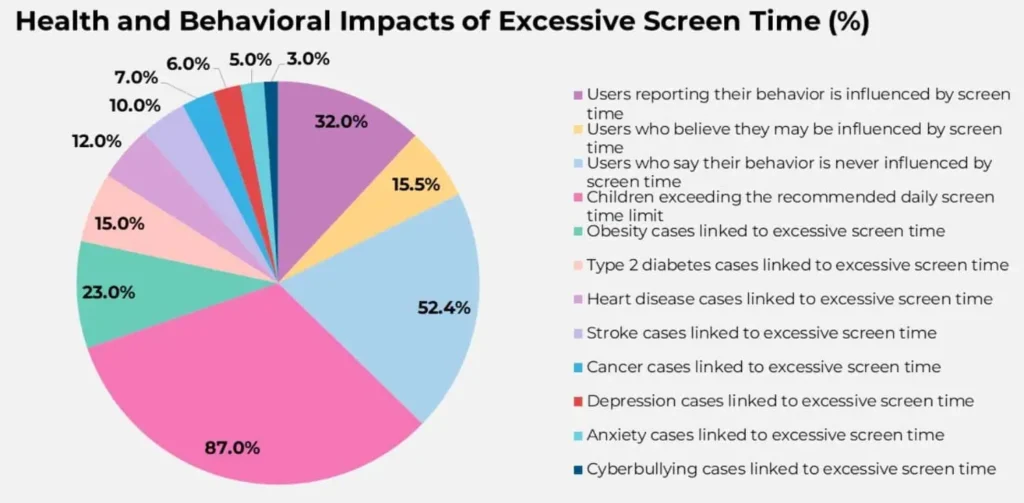
- About 87% of kids exceed the WHO-recommended daily two-hour screen time limit.
- Obesity is the cause of 23% of health cases related to excessive screen time.
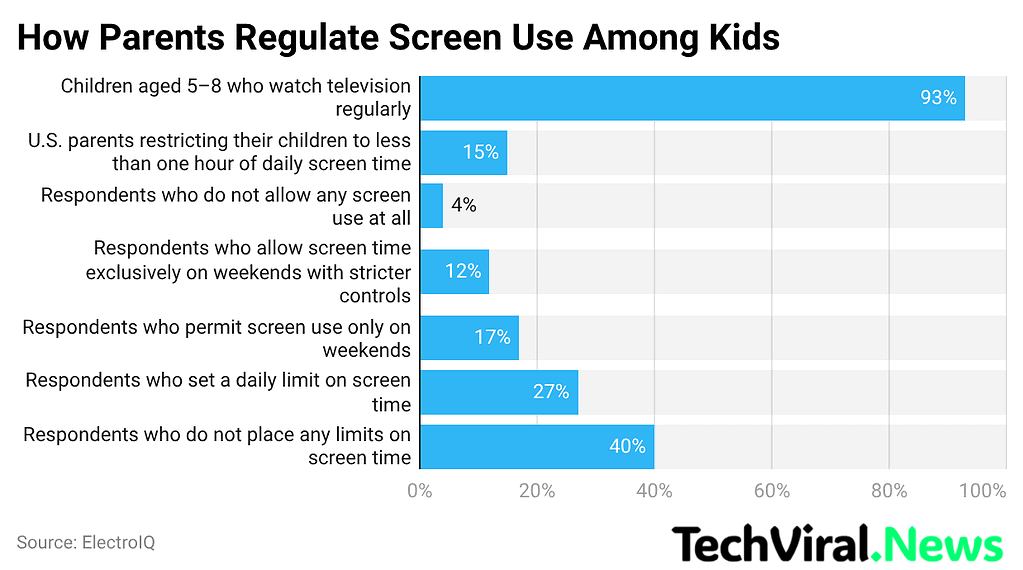
- About 40% of parents do not set any limits for their children’s screen time.
- Global social media screen time jumped from 56 minutes in 2019 to 145 minutes in 2020 due to COVID-19.
Global Social Media Screen Time Trends And Behavioral Impact
(Reference: statista.com)
- The most recent Statista data indicates a delicate yet significant shift in global use of digital devices.
- The average daily usage decreased slightly to 141 minutes in February 2025, suggesting that signs of saturation were emerging after the massive growth in social media screen time, which had been lasting for years, was still making its way through.
- Brazil leads with almost 4 hours daily, indicating that social media platforms are inseparable from life, while the U.S. stays at about 2 hours, which is quite moderate usage.
- The global penetration has reached 62.3%; therefore, social media has already become part of the infrastructure rather than a newly emerging phenomenon.
- Northern Europe has the highest penetration at 81.7%, indicating digital maturity, while some areas in Africa are still showing the growth potential, which has not been tapped yet. The impact beyond use is difficult to pin down.
- Social networks facilitate access to information, communication, and even people’s opinions, but they also raise growing privacy concerns, political divisions, and sometimes even distractions in daily life, among other things.
- Users’ value defines the next phase of people spending time on social media, where the quality of engagement may matter more than the raw minutes spent on the screen.
Rising Screen Engagement Patterns Among U.S. Teens
- There is a drastic rise in social media screen time from age 15 to 18, with 17-year-olds, the very group with academic pressure, social identity, and digital connectivity clashing, pulling as much as 5.8 hours a day, which is the peak.
- More than 50% of teenagers currently have daily usage of more than 4 hours, indicating that this heavy usage is no longer exceptional but the standard.
- The younger teens do not have such high average usage, but even the 13-year-olds spend more than 4 hours daily, which could indicate that younger children are being introduced to technology earlier than ever.
- The trend of 4.8 hours on average is a sign of how much screen time has penetrated adolescent lives.
- On the other hand, the trend raises very important questions socially, mentally, and with the content itself, as the way teenagers deal with and behave under the influence of social media is changing and getting embedded in their development cycle.
Digital Engagement Trends Based On Gender
- Recent data show not only differences in social media screen time by gender but also by life stage and platform preference.
- Women’s usage, which is the highest overall, is driven by visually rich, community-oriented platforms like Instagram and TikTok, whereas men’s somewhat lower averages mask longer, deeper sessions on YouTube and Reddit.
- One trend is that non-binary people show the highest daily screen time of all recorded groups on social media.
- Among young people, girls are already much further ahead than boys, meaning they are adopting new technology more quickly and are more likely to use it than boys.
- The gap that has been narrowed in the mid-adulthood stage is due to lifestyle restrictions that have equalized usage, whereas the 11% increase among women over 50 indicates a great change in the demographic composition.
How Screen Habits Diverge Between Teens And Adults
(Reference: ElectroIQ)
- According to ElectroIQ, the analysis lays bare a remarkable generational divide in the time spent on social media.
- Youngsters have certainly left grown-ups behind by more than 15 hours a day, including all their digital activities, and the latter are thus realising that screens are an essential part of young people’s lives.
- The very small difference in hits on TV consumption can be ignored, as the major difference lies in multitasking—students are engaged on school-related screens while being involved in higher social media activities.
- On the other hand, adults are showing little more computerized care, focusing on health and practical necessities, which results in somewhat different drivers of engagement being as such.
- All in all, it is the total exposure for adolescents through social media screen time that has been emphasized, and it is thus the question of what to balance, where to draw the line in terms of productivity, and digital well-being in general that has come up.
Why Smartphones Now Own The Social Media Attention Economy
- Mobile phones are the main route for social media screen time in massive amounts in 2025.
- Social platforms are practically in people’s pockets, with 92% of total time spent on them on smartphones.
- It is almost two and a half hours of life taken daily for the users to be on mobile social apps against only a few minutes on desktop, which is a signal of the shifting behavior towards always being engaged, even when they are out.
- Gen Z is at the forefront of this trend, trusting almost entirely in phones for their communication, entertainment, and expressing their personalities.
- Even the session behavior has changed—mobile sessions are getting longer, and the steep rise of short-form video has pushed the social media screen time across all demographics.
- The desktop still has certain apps that make it relevant besides everyday office work or professional networking like LinkedIn or playing games via Discord, for example, while tablets are almost completely becoming obsolete.
- The overall picture painted by the mobile dominance is that social media screen time, now more than ever, is ruled by ease of access, format design, and smartphone availability rather than traditional computing habits.
How Too Much Screen Time Is Affecting Health And Behaviour
(Source: market.biz)
- According to Market.biz, the health data tells a similar story about people’s real-world habits versus the recommended guidelines.
- Though the experts are saying that the exposure to screens should be limited to two hours a day—not even a minute for the children under two—the behavior of the people speaks otherwise.
- A huge number—87%—of kids are exceeding the suggested limit, which indicates how much social media is literally a part of one’s day-to-day life.
- 52.4% of the users think their behavior is not at all influenced by the use of screens, while almost half either admit or suspect the influence of the behavior.
- The gap between the two perceptions indicates that sometimes people are not even aware of the fact that social media is affecting their habits.
- The number one health problem connected with the heavy use of screens is obesity, which takes up 23% of the cases, highlighting the drawback of being sedentary for a long time.
- The metabolic and cardiac risks are the next ones in line, with the trio of type 2 diabetes, heart disease, and stroke together accounting for more than a third of the reported cases.
- These are not short-term effects, but long-term health burdens. Mental and social outcomes, such as depression, anxiety, and cyberbullying, may be small in percentage, but their impact on emotional well-being—especially of the young—has been huge.
How Parents Manage Their Children’s Screen Time Today
(Reference: market.biz)
- Children’s digital habits were managed through a fragmented and often reactive approach, as reflected in the above numbers.
- It is most remarkable that 40% of all parents do not impose any limits on screen time, which, in fact, allows social media and digital entertainment to monitor their children while they play.
- This disorganization of the screen time activities is very obvious in the 27% who put daily limits on their children, indicating their awareness of the screen-related threats that are growing.
- Similarly, the other 29% impose restrictions that allow using the screens only on weekends to varying degrees; thus, many households are relying on time-based controls rather than content-based guidance.
- Only 15% of U.S. parents have a policy of strict control over availability, with less than 1 hour daily, indicating the difficulty of consistent moderation.
- The fact that 93% of kids aged 5 to 8 watch television regularly proves that the exposure to screens starts quite early now.
- Overall, social media screen time is less of a digital boundary and is instead negotiated, moulded by convenience, routine, and cultural practices rather than enforced digital limits.
How People Track And Control Screen Time Using Digital Tools
- By 2025, built-in tools like Apple Screen Time and Google Digital Wellbeing represent the overwhelming majority as they reduce the friction; users do not need extra apps to start tracking their behavior.
- Among younger adults, adoption is very robust, with more than 60% of users aged 18 to 34 having at least one screen-monitoring or limiting app installed, indicating rising concern about digital overuse.
- Productivity-focused users are attracted to third-party apps like Forest, RescueTime, and Freedom, while parents are increasingly relying on Bark, Qustodio, and Microsoft Family Safety to control their children’s screen time on social media across different devices.
- Instagram and TikTok’s AI-powered nudges are showing how the responsibility is being returned to the ecosystems.
- Nevertheless, the success of this approach remains uncertain, as four out of ten teenagers admit to frequently overriding restrictions.
- Even with the weekly reports on “time well spent,” only 18% of users act on them; this suggests that tracking social media screen time is easier than changing the habits that have grown around always being connected.
How The Pandemic Pushed People To Spend More Time On Social Media
- The coronavirus was an accelerant for digital behavior rather than a disruptor. The lockdowns led to daily life moving to screens, where social media became the main space for work, connection, and emotional release.
- The number of social media users worldwide increased by 11% from 2019 to 2021, but the more remarkable change was in the time spent on social media.
- The average daily usage went up from 56 minutes in 2019 to 145 minutes in 2020, a clear indication of how much the platforms had become part of the daily routine.
- Brands reported a 6% rise in engagement, and at the same time, online video consumption jumped by 85%, indicating that the audience had shifted decisively to visual and interactive formats.
- TikTok and Instagram were quick to capitalise on this trend by introducing similar features, such as Reels and Live, to reduce the feeling of isolation through simulated presence during lockdowns.
- In addition to the metrics, the tone of the content also changed—users tended to the materials that were light, comforting, and funny.
- Social media screen time during a crisis proved both a coping mechanism and a commercial opportunity.
Conclusion
Social Media Screen Time Statistics: The use of social media has altered from being a minor habit to a major characteristic of contemporary society. Although the rise in usage is slowly coming to a standstill in developed nations, the use among teenagers continues to increase, which is impacting the behavioral patterns, health, and even the competition for people’s attention in a new way.
On the other hand, as health issues become more serious, self-regulation tools yield mixed results, and people are aware of the problems but not taking action, the gap between awareness and action is widening. The amount of time spent on social media will not be the main factor determining the future of social media screen time; rather, it will be the quality of engagement, accountability, and sustainable digital balance.
In February 2025, the worldwide average daily usage of social media will be 141 minutes, which indicates early signs of a plateau in usage after a long period of growth.
Brazil is at the forefront worldwide, as users spend almost four hours a day on social media, denoting that in Brazil, the cultural integration of platforms is very deep.
The average of U.S. teens’ usage is 4.8 hours daily, with 17-year-olds reaching the peak of 5.8 hours, turning the heavy usage into a norm instead of an exception.
Young people are the group that spends the most time, with more than 15 hours a day, including all digital activities of school, entertainment, and social meetings.
Approximately 40% of parents do not impose any restrictions, whereas only 15% of U.S parents limit their children’s screen time to one hour or less per day.