






Introduction
Social Media Advertising Statistics: In 2025, social media has completely changed the face of advertising; it has become the core of the advertising world. What started with mere banner ads on the Facebook timeline has turned into a detailed setup of artificial intelligence-powered campaigns, highly focused video ads, and even more, a combination of shopping and entertainment that allows consumers to purchase without leaving the platform. Brands are now investing huge sums in social media general marketing; therefore, global advertising has gone up to hundreds of billions of dollars, and it is quite competitive, making the brands chase the customers through their reach, engagement, and conversion.
This huge expenditure of money is a clear indication of a change in the trend of people, where they not only watch the happenings around but also learn about the products, try them out, and even buy them at the same time. This article will showcase the trending social media advertising statistics and their market impressions in 2025.
Editor’s Choice
- Social media marketing has been the very basis of advertising for the modern world in 2025, with more than 5.4 billion users in total around the globe, which is almost 68% of people worldwide.
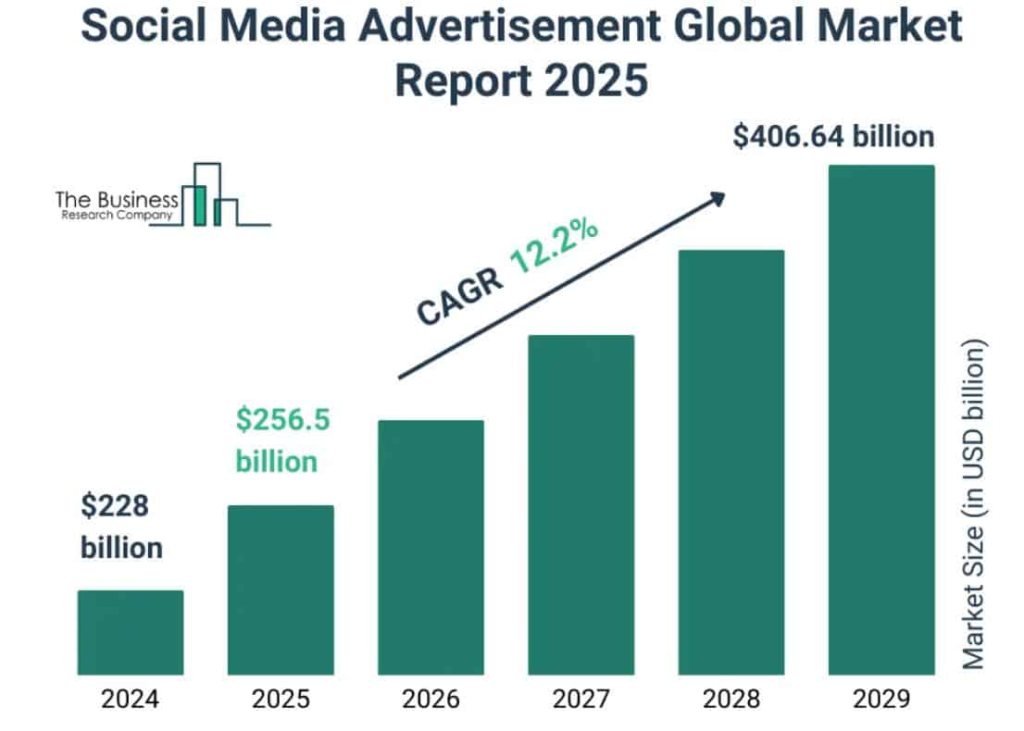
- The global social media advertising market is anticipated to grow from US$256.5 billion in 2025 to about US$406.64 billion by 2029, at a remarkably high CAGR of 12.2%.
- With a dominant position of 2.53 billion users, YouTube is the king of ad reach worldwide, and very close to it is Facebook with 2.28 billion. On the other hand, Instagram (1.67 billion) and TikTok (1.59 billion) are the two main players in the short-form and visual advertising formats, respectively.
- Almost 36% of the entire social media advertising budget worldwide comes from North America, while Southeast Asia and the Pacific Region are classes showing more than 13% year-on-year growth in the segment.
- The use of AI in dynamic ads has been a tremendous factor in the media spend, with AI dynamic ads claiming 41% of total social media ad spend, which is indicative of the massive acceptance and use of the technology for automation and personalizing purposes.
- With TikTok as the undisputed champion in e-commerce CPA at a whopping US$25, Instagram and Facebook were next at US$32 and US$38, respectively, thus drawing attention to the differences in the efficiency of the platforms.
- With a 6.8:1 ROAS and a US$65 CPA, LinkedIn is indeed the top performer in B2B, and thus, through the professional audience targeting, it is a very attractive channel.
- The process of landing page optimization produces the greatest return on investment of 42%, followed by precise audience targeting and accurate conversion tracking.
- Most of the social advertising comes from mobile devices, contributing more than 92% of total ad clicks and 2.6 trillion impressions worldwide, while desktop use is still associated with the highest average order values.
- Besides, short-form video ads of 60 seconds are recognized as the best across all platforms in terms of engagement, completion rates, and brand recall since they consistently outperform others in these aspects.
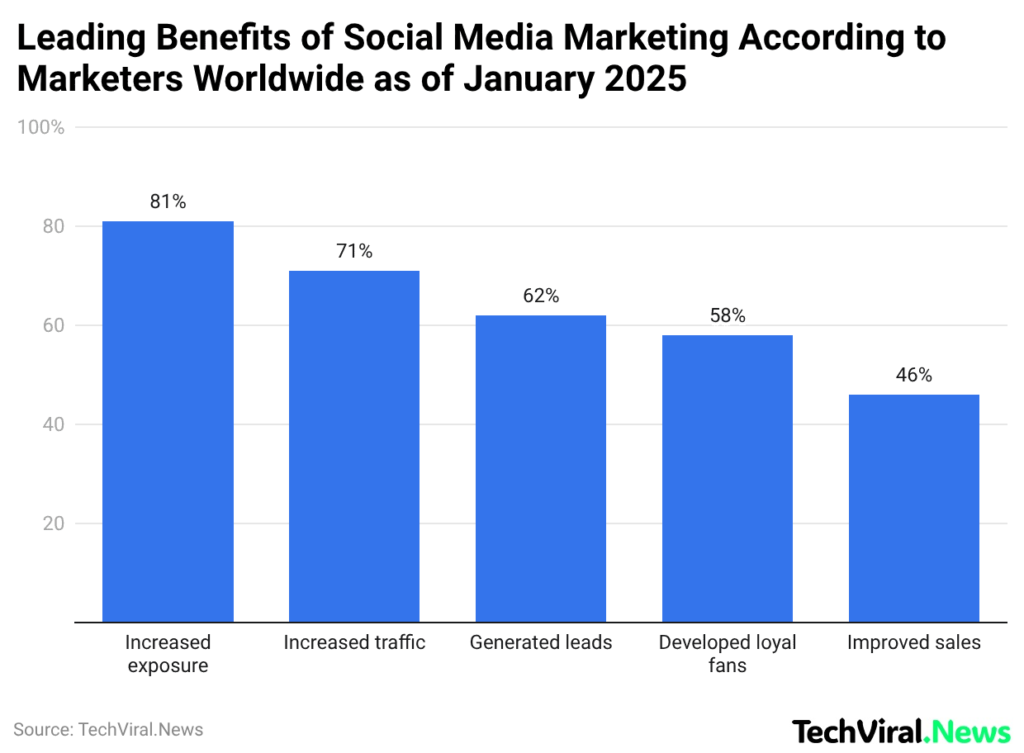
- Marketers, in a large number of cases, identify increased exposure (81%), traffic increase (71%), and lead generation (62%) as the main advantages of using social media marketing.
- Social media advertising expenses all over the world have shot up by approximately 140% since 2019 and are said to exceed US$230 billion by 2024 while maintaining the same rapid increase in their growth rate.
- More than 68% of advertisers have started using AI for the three activities, right from bidding to targeting and creative optimization.
Worldwide Social Media Advertising Market
(Source: sqmagazine.co.uk)
- The global social media advertising market is growing rapidly and steadily as brands keep moving their budgets to digital platforms.
- In 2024, the total market is US$228 billion, and it is predicted that there will be a steep increase in this value in the coming years.
- The global social media advertising market will be worth US$256.5 billion in 2025, and this is going to be a strong year-over-year rise mainly due to more mobile users, more video watchers, and better ad-targeting technology.
- The pace of growth will be 12.2% CAGR from 2024 to 2029.
- The market size is expected to be over US$280 billion in 2026 and then gradually grow in 2027 and 2028 as advertisers spend more on all the platforms: Instagram, TikTok, YouTube, and Facebook.
- By the end of 2029, social media advertising globally is anticipated to be around US$406.64 billion, showing a greater role for the sector in the whole advertising ecosystem.
Global Social Media Advertising
| Social Media Platform | Potential Ad Reach (All Ages) |
| YouTube | 2.53 billion |
| 2.28 billion | |
| 1.67 billion | |
| TikTok | 1.59 billion |
| 1.20 billion | |
| Messenger | 947 million |
| Snapchat | 709 million |
| 606 million | |
| X (formerly Twitter) | 586 million |
| 340 million |
(Source: theglobalstatistics.com)
- Data indicates that in 2025, the global reach of social media advertising is highly concentrated among the major players.
- YouTube is at the top with a possible audience of 2.53 billion users for ads, hence being the largest platform for advertising globally.
- The size of YouTube gives it an upper hand of 11% over Facebook, which is next with 2.28 billion users.
- However, when the consideration is of adults 18 years and older, Facebook gets the upper hand over YouTube by about 20 million users, which means both platforms have almost the same size of monetizable audiences.
- With a reach of 1.67 billion users, Instagram comes in third place, just slightly ahead of TikTok, which has 1.59 billion users, thus consolidating Meta’s dominance with a variety of high-scale platforms.
- Despite its professional nature, LinkedIn still manages to reach a vast audience of 1.20 billion people, while also utilizing Messenger, Snapchat, Reddit, X, and Pinterest, gaining more or less, but large progressively smaller audiences down the list.
- The aforementioned numbers in concert provide insight into the extensive range of scale and targeting options that advertisers can utilize across all platforms.
Influencer Marketing Statistics On Social Platforms
- Instagram is still at the top of the list when it comes to influencer marketing; 69% of marketers see it as the best channel for ROI in 2025.
- TikTok influencers, on the other hand, have patently outdone the brands, as they have 33% more engagement rates, especially in the areas of beauty and lifestyle, where the audience is really into creator storytelling.
- It is the small fish that has done the trick. Nano-influencers, who have less than 10,000 followers, had an average engagement rate of 4.3%, which was higher than that of the mega-influencers, thus demonstrating the worth of the small communities that are niche and highly engaged.
- Youtubers with over 500,000 subscribers were able to realize an investment of 6.7 times through brand partnerships in the year 2025.
- In the B2B world, LinkedIn influencers—often tech and finance industry specialists—were able to produce lead quality that was 2.4 times better than that of regular campaigns.
- Story-based influencer advertisements on Snapchat and Instagram stories that were short and engaging got completion rates of 49%, which was a strong indicator of viewer interest and attention.
- The prices of influencer marketing have also increased. The cost of a TikTok post by a mid-tier influencer with 50,000 to 500,000 followers is currently around US$1,150 per post.
- Brands and influencers working together in the form of Instagram Reels and YouTube Shorts have a reach that is 38% greater than that of similar non-collaborative content.
- Live-stream influencer marketing, especially on TikTok and YouTube, is estimated to have brought in US$5.6 billion in global revenue.
- A more results-oriented strategy is being applied since over 40% of influencer contracts in 2025 will be based on performance indicators such as sales and conversions as opposed to flat fees.
Global Social Media Ad Spend Trends
- The numbers indicate that social media advertising worldwide was on an ever-increasing trend, and that overall spending increased by 11.6% each year from 2024’s US$221.6 billion to 2025’s US$247.3 billion.
- North America continued to be the largest source of revenue that contributed almost 36% of the total spending in the world, while the Asia-Pacific region was gaining ground faster, as it was growing 13.2% to a total of US$72.5 billion.
- The total sum for the European continent was US$49.6 billion after a moderate but stable growth rate of 8.3%.
- Social ads allocated to short-form videos like Reels were on the rise in terms of budgets and were already making up 32% of the global social ad market.
- The retail sector was the largest single advertiser, accounting for 18.7%, and political advertising was also up, an estimated US$12 billion, as elections were held in many places.
- Dynamic ads powered by AI became a major player, accounting for 41% of total spend, and small companies put together a sizeable US$38.9 billion investment.
- The intense rivalry caused the global average cost per mille (CPM) to rise to US$8.74 from US$7.91 in the prior year.
Social Media Advertising ROI And Cost Analysis
- The performance of social media advertising varies significantly across different platforms, industries, and campaign objectives, as illustrated by the data.
- The metrics of Cost Per Acquisition (CPA) and Return on Ad Spend (ROAS) indicate that platforms designed for discovery and visual engagement are generally more cost-effective for e-commerce. In contrast, professional and content-rich platforms provide better quality for B2B marketing.
- TikTok is the e-commerce brand’s lowest Cost per Acquisition (CPA) platform, which is about US$25. An impulsive buying mindset and viral product discovery drive these customer acquisitions.
- Pinterest is next in line with a US$28 CPA, and the home and lifestyle sectors, whose users are actively looking for purchase inspiration, are part of its benefits.
- The US$32 CPA of Instagram corresponds to its presence in fashion and lifestyle shopping, whereas the larger audience of Facebook leads to a higher US$38 CPA. E-commerce CPA is the highest for YouTube at US$45 because users are generally doing research-heavy, considered purchases.
- In B2B lead generation, CPAs are naturally higher due to the longer sales cycles and the need for qualified prospects.
- LinkedIn shines with a US$65 CPA, giving strong value through professional targeting.
- Facebook and YouTube fall between US$85 and US$95, supporting scale and educational content, while Twitter/X has the highest CPA at US$110, indicating its focus on thought leadership rather than direct conversions.
Return On Ad Spend (ROAS) Analysis
- The ROAS data indicates the areas where advertisers derive maximum benefit from their spending.
- With a 6.8:1 ROAS, LinkedIn takes the lead in B2B performance, owing to the fact that companies are able to get more deals with high-quality leads.
- Pinterest, with its 6.2:1 ROAS, is the second-best performer, and the reason for this is the very strong purchase intent.
- TikTok’s ability to go viral and draw the younger generation gives it a strong 5.1:1 ROAS, while YouTube (4.5:1) and Instagram (4.2:1) have their victories through video engagement and shopping integrations.
- Facebook is at 3.8:1 ROAS, which indicates a mature market and growing competition.
ROAS Improvement Factors
- The analysis reveals that the extent of the impact of the optimization on the returns is huge.
- The process of optimizing the landing page gives the most noticeable increase, resulting in a 42% improvement in ROAS, and the accurate audience targeting is the next, with a ROAS increase of 35%.
- The correct conversion tracking leads to a 31% ROAS increase, whereas the creative optimization is 28%.
- The time-related ongoing campaign optimization gives a 25% boost improvement, which supports the argument that continuous testing and refinement are critical to maximizing advertising efficiency across all platforms.
Social Media Advertising Strategies
- The strategy is to allocate the budget according to both the size of the business and the objectives of the campaign, which will result in the maximization of efficiency and return.
- For startup companies with monthly advertising budgets of US$1,000 to US$5,000, the emphasis is largely on Meta platforms, which receive about 70% of the budget due to their reliable targeting and conversion capabilities.
- TikTok accounts for about 20% of the budget that is to be spent on grabbing discovery-driven traffic, while the remaining 10% is for testing new platforms, creators, or audiences. This way, early-stage companies will learn fast, and at the same time, the risk will be minimized.
- As companies expand their budgets within the range of US$5,000 to US$25,000 monthly, the distribution of expenses gets more equal treatment.
- The share for Meta, which is the platform for stable performance, is still about 50%, while TikTok gets more allocation, up to 30%, in order to benefit from the extensive and stimulating reach.
- Also, the 20% that is left is going to platforms diversification, such as YouTube, LinkedIn, or Pinterest, which is a great way to lessen the reliance on one channel at the same time and open new ways for growth.
- For high-spending, basically enterprise advertisers, the strategy of spending over US$25,000 per month is quite large, and thus it is not surprising that the strategy is even more diversified now.
- In this case, Meta is still the major performer with 40%, but TikTok takes 25%, and a huge 35% is divided among different platforms.
- Shifting the campaign objective perspective, the budget allocation prioritizes the revenue-driven outcomes.
- Around 40% of the budget sales campaigns focused on ROAS optimization are devoted, thus ensuring direct contribution to revenue.
- Lead generation is approximately 30%, supports pipeline growth, and future conversions.
- Brand awareness campaigns take 20%, which consists of reach and impressions, thereby building long-term visibility.
- Retargeting is the category for the remaining budget, which accounts for 10%.
- Retargeting is the one that nurtures high-intent users and also keeps the conversions through re-engaging the audience that is already familiar with the brand, but it is done at a lower cost.
Mobile Vs Desktop Ad Engagement Rates
- In the case of social media advertising, it is predominantly mobile, with more than 92% of all advertisement clicks coming from mobile devices.
- Such a shift indicates how much smartphones are involved in everyday digital activity, and it also causes an increase in mobile ad impressions by 19% year-over-year to a total of 2.6 trillion worldwide.
- Formats like Instagram Reels are much more successful on mobile and generate three times more interactions than desktop views, whereas vertical video ads get the engagement that is recognizable because of their natural compatibility with mobile screens.
- Progress in mobile infrastructure, especially the rollout of 5G, stimulated ad performance by reducing video load times and increasing click-through rates to surpass desktop averages.
- Users of desktop platforms are significantly more valuable because they have the highest average order values, which are probably a result of larger screens and longer browsing sessions supporting more thoughtful purchase decisions.
- So, mobile drives volume and engagement, while desktop remains the one that does high-ticket conversions and detailed product research, thus making a blended approach essential for advertisers.
Video Ad Performance Across Platforms
- In 2025, short-form video content was found to be much more effective than long videos, with an engagement rate of 34% more, especially since audiences were leaning towards faster and easier-to-digest content.
- YouTube not only overshadowed the rest of the video-making platforms but also took a major share of the global video ad market with 44%, thereby solidifying its role as the best platform for video marketing.
- Instagram Reels ads showed powerful growth as well, with a 26% rise in click-through rates over 2024, which was a sign of the increasing user engagement with the captivating vertical video formats.
- On the other hand, TikTok’s Spark Ads were really powerful in terms of the brand getting recognition, as it was able to deliver 17% higher brand recall to the customers, especially with the Gen Z audience.
- Facebook In-Stream video ads also gained more viewers, reaching an average number of 85%, which is a 6% gain from the previous year.
- YouTube Shorts was the king of the mobile videos as it gathered 12% more people watching till the end than traditional mobile videos did, which was proof that shorter and mobile-first content is the best solution.
- The business class felt the same with LinkedIn native video, as the video generated 1.3 times more action when used for thought leadership than videos shared through external links.
- Snapchat ads maintained strong user interaction, getting a swipe rate of 2.12%, along with AR filters taking the user engagement to a higher level.
- On Pinterest, Idea Pins, which had video content, showed a 15% lift in saves and clicks, thus indicating that the platform is increasingly becoming valuable for discovery-driven marketing.
Leading Benefits of Social Media Marketing According To Marketers Worldwide
(Reference: statista.com)
- The year 2025 saw universal acceptance of social media by marketers as a potent marketing channel; the most significant benefit perceived was the increase in exposure.
- A high percentage (around 81%) of marketers affirmed that social media marketing noticeably enhances the visibility of the brand, which in turn, makes it possible for the business to reach a larger and more heterogeneous audience.
- Apart from the exposure, user generation was another advantage that was mentioned as a major one, and 71% of the participants identified that social sites have become very efficient in directing users to websites and landing pages.
- Also, lead generation was considered a strong outcome, as 62% of marketers associated social media campaigns with their efforts to attract and capture potential customers.
- The fast-growing social media advertising industry on a global scale is proof of the increasing social media dependence.
- The worldwide spending on social media advertising has more than doubled since 2019, the last full year before the pandemic, and is projected to reach over 230 billion U.S. dollars by 2024.
- The trend is expected to continue with an additional nearly 50% climb in global ad spending by 2029, thus, going past the 345 billion-dollar threshold.
- User base continues to drive the growth as Facebook and YouTube lead the pack by monthly active users, with Facebook having over 3 billion users and YouTube having over 2.5 billion users by 2024.
- Simultaneously, generative AI is transforming the marketing industry in terms of social media strategies.
- In a worldwide survey conducted in 2025, the marketers identified the gains in efficiency and the generation of ideas as the major benefits of GenAI, which made the technology a powerful upcoming tool for the standardization of processes and the planning of content promptly.
- The increased content output and the greater creativity lagged only slightly behind as they demonstrated how the AI tools could support both the volume and the innovation in the social campaigns.
- A large number of marketers mentioned authenticity and the issue of human creativity being suppressed as the issues they face the most, while a considerable portion of them think that the content created by AI will be less authentic.
- Moreover, the fact that the audience does not react to the AI-generated content still poses a major hurdle; hence, the necessity for human supervision and strategic decision-making in social media marketing is reasserted.
Demographics of Social Media Ad Audiences
- The Millennials, who are aged from 27 to 42, are still the ones to engage in social media ads the most, and they are responsible for 38% of the total paid clicks in the U.S.
- Gen Z has been faster than millennials in video-oriented activities, and that is why they are the main contributors to 42% of the overall TikTok ad interaction in 2025.
- On the other hand, Baby Boomers who fall in the age group of 59-77 years are also becoming discriminating customers, and the response rates for this ad group on Facebook have grown by 17% annually, which signals that they have gotten more responsive.
- The analysis of interactions by gender indicated that women are 27% more likely than men to react to lifestyle and e-commerce advertisements that appear on social media sites like Instagram and Pinterest.
- In contrast, LinkedIn has the highest time spent by decision-makers or business consumers who invest an average of 1.6 hours on the site daily, thus making it the best place for collecting leads with high intent.
- The males aged between 18-24 years have been identified as the segment of the audience that is the quickest to respond to ads in the year 2025, and this is especially true for the content related to entertainment and sports.
- When it comes to psychological and financial categories, Hispanic users make up 21% of the total Instagram ads viewed in the U.S., and they are particularly involved in the categories of retail and food.
- African American users, as per the study, have 15% higher advertisement recall than the typical user on short-form video platforms.
- The users from the upper-middle-income group, that is, households with an income of US$100,000 and above, are the ones who engage with the branded content on YouTube 23% more than the general users.
- The urban population continues to lead in mobile engagement, contributing to 68% of the total social media ad traffic.
AI And Automation In Social Media Advertising
- 68% of advertisers have already included AI in their campaigns.
- Those are the areas where AI is the most utilized in advertising: the improvement of the ad’s bidding, the selection of the audience, and the writing of ads.
- AI has been credited with an average of 23% increase in ad performance with the help of dynamic creative optimization, while customer acquisition costs have been reduced by 19% with the use of predictive analytics.
- AI conversational agents of the same type as ChatGPT have become a part of 42% of the brand messaging communications on Facebook and Instagram, thus granting users quicker and more personalized interactions.
- The process of A/B testing has been automated, and this has led to an increase in creative experimentation by 3.4 times, especially in the Meta advertising ecosystem.
- On the other hand, AI-powered video editing solutions for small businesses have decreased the costs of content creation by 31%.
- B2B advertising on LinkedIn, Paul Ad Manager debuted predictive lead scoring in 2025, which greatly improved the accuracy of ad targeting.
- The retailers that used automated retargeting systems reaped 37% more from the recovery of the abandoned carts.
- At the same time, AI-made virtual influencers now account for 2.3% of sponsored posts on TikTok and Instagram.
- Voice-recognition AI processing in interactive ads like podcasts has been observed to increase ad recall by 18% when compared with old-style methods.
Social Media Ad Fraud And Brand Safety Statistics
- The ad fraud issue is still significant, as the global costs in 2025 due to the aforementioned problem are estimated to be US$9.8 billion, with fake clicks, bot traffic, and other types of fraudulent activity being the main reasons for that.
- Click farms account for around 21% of invalid traffic on smaller or less popular platforms.
- The major networks are taking decisive measures — Facebook and Instagram recognized over 1.3 million ads just in the first quarter of 2025 and marked them as unsafe.
- Via artificial intelligence, the fraud detection systems have been a major contributor in the reduction of losses, the leading platforms having together saved over US$3.2 billion in ad spend waste.
- TikTok’s automatically controlled moderation system was able to catch and block 96% of the harmful ad content before the content went live.
- The advertisers applying pre-bid brand safety filters experienced a 54% drop in the number of policy violations, while YouTube’s brand suitability tools managed to cut down the number of wrong ad placements by 38%.
- Ad fraud and impersonation scams comprised 6.5% of the reported fraud cases, and political advertising was scrutinized the most heavily, with 28% of all brand safety violations traced back to it.
- To boost transparency even further, a total of 11% of the brands worldwide have opted for blockchain-related ad verification solutions.
Recent Developments In Social Media Advertising
- Continued automation and creativity driven by the e-commerce sector are factors that keep changing the nature of social media advertising.
- Meta’s Advantage+ Shopping Campaigns have reached a point where they can automate the entire targeting and budget allocation process, and as a result, the company sees a 30% improvement in cost-per-acquisition performance.
- YouTube’s vertical shopping ads for Shorts have led to a 41% increase in product click-through rates.
- LinkedIn’s Thought Leader Ads, which first came on the market in late 2024, now eat up 7% of the total B2B advertising budgets as brands are driven by executives.
- Pinterest has amplified its artificial intelligence-driven shopping features and hence reported a double-digit growth in conversion rates in the beauty sector.
- Meta’s Threads social network opened up to advertisers in March 2025 and is already experiencing 1.6 times the engagement that Instagram had during its early phase of launch.
- Snapchat launched Sponsored Lenses 2.0, which included the use of AI and real-time data for creating personalized experiences, while X presented a new revenue-sharing model for the purpose of incentivizing the best advertisers and creators.
- Meta further facilitated WhatsApp Business integrations by allowing video ads to be shoppable right in chat shows.
- TikTok made its e-commerce ecosystem more robust by teaming up with Shopify and BigCommerce; thus, U.S. retailers will be able to provide in-app checkout starting from Q2 2025.
- It is common to see AI-powered creative assistants being an inseparable part of most ad managers across platforms, as they allow for real-time optimization using live performance data.
Conclusion
Social Media Advertising Statistics: Social media advertising in 2025 still holds the position of the leading actor in the digital marketing scene, thanks to enormous global acceptance, fast-paced technology innovation, and changing consumer habits. Social media platforms have transformed into full-funnel ecosystems where the activities of discovering, engaging, and selling have all taken place without anyone realizing it. Meanwhile, the popularity of short-form video and the push for mobile-only and AI-optimized content have allowed the brands to reach their target audience with better accuracy and more effectively than ever before.
Though the issues of ad fraud and the question of genuineness have not gone away, the measures taken in terms of tapping, analytics, and brand safety are all contributing to the building of trust and performance. The increasing spend on social media advertising makes it possible to view this area as the main driver of a company’s growth that is not only sustainable but also measurable in terms of business impact.
FAQ
In the year 2025, close to US$256.5 billion will be the amount projected for global spending on social media advertising. The market’s growth speed is phenomenal, which is mainly because of the influence of mobile devices, the popularity of video, AI-assisted audience targeting, and business engagement of all scales, granted it could be more than US$400 billion by 2029, as per certain predictions.
YouTube is the number one platform with the widest global reach for ads, and the number of potential ad viewers is over 2.5 billion, while Facebook comes next at 2.28 billion. Instagram, TikTok, and LinkedIn are also among the platforms with large and easily targetable audiences; thus, they provide advertisers with many high-scale options that are suitable for their campaign objectives and demographics.
The return on investment fluctuates according to the aim. In B2B campaigns, LinkedIn provides the best return on ad spend as it brings in good-quality leads. On the other hand, TikTok and Pinterest are the best for e-commerce as they yield very high ROIs.
Mobile devices account for over 92% of social media ad clicks today, a trend that is primarily driven by smartphone usage, short-form video consumption, and faster mobile networks. Desktop users may bring in more revenue per order, but mobile still runs the race in terms of reach, engagement, and volume; thus, the advertisers’ primary focus is on mobile.
AI has completely modified the social media marketing landscape by means of various technologies like automated bidding, dynamic creative optimization, predictive analytics, and audience targeting. The usage of these technologies is leading to the rise of performance metrics, a decrease in customer acquisition costs, faster testing cycles, and efficient brand campaign scaling that does not compromise the aspects of relevance and personalization.