






Introduction
Smartphone Addiction Statistics: Smartphones, fine devices that they were, were regarded as the ultimate convenience, the best connection, and the savviest productivity. However, in a mere span of less than two decades, these tiny computers have turned into one of the most heated debates and the biggest health concerns in the digital world. With a staggering number of over 6.8 billion smartphone users globally, which is more than 85% of the world population, the issue has changed from who has a mobile phone to who is really in charge of their screen time.
The good and the bad kept on going together as technology was the main reason for bridging various continents, and it was also the main reason for reshaping the human being’s attention, sleep, emotion, and even neural wiring. In 2025, the researchers are ringing the bell: the smartphone addiction is no longer a hypothetical issue; it is a measurable, clear, and conscious part of daily life. This article will present the trending smartphone addiction statistics.
Editor’s Choice
- People in 2025 will be checking their smartphones around 96 times a day on average, which suggests that the behavior is already very much ingrained.
- The number of smartphone users is now over 6.8 billion, which means that more than 85% of the world’s population is using these devices.
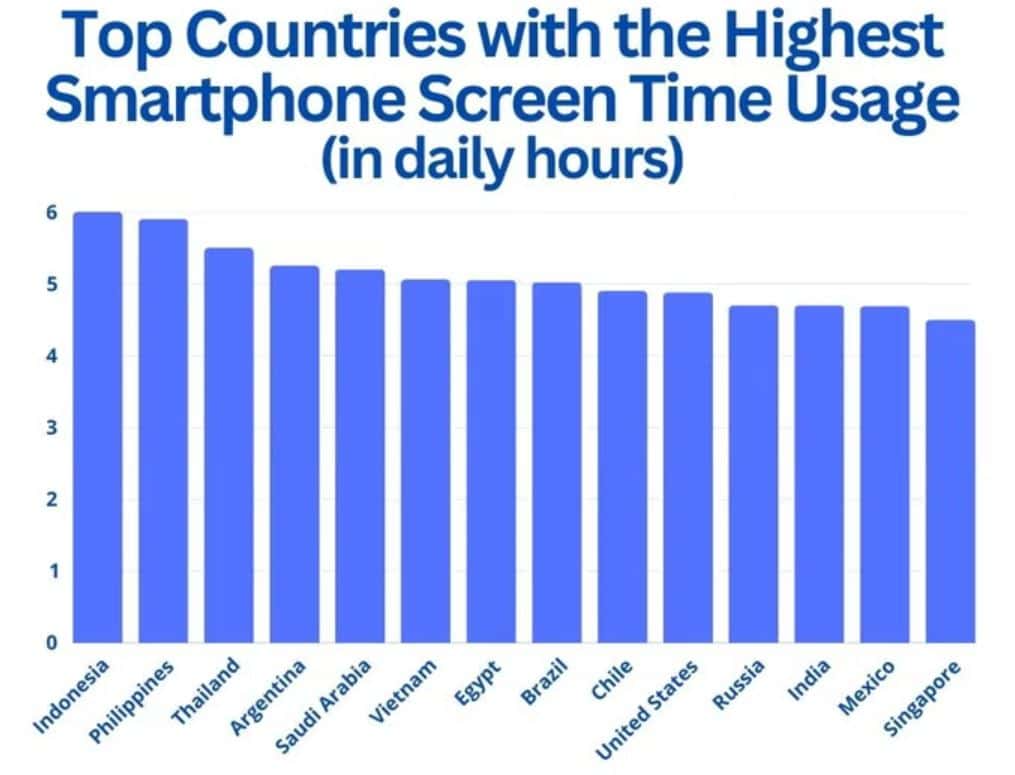
- The longest daily smartphone screen time among the countries worldwide is in Indonesia, which exceeds 6 hours, thus showing a very high level of digital absorption.
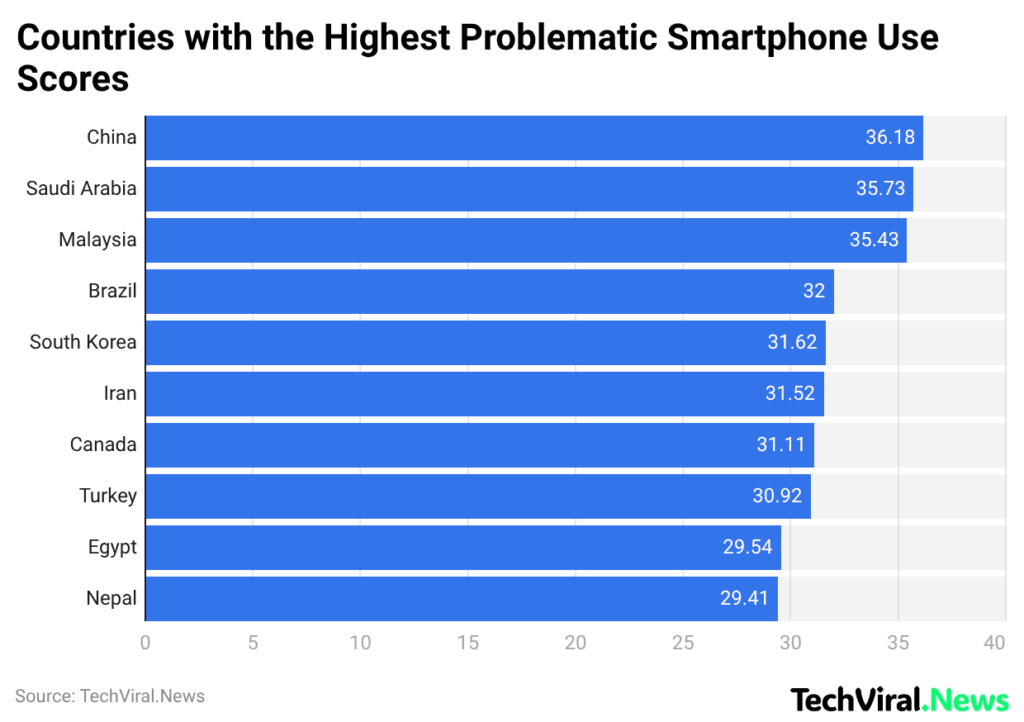
- China has the highest rating for problematic smartphone usage, with a score of 36.18, due to people depending heavily on super-apps.
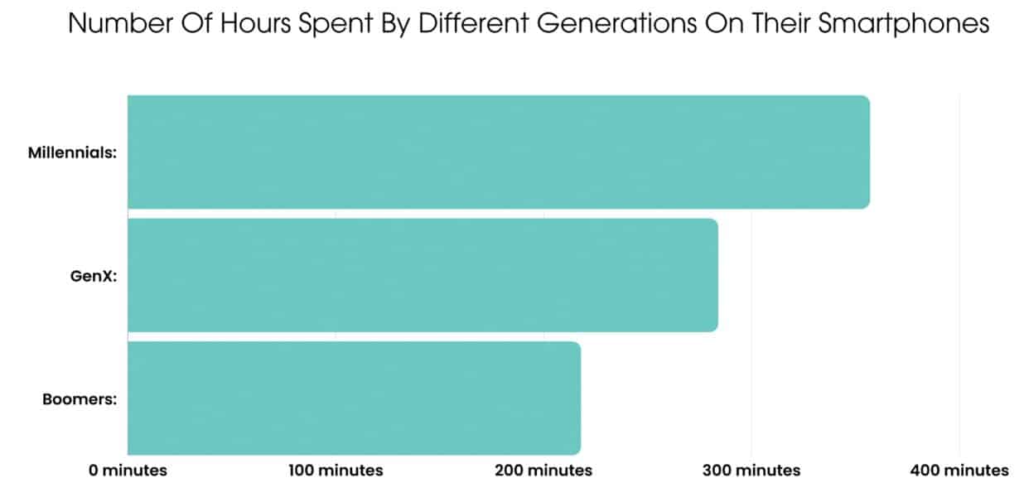
- Younger adults spend, on average, 6 hours and 37 minutes daily on their smartphones, which is almost double the time of the older generation.
- On the other hand, 41% of the younger generation, even though they spend so much time on their phones, are determined to cut back, which is a sign of increasing self-awareness.
- The smartphone user proportion in the under-50 age group is 95%, while in over 65 is only 61%.
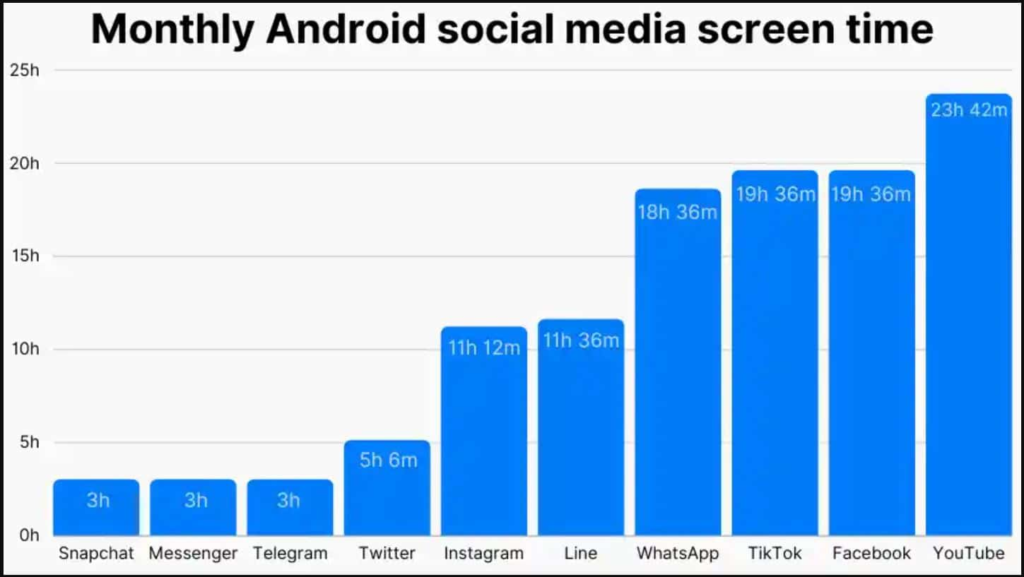
- The screen time on Android devices for YouTube alone equals almost 24 hours per month per user.
- Half of all American teenagers between the ages of 13 and 18 are honest enough to say that they are completely hooked on their smartphones.
- On average, kids all over the world are taking up to 9 hours using smartphones per day, which is nearly the same as the time adults spend on that.
- An average college student picks up their phone 11 times during a class, and thus, attention to the academic material is reduced. The scores of students using their phones in class are 14% lower in the final tests, so the negative effect on academia can be measured.
- Smartphone addicts are less physically active as they walk 38% less every day due to their phone use.
Top Countries With The Highest Smartphone Screen Time
(Source: softonic.com)
- The screen-time ranking presented here underscores the ubiquity of smartphones in the daily lives of people from both the emerging and developed markets.
- Indonesia stands at the top with its average of more than six hours of daily smartphone use. This trend reveals users’ reliance on continuous digital interaction through social media, mobile entertainment, and app-based services—all of which are classic signs of smartphone addiction.
- The Philippines and Thailand are not far behind, thus confirming Southeast Asia as a mobile-first region.
- High usage is also a characteristic of Latin American countries, such as Argentina and Brazil, which reflects high levels of social interaction and content consumption.
- Even developed markets such as the US, India, and Singapore reveal significant daily exposure to screens.
- The totality of the data indicates that smartphone addiction is a global behavioral trend driven by the culture, connectivity, and mobile-centric lifestyles of the various regions rather than being a localized issue.
Countries With The Highest Problematic Smartphone Use Scores
(Reference: sqmagazine.co.uk)
- The scores for problematic smartphone usage generate a very powerful image of how much mobile behavior is influencing the pattern of life in modern societies, regardless of whether they are developed or emerging economies.
- The score of 36.18 for China is the highest among the countries considered, and it reflects the super-app ecosystems’ main character.
- In such an ecosystem, work, payments, entertainment, and social interaction all get funnelled through a single device—an environment that is indeed ripe for smartphone addiction.
- Close behind come Saudi Arabia and Malaysia, which shows that high-income countries, where digital adoption is the norm and constant social connections can lead to dependency patterns.
- The situation in Brazil and South Korea is quite different, as social media interactions, gaming culture, and mobile-first entertainment ecosystems that are all very strong in these countries are continuously driving smartphone addiction upwards, particularly in the case of young individuals.
- On the other hand, countries like Iran, Canada, and Turkey are proof that problematic usage is not confined to a particular area or economic condition, but to the behavioral dependence on smartphones for everyday activities.
- Smartphone usage in Egypt and Nepal, though their scores are lower, is still considered worrying, as the countries are on the edge of the probable unhealthy usage area.
Smartphone Addiction In Different Generations
By Generations
(Source: demandsage.com)
- The above data trends given by Demandsage reveal that today’s smartphone addicts belong largely to the Gen Z cohort, with their average daily use astonishingly amounting to 6 hours and 37 minutes.
- This particular generation nearly doubles the time spent on mobile phones compared to their elders, the Baby Boomers, who still manage to keep their mobile time to below 4 hours a day, hence marking a clear demarcation in the behaviors of those who grew up with the technology and those who did not.
- The two groups of Millennials and Gen X still exhibit a similar pattern; the former being less dependent on screens than younger ones, and the latter being more than the ones coming next.
- 41% among Gen X are looking for ways to decrease their screen time, which is really a very large percentage compared to only 31% of Boomers holding the same position.
- However, perception gaps do not evaporate: more than three-quarters of Gen Z confess that they are using their phones more than they would like, while for Boomers, the same is only about halfway.
By Age Group
| Age group | Percentage of Smartphone users. |
| Under 50 years | 95% |
| Between 50 to 64 years | 84% |
| Above 65 years | 61% |
(Source: demandsage.com)
- The adoption trend of technology based on age distribution is another factor that emphasizes the addiction issue of the youngest generation.
- The data shows that smartphone penetration is nearly universal (95%) for people under 50, while only a little over a third (61%) of the population aged 65 and over own one; thus, the presence of smartphones in people’s lives turns out to be the major contributor to the addiction.
Monthly Screen Time of Android Social Media
(Source: sqmagazine.co.uk)
- The monthly Android screen time data brings out the fact that the addiction to smartphones is becoming more and more determined by a few social platforms.
- YouTube is in the front row with almost a whole day of usage in a month, which is indicative of its role both as a source of amusement and as a companion for the screen.
- Facebook and TikTok are the next two, each holding over 19 hours a month of users’ time, which points out that the mix of short videos and the social feeds still continues to boost habitual scrolling and make the patterns of smartphone addiction even stronger.
- Besides, the “message” apps have a big share of people’s time; WhatsApp is almost at 19 hours, which indicates that being always connected is a habit that people have adopted rather than a choice.
- On the other hand, Twitter, Snapchat, and Telegram are among the platforms that are more selective in their engagement.
- In general, the data put forward the idea that the diversity of apps is not the main factor that causes people to be addicted to smartphones, but rather the time-consuming, content-rich platforms that become firmly embedded in daily digital routines are the ones that cause the addiction.
Smartphone Addiction In Kids
- The data points to a worrying trend of smartphone dependency among the young ones, especially in Gen Alpha.
- The early and continuous use of digital devices has created a situation where dependency on smartphones is the norm, with even half of the U.S. teens aged between 13 and 18 admitting to being addicted.
- For a lot of them, the smartphones are no longer just tools that they can choose not to use; instead, they are emotional attachments that they have to have with them all the time—during meals, at bedtime, and even when they are just sitting doing nothing.
- Almost one-third of children globally are showing unmistakable signs of smartphone addiction, and two-thirds feel anxious if their phones are out of reach, indicating emotional dependence and not casual use.
- The fact that 34% acknowledge excessive usage, and nearly half check their phones compulsively, underscores a shift toward habitual behaviour.
- Collectively, these trends suggest smartphone addiction is becoming embedded at younger ages, raising long-term concerns around attention, mental health, and social development if left unaddressed.
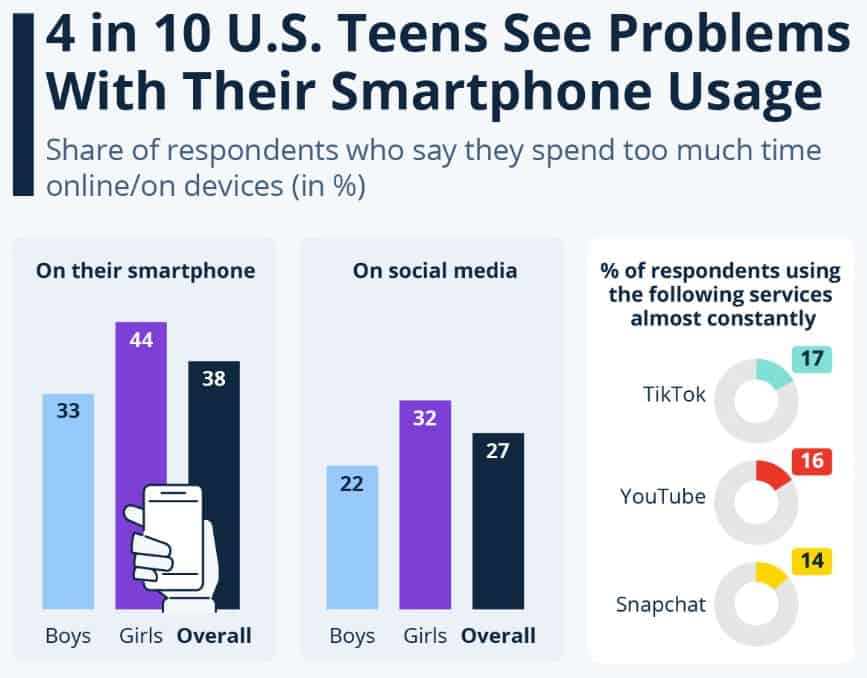
U.S. Teens See Problems With Their Smartphone Usage
(Source: statista.com)
- The above data given by Statista marks an important change in the way U.S. teens perceive and manage addiction to smartphones.
- A majority of young people consider their total screen time as “about right.”
- Nevertheless, a substantial 38% admit to spending too much time on their smartphones—an exceptionally high degree of self-understanding for a habit-based and design-driven behavior.
- Only a few have significantly cut down on their usage, indicating that smartphone dependency is so ingrained in the daily schemes of life that it is not merely a matter of choosing not to use the device.
- Girls seem to be more aware of their excessive use, with 44% saying they are using too much, while the figure is still only one-third for boys, and they are also more active in reducing consumption.
- This implies that the correctness of behavior may be influenced by the social consciousness of the user and his/her self-control, as well as the volume of use itself.
- Analysts often interpret this gap as an opening for digital well-being interventions targeting the particular rather than restrictions for all.
- The video-centric platforms like TikTok and YouTube have become the favorite of teens, and most of them are almost always engaged.
- The two-fold growth of “almost constant” internet use from 2014 points to the fact that smartphone addiction has progressed from occasional use to steady connectivity; hence, the line between offline and online life is shadowy.
- Screen time regulation’s transition from households to law indicates that the smartphone addiction issue is not just domestic anymore but systemic.
- Banning smartphone use in schools is a manifestation of the growing agreement that no mobile access might be causing the students’ distraction from the study, isolation from peers, and mental distress—hence society is coerced to alter its views towards the digital devices it had once embraced.
Smart Phones Dependency Among Students
- The present-day scenario clearly reveals the grounds of smartphone addiction in the current education system and how deep it is.
- When 82% of high school students claim they will not be able to go without their phones unless there is strict enforcement, that shows a behavioral dependency instead of a simple distraction. This becomes even more pronounced in higher education, where students in college are churning through their phones, checking them 11 times in one class, directly undercutting sustained attention and cognitive absorption.
- Middle school teachers who consider smartphone distraction to be the biggest barrier to participation indicate that the problem starts in the very first years and keeps on growing.
- At the same time, 24% of students turn to their smartphones as a stress-relief tool, which sometimes only serves to intensify the addiction, making it hard to tell where the support ends and dependence starts.
- The pattern has been further sped up by online learning, which has resulted in 38% of students engaging in social media activity while attending live sessions.
- The fact that almost 75% of students at college and university are relying on their smartphones emotionally is a clear demonstration of the effects of smartphone addiction on personal identity, severed communication, and academic discipline.
- 14% drop in exam score, which is directly linked to the use of phones during lectures, a sharp and clear case of a performance penalty.
Correlation Between Social Media Use And Addiction
- The relationship between social media intensity and smartphone addiction in 2025 is extremely tight, as the data presented here provides strong evidence for that.
- When 61% of smartphone addicts claim that social platforms are the main reason preventing them from reducing their use, it becomes apparent that apps are not merely simple, passive tools but rather sophisticated, active habit-forming systems.
- TikTok, Instagram, and Snapchat are the main players in the youth market, with these three apps together accounting for nearly half of all screen time of the 13 to 30 age group; thus, it is the short-form, algorithm-driven content that is the main reason for this dependence problem.
- Social media users, who spend more than three hours per day on it, have 2.4 times greater chances to cultivate annoying mobile phone habits than others, while teenagers who exceed four hours show significantly greater attention problems.
- The fact that 35% of users log into their Meta apps within minutes of waking up emphasizes how commonly these habits have been integrated into our everyday lives.
- 58% of Gen Zs think they have to be online all the time, and 67% of e-therapy cases mention FOMO as a reason for their addiction.
Smartphone Addiction And Physical Health Effects
- Data coming from 2025 indicates that smartphone addiction is not merely a psychological issue anymore, but it has transformed into a public health concern that can be measured.
- Heavy users report various complaints related to their eyesight—35% of them say they have eye strain, headaches, and blurred vision—this is a case of overstretched visual and brain areas due to prolonged screen time.
- “Text neck” has become one of the major posture problems among 20% of the population under 40.
- Smartphone addiction has many bad effects, but sleep disruption is the most damaging one.
- The blue light emitted from the screens postpones REM sleep cycles by more than 20 minutes, leading to the accumulation of fatigue, deterioration of cognitive performance, and increased health risks in the long term.
- Even more worrying is the situation with the young ones, where the adults can already see signs of misalignment and lack of physical activity occurring even before the children reach adolescence.
- Almost 40% less daily walking among the high users emphasizes how smartphone addiction indirectly leads to overweight and metabolic issues, particularly in the adolescent population.
- Even fitness gadgets have difficulty offsetting this trend since users increasingly disregard the activity reminders.
Top Activities For Which People Use Smartphones
| Activities | Percentage of smartphone users |
| Chatting or sending messages | 74.70% |
| E-mailing | 70.95% |
| Online banking | 62.90% |
| Listening to music | 61.70% |
| Watching videos | 61.10% |
| Searching for products | 56.70% |
| Buying products | 56.60% |
| Uploading videos or photos | 54.55% |
| Reading news pages | 52.30% |
| Making internet calls | 47.45% |
| Using online map/navigation services | 46.70% |
| Watching movies/series | 44.85% |
(Source: demandsage.com)
- The above-mentioned breakdown of activities aptly demonstrates how smartphones have turned out to be all-in-one digital command centers, while at the same time, they have been the main contributing factor in the addiction.
- Communication is at the center of usage pattern with 74.7% of users asserting that their main activity was chatting or sending messages.
- Almost 71% saying their major activity was email, thus supporting the notion that being connected all the time is more of a social expectation than a choice.
- With 62.9 % of users engaged in online banking and more than 56 % of users using their phones to search for or buy products, it is evident that smartphones have taken over the role of personal financial advisors and shopping centers.
- 61.7% play music, 61.1% view videos, and almost 45% watch or binge on films or series, often in long, uninterrupted sessions that lead to increased total screen time.
- More than 54% of people upload pictures or movies, and 52.3% of users keep reading news every day, which results in the customers being mentally and emotionally engaged throughout the day.
- However, almost half of the entire population is still using their smartphones for utilities that are not the main function, such as navigation or internet calling.
Parental Concerns And Youth Usage Patterns
- Data from 2025 gives a vivid illustration of increased parental anxiety regarding the early exposure of devices to children and the ever-growing smartphone addiction among kids and teens.
- One-third of U.S. parents regret allowing their children to use smartphones too soon, and almost 50% of kids aged 5–11 years have already started using the internet, so the culture of being constantly connected is growing faster than what parents are willing to accept.
- Reports from 76% of parents indicate that phone-related conflicts have become frequent occurrences in their homes and indicate that the disruptive elements in communication have turned into a major source of family tension.
- The increased use of parental control applications and the rule of no cell phones at the dinner table show that families are making a conscious effort to resist smartphone addiction; however, low compliance rates are still a sign of how hard it is to enforce this rule.
- Late-night phone use was found by 43% of parents, thus highlighting that the time spent on the phone without parents’ supervision overlaps with sleep and studies.
- The studies that connect early exposure to impulsivity with the lack of attention support the worry that smartphone addiction is affecting attention spans at the most critical time of their development.
- One more aspect is the gender difference, as the teenage girls are the ones who spend most of the time on their phones talking, thus being more dependent emotionally.
- However, the rise in using “light phones” with very few features indicates that people are now opting for the prevention approach rather than control.
Conclusion
Smartphone Addiction Statistics: The data from 2025 very clearly signals one fact: addiction to smartphones has transformed from a personal matter to a global behavioral and public health issue. Smartphones have taken over communication, entertainment, education, and even emotional regulation in all age groups, places, and use cases. The most astonishing thing is not only the huge volume of usage but also the high level of dependency—children, students, workers, and even family members are among the impacted.
Though the awareness of the issue is growing, especially among younger people and parents, the behavioral change is still challenging in a situation where the economy is solely based on the attention drawn by the companies themselves. The question of whether smartphones will be seen as empowering tools or just be the defining addiction of the digital era will be dependent on sustainable digital habits, platform accountability, and early intervention.
FAQ
The average person in 2025 is expected to check their smartphone about 96 times a day, which is roughly every 15 minutes.
Some of the countries that are leading in terms of daily screen time are Indonesia, the Philippines, Thailand, Brazil, and Argentina; in fact, their people are using their phones for more than six hours a day on average.
Gen Z is the worst affected by smartphone addiction, as they have an average daily usage of 6.5 hours or more, which is significantly higher than that of Millennials, Gen X, and Boomers.
50% of the adolescents in the United States confess that they are dependent on their smartphones, and approximately one-third of the children worldwide exhibit symptoms of smartphone addiction or emotional reliance on the device.
The major activities consist of texting (74.7%), emailing, online banking, video watching, music listening, shopping, and social networking, resulting in multifaceted daily screen contact.