





Introduction
How Does Social Media Affect Sleep Statistics: Social Media has become a daily habit; thus, many people start and end their day scrolling, which can disrupt sleep. Social media affects sleep in several common ways, such as keeping users awake longer by causing them to lose track of time. Next, fast videos, alerts, and new posts keep users’ minds active rather than calm. Lastly, late-night social media posts can elicit strong feelings of stress, jealousy, or fear of missing out, which can make it harder to relax.
The bright light from phone screens may also delay the body’s sleep signal and shift your sleep schedule. Studies often report similar trends: the more someone uses social media at night, especially immediately before bed, the less they sleep and the more tired they feel the next day. Teens and young adults are usually the most affected.
Editor’s Choice
- According to EIQ, in 2025, the average screen time in the hour before bed was 93 minutes.
- Around 49% user rated their sleep as poor after viewing emotionally triggering posts.
- Bed rotting was particularly common among Gen Z, with 31% reported having tried it.
- As of 2025, Facebook elicited the most anxiety (21.5%), followed by TikTok (12.8%).
- In the United States, 8 out of 10 smartphone users say social media is the last thing they do before going to sleep.
- A report published by Sleep Doctor said that adults in the United States spent about 3.5 hours on social media each day before going to sleep.
- 38% of adults say notifications wake them at least once a night.
- Approximately 68% of high school students slept fewer than 7 hours per night.
- 73% of adolescents aged 13 to 17 reported using YouTube daily.
- In the 0-8 group, 19% of people with high depression symptoms were in this range, while 36% of people with low depression symptoms were there.
- Around 5% to 10% of internet users were affected by social media addiction.
- 48% of young adults reported that it damaged their relationships.
- In 2025, clinicians linked bedtime social media use to higher pre-sleep arousal in 64% young adults.
Sleep Trends From Social Media Statistics
- A 2025 survey by the American Academy of Sleep Medicine found that 56% of U.S. adults tried a viral social media sleep trend.
- One trend, bed rotting, was particularly common among Gen Z, with 31% reported having tried it, whereas only 5% of adults aged 65 and older reported the same.
- Practising mindfulness/meditation/breathwork (27%), sleepmaxxing (12%), sleeping in 90-minute blocks (12%), and mouth taping (7%).
- Magnesium also became more popular among 19% used it for sleep in 2025, up from 9% in 2024.
Impacts of Social Media Screen Time On Sleep Duration
- According to ElectroIQ, in 2025, the average screen time in the hour before bed was 93 minutes.
- Almost 68% of adults who use their phones for more than two hours at night sleep about 5.9 hours, which is below the recommended 7-9 hours.
- Using a screen within 1 hour before bedtime is associated with 18% less REM sleep, a key stage for memory and mood.
- Sleep specialists note that frequent late-night social media use can cut deep sleep by up to 23 minutes.
- Tired even after a full night of long bedtime screen use, and digital night owls slept 41 minutes later.
- Without household limits, 34% of adolescents sleep fewer than 6 hours on school nights.
- Using TikTok/Instagram after 10 p.m. means 37 fewer minutes of sleep.
- Additionally, in social media use, dark mode/less blue light improved sleep efficiency by 12%, while passive scrolling reduced sleep by 28 minutes on average.
Relationship Between Social Media And Sleep Cycle
- As of 2025, around 49% rated their sleep fair or poor after viewing emotionally triggering posts.
- Greater engagement, including likes, comments, and replies, was associated with 21% more sleep interruptions.
- Online conflict right before bed made people 3 times more likely to feel restless.
- Checking social media more than six times an hour before bed is linked to 28% lower sleep satisfaction.
- Moreover, 42% said social media kept their minds too active to fall asleep.
- Doomscrolling raised disturbing dreams by 17%, and late-night TikTok use left 61% mentally overstimulated.
- Teens and young adults following more than 500 accounts had 35% higher sleep fragmentation.
Anxiety Causing Social Media Platforms Statistics
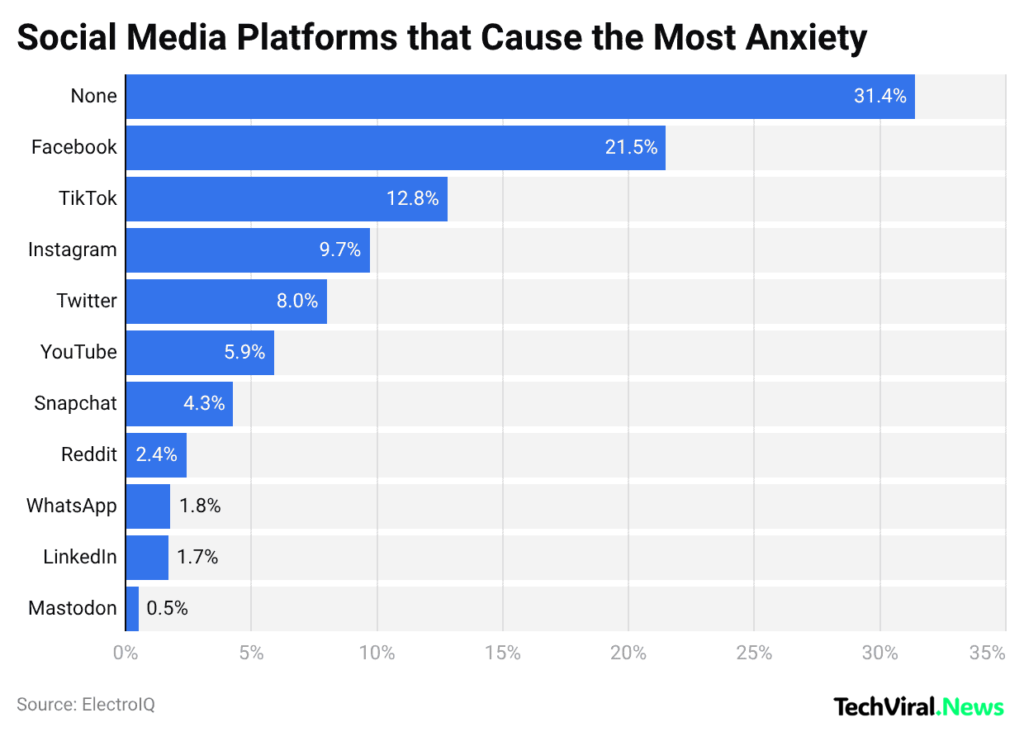
- In 2025, Facebook elicited the most anxiety (21.5%), followed by TikTok (12.8%), while Instagram affected 9.7% of respondents, according to SQ Magazine.
- Meanwhile, other social platforms faced anxiety due to user share as follows: Twitter (8%), YouTube (5.9%), Snapchat (4.3%), Reddit (2.4%), WhatsApp (1.8%), LinkedIn (1.7%), and Mastodon (0.5%).
- Interestingly, 31.4% reported no social platform caused them anxiety.
Bedtime Social Media Use Statistics
- In the United States, 8 in 10 smartphone users say social media is the last thing they do before sleeping.
- About 51% of adults aged 25-44 use it to relax at night, and 39% check social apps within 5 minutes of going to bed.
- After lights-out, 73% of teens (13-18) keep scrolling on TikTok, Snapchat, or Instagram instead of going to sleep.
- Overall, 62% use their phones in bed, even when they are not posting.
- Approximately 54% of users open apps when they briefly wake up during the night.
- Among full-time workers, 29% report postponing sleep by more than one hour due to phone use.
- Social media activity is highest from 10:00 p.m. to 12:00 a.m., peaking at 11:27 p.m.
- Nearly 46% of adults (18-34) say they feel unable to disconnect from their phones.
- Only 17% place their phones out of arm’s reach, suggesting most keep the device close while trying to sleep.
In the United States
- A report published by Sleep Doctor said that adults in the United States spent about 3.5 hours on social media each day before going to sleep.
- It also said that almost three-quarters (74.7%) of all social media use happened at night before bed.
- Among the main apps, people linked Facebook most strongly to feelings of anxiety.
- Approximately 55.2% of U.S. adults opened Facebook immediately upon waking.
- Among people who scrolled before bed, 73.8% reported using YouTube at that time.
- People who used Instagram, Snapchat, or TikTok before bed slept at least two minutes longer than the average person each night.
Social Media Notifications And Sleep Disruptions Analyses
- As of 2025, 38% of adults say notifications wake them at least once a night.
- Late-night notifications are associated with a 31% increase in daytime tiredness, and alerts increased WASO by 19%.
- Between 11 p.m. and 6 a.m., individuals received approximately 6.2 alerts.
- Besides, 45% of social media addicts kept their phones on a pillow or mattress, which reports disrupted sleep cycles.
- The use of Do Not Disturb increased by 13%, yet 41% still check alerts while half-asleep.
- Switching off alerts after 10 p.m. reduces awakenings by 23%.
- Moreover, 35% of wearable users reported more light-sleep spikes after late alerts, whereas 29% of teens reported responding at night and keeping their phones close.
Social Media Affecting Teen Sleep Statistics
- According to Sci-Tech Today, approximately 68% of high school students slept fewer than 7 hours per night.
- Girls aged 13-17 spend about 103 minutes on social media in the hour before sleep.
- About 42% of teens stay awake on purpose to reply to messages or comments.
- TikTok and Instagram are 2.7 times more likely to fall asleep after midnight.
- Watching online drama, comparing oneself, or witnessing bullying reduced the sleep quality by 24%.
- Additionally, 48% of adolescents aged 14-18 reported they felt tired every day due to late-night scrolling.
- Among students with a GPA below 2.5, almost 61% used social media for more than 90 minutes after 9 p.m.
- Sleep trackers indicated that heavy users slept 52 minutes less, and peak scrolling time occurred at 12:12 a.m.
- In 2025, schools with digital wellness programs improved sleep and mood by 17%.
Lack of Sleep Affects Academic Performance
| Frequency | Share |
| Weekly | 22.54% |
| 2+ times weekly | 19.72% |
| Don’t wonder | 14.08% |
| Daily | 14.08% |
| Monthly | 11.27% |
| Less than monthly | 9.86% |
| 2+ times daily | 5.63% |
| Less than once a year | 2.82% |
Social Media Each Day Usage Statistics By U.S. Teens
(Source: framerusercontent.com)
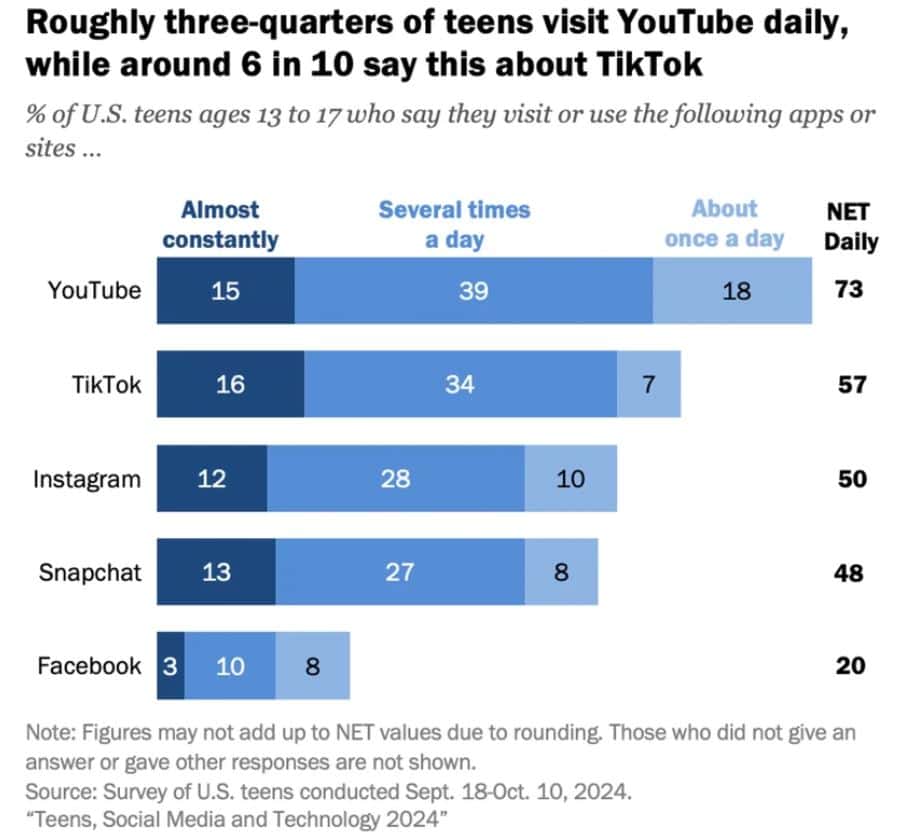
- 73% access YouTube each day, 15% nearly nonstop, 39% multiple times daily, and 18% roughly once per day.
- 57% open TikTok daily, 16% very frequently, 34% several visits per day, and 7% around once daily.
- 50% check Instagram every day, 12% close to constantly, 28% repeatedly during the day, and 10% about once a day.
- 48% use Snapchat daily, 13% use it nearly continuously, 27% use it many times a day, and 8% use it approximately once per day.
- 20% log into Facebook daily, 3% almost all the time, 10% more than once a day, and 8% about once a day.
Social Media Use Statistics By Depression Levels
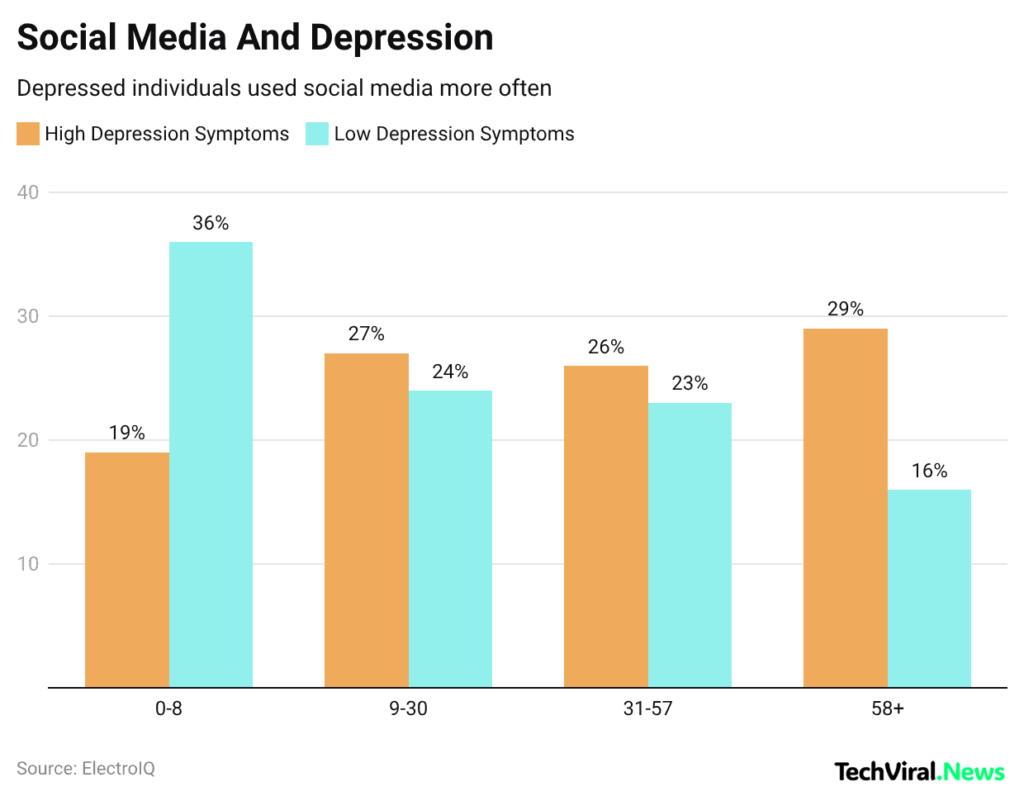
- In the 0-8 group, 19% of people with high depression symptoms were in this range, while 36% of people with low depression symptoms were there.
- In the 9-30 group, 27% of the high-symptom group and 24% of the low-symptom group fell in this range.
- For 31-57, the numbers were 26% for high depression symptoms and 23% for low depression symptoms.
- In the highest group, more than 58 years, 29% of people with high depression symptoms were in this range, compared with 16% of people with low depression symptoms.
By Addiction
- According to Townsend, around 5% to 10% of internet users were affected by social media addiction.
- Approximately 3.8 billion people worldwide used social media, representing about 45% of the global population.
- On average, one person had 7 social media accounts.
- About 54% used social media to research products, 50% followed brands, and 63% used it to stay updated with brands.
- Around 71% used it to keep in touch with friends/family, and 49% used it for news and current events.
- About 1 in 3 people used social media to find new products.
- 56% searched for inspiration, 50% for funny content, 57% for entertaining content, 45% for educational content, and 42% for informative content.
- 31% looked for political news, 28% for sports news, and 25% for celebrity news.
Negative Effects of Social Media On Mental Health
- Approximately 48% of young adults reported that it damaged their relationships.
- Nearly 37% of adolescents reported feeling pressure to post content to gain likes and appear popular.
- 56% of users reported feeling anxious when comparing themselves with friends online.
- 42% said they had felt jealous of other people’s lives.
- Additionally, 64% reported that social media made them feel lonelier.
(Reference: shortpixel.ai)
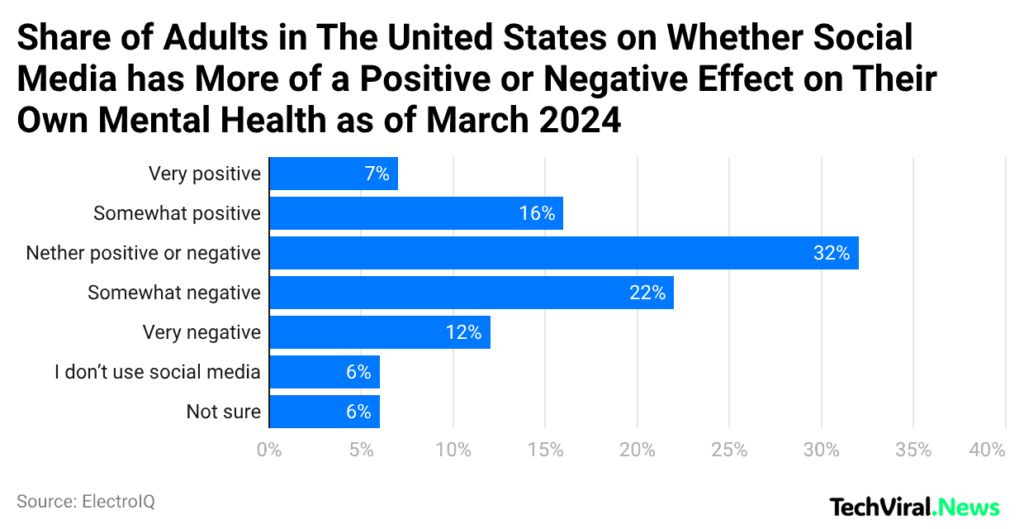
- In March 2024, only 7% of U.S. adults stated social media had a very positive effect on their mental health.
- Besides positive results in social media, around 16% users claimed somewhat positive, 32% no effect, 22% somewhat negative, 12% very negative, while 6% did not use social media and 6% were unsure.
Reasons Behind Social Media-Induced Insomnia Analyses
- In 2025, clinicians linked bedtime social media use to higher pre-sleep arousal in 64% young adults.
- Many teens used social media at night because of FOMO (51%), and checked likes and posts, which delayed their sleep time by approximately 26 minutes.
- 34% of users reported phantom vibrations or anxiety when logged out from social media platforms.
- Whereas emotional posts increased cortisol levels by 29% in monitored adults.
- Frequent bedtime scrolling is associated with circadian disruption in 1 in 5 users.
- Reading harsh news can cause 19% more intrusive thoughts, and 52% of insomnia cases are linked to overuse of screens or social media.
Conclusion
After reviewing the article “How Does Social Media Affect Sleep Statistics,” it can be concluded that social media is not always harmful; however, late-night use can disrupt healthy sleep. It can disrupt bedtime, keep the mind occupied, and trigger stress or strong emotions that impede relaxation. Screen light may also disrupt the body’s circadian rhythm. As a result, analyses from multiple perspectives provide evidence on how, when, and why social media use leads to shorter sleep, poorer sleep quality, and greater tiredness.
Sleep duration can be improved by reducing pre-bed scrolling, silencing notifications, and choosing calmer activities at night. Small changes in phone habits can lead to improved sleep and improved mornings.