







Key Takeaways
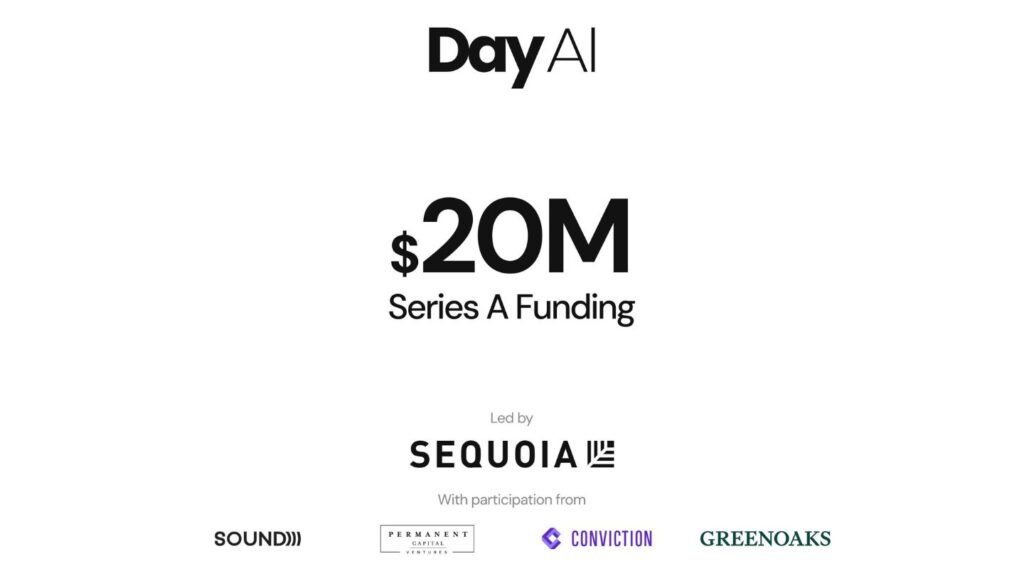
- Day AI has secured a $20 million Series A round led by Sequoia Capital, with participation from Sound Ventures, Permanent Capital, Conviction, and Greenoaks.
- The funding coincides with the general availability of Day AI’s “CRMx” platform, following roughly 18 months of private testing with early customers.
- Founded in 2023 by former HubSpot leaders Christopher O’Donnell and Michael Pici, Day AI aims to replace traditional CRM workflows with an AI-native, autonomous context graph.
- The company targets the large CRM market by automating data entry, meeting prep, and pipeline reporting tasks that can consume up to 65% of a salesperson’s week.
Quick Recap
Day AI, an AI-native customer relationship platform, has announced a $20 million Series A funding round led by Sequoia Capital, with participation from Sound Ventures, Permanent Capital, Conviction, and Greenoaks. The company revealed the news via a public post on X (formerly Twitter) and LinkedIn, alongside the launch of general availability for its “CRMx” product after more than a year of early-access development.
From Passive CRM To Autonomous “CRMx”
Day AI positions itself as an AI-native alternative to legacy CRMs, built around a “context graph” that unifies emails, meetings, customer records and internal knowledge into an index that large language models can reason across. Instead of sales teams manually updating fields and running reports, Day AI’s agents automatically capture interactions, prepare meeting briefings, log deal updates and surface explanations for why opportunities are moving, slipping or churning. The $20 million Series A, led by Sequoia partner Pat Grady, who also joins the board, will fund deeper AI and machine-learning work as well as go‑to‑market expansion.
Technically, the platform leans on frontier models such as Anthropic’s Claude 3.5 Sonnet, which offers a 200,000‑token context window at roughly 3 dollars per million input tokens and 15 dollars per million output tokens via API. That long context is designed to enable Day AI to ingest the “exhaust” of a workday threads of emails, notes, transcripts, and CRM records so agents can answer nuanced questions such as why a region underperformed or which messaging is resonating in late‑stage deals. Commercially, Day AI currently prices by AI assistant rather than per token, mirroring SaaS CRM pricing while abstracting away underlying LLM costs for customers.
Why This Matters In The CRM Arms Race?
The CRM market has long been dominated by incumbents such as Salesforce and Microsoft Dynamics, but those platforms were built for a world where humans are the primary users and data-entry engines. Day AI is part of a newer cohort arguing that CRM should evolve into an autonomous system of action, not just a system of record, with agents doing the tedious upkeep so reps can spend more time selling. Early adopters report faster onboarding and reduced status‑update meetings, as pipeline questions can be answered directly in tools like Slack using Day AI.
This shift comes amid a broader shift toward AI‑native go‑to‑market stacks, where startups such as Attio, Clay, and Granola are already automating parts of sales and customer work. By going full‑stack pitching CRMx as either a primary CRM for younger companies or a context layer on top of incumbents for scale‑ups Day AI is effectively betting that the next competitive frontier will be context‑rich, agentic workflows rather than static dashboards and manual reporting.
Competitive Landscape
Day AI vs. Attio vs. Clay
For like‑for‑like context, Day AI is best compared with emerging AI‑forward CRM and revenue platforms rather than giants such as Salesforce. Attio offers a flexible, highly customizable AI‑enhanced CRM for startups, while Clay focuses on AI‑powered data enrichment and outbound orchestration rather than full lifecycle CRM.
| Feature / Metric | Day AI (CRMx) | Attio | Clay |
| Context Window | Built on Claude 3.5 Sonnet; supports up to a 200K‑token model context window for reasoning over CRM data. | Uses third‑party LLMs behind the scenes; vendor does not publish explicit token limits. | Uses external LLMs (e.g., GPT/Claude) for enrichment; no official context‑window specs disclosed. |
| Pricing per 1M Tokens | Not sold per token; SaaS charges per AI assistant. Underlying Claude 3.5 Sonnet is 3 dollars input / 15 dollars output per 1M tokens at API level. | Seat‑based SaaS and tiered plans; LLM token pricing abstracted from end users. | Workspace / seat‑based pricing; usage of LLM tokens bundled into platform fees. |
| Multimodal Support | Primarily text plus structured business data (email, calendar, CRM records, transcripts); no native image/video AI disclosed. | Email, calendar and structured CRM data; focus on relationship graphs rather than vision features. | Structured data, web and third‑party sources for enrichment; text‑centric workflows. |
| Agentic Capabilities | Designed as an “autonomous CRM”: agents auto‑log activity, prep meetings, update pipeline and suggest next actions. | Powerful no‑code automations and sequences, but still oriented around user‑defined workflows. | Strong automation for lead research and outreach (“Claygent” agents), less focused on full CRM automation. |
Strategically, Day AI appears to lead on deep, CRM‑native agentic behavior, using long‑context LLMs to drive autonomous workflows across the entire customer lifecycle. Attio remains stronger for teams that need a highly customizable, general‑purpose CRM, while Clay is better suited for organizations prioritizing sophisticated data enrichment and outbound campaign automation.
TechViral’s Takeaway
From TechViral’s viewpoint, this round looks decidedly bullish for the thesis that CRM is about to be rebuilt around autonomous agents rather than human data entry. In practice, most sales organizations still wrestle with incomplete records, lagging reports and hours lost to status meetings exactly the friction Day AI is targeting with CRMx’s context graph and long‑context LLM foundation.
If execution matches the ambition, this funding gives Day AI enough runway to prove that an AI‑first system of action can sit at the center of go‑to‑market stacks, either replacing or wrapping legacy CRMs. For readers, the signal is straightforward: expect the next generation of tools in this category to feel less like static databases and more like always‑on teammates quietly keeping every deal, contact and conversation up to date in the background.