








Introduction
Data Analytics Statistics: As we all know, websites, applications, and digital platforms generate large volumes of data every day. By itself, this data does not provide a clear meaning. Data analytics helps convert this raw information into valuable insights. It enables analysts to examine current situations, identify underlying causes, and predict future outcomes.
This article examines several data patterns and trends, enabling organisations to make informed decisions and develop effective strategies. As a result, data analytics is now widely applied across sectors such as business, healthcare, finance, and education to address challenges and enhance overall performance.
Editor’s Choice
- The global data analytics market is expected to reach around USD 83.79 billion by 2026.
- As of 2025, the software segment accounted for the largest share of the data analytics market, at 67.80%.
- The North American region accounted for the largest share of the data analytics market, at 45%.
- In 2025, the U.S. data analytics market was valued at USD 20.40 billion and is projected to reach USD 26.39 billion by 2026.
- 80% of companies have adopted big data analytics as part of their daily operations.
- The Big Data and Business Analytics market grew from USD 313.04 billion in 2025 to USD 1.31 trillion by 2035.
- Approximately 92% of leading eCommerce companies now rely on AI-based personalisation tools.
- The global healthcare predictive analytics market is projected to grow rapidly, reaching approximately USD 74.62 billion by 2028.
- Additionally, 64% of municipalities in the United States now use AI-based urban analytics to improve the management of city operations.
- 73% of enterprises reported that data analytics is a top priority for digital transformation.
- The global data volume is projected to reach 221 zettabytes in 2026, representing a 22.09% increase over the previous year.
Key Takeaways
- According to Folio3 Data Services, 91.9% of organisations reported measurable benefits from their investments in data and analytics.
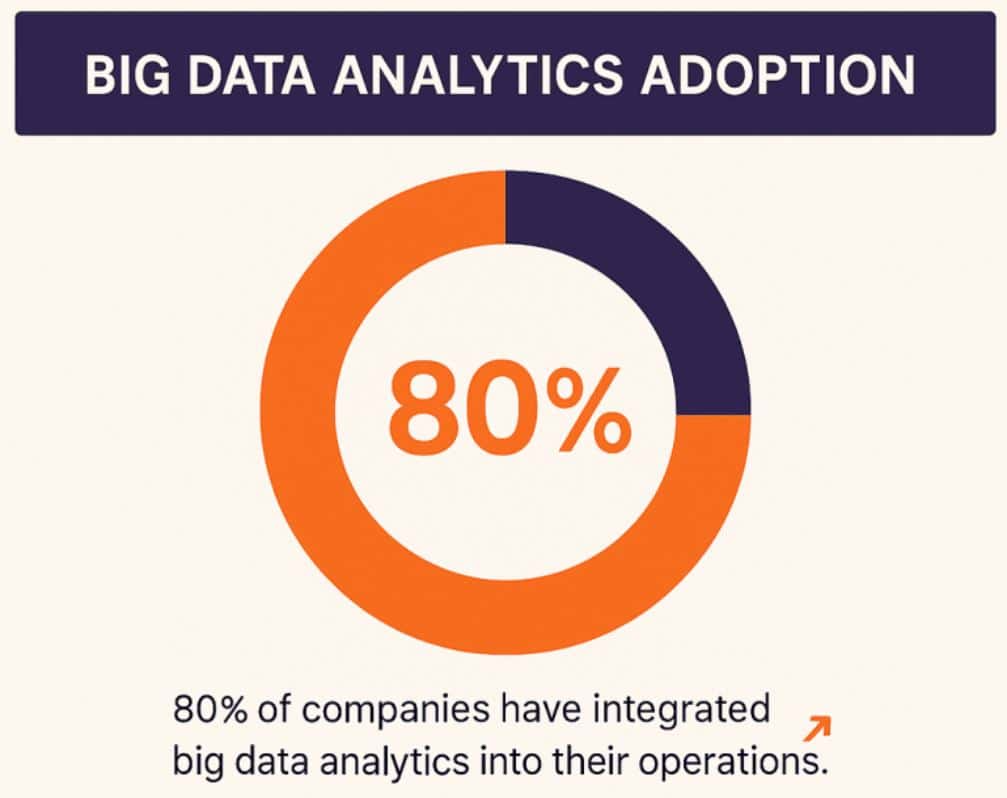
(Source: folio3.com)
- 80% of companies have adopted big data analytics as part of their daily operations.
- 60% of data leaders focus on data governance to ensure effective management of their information.
- Poor data quality causes companies to lose around 12% of their annual revenue.
- 66% of CEOs report clear business advantages from the use of generative AI.
- Business intelligence projects provide an average return on investment (ROI) of 127% within three years.
- Only 11% of data leaders link their data and analytics efforts directly to business outcomes, whereas more than 50% do not formally track ROI.
Data Analytics Market Size
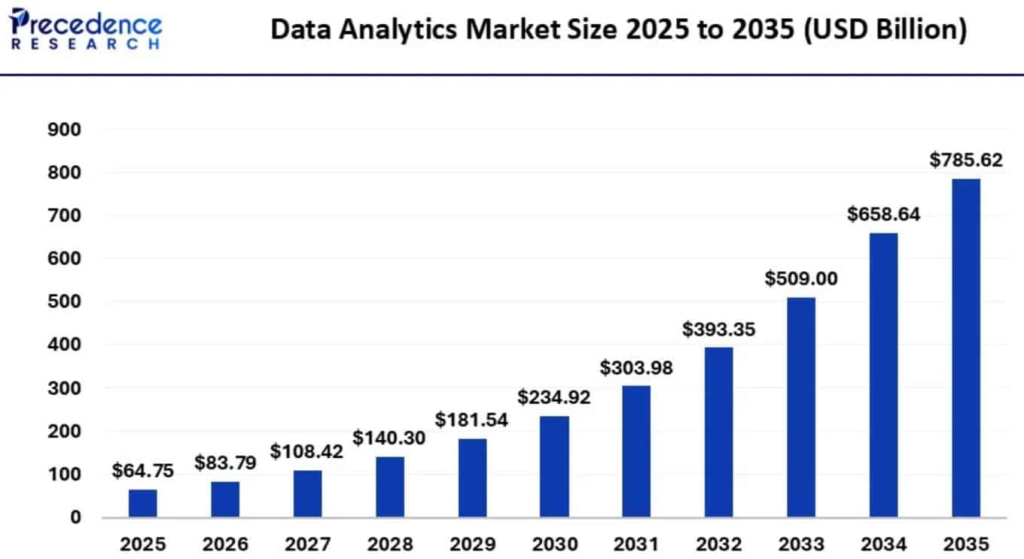
(Source: precedenceresearch.com)
- The global data analytics market accounted for USD 64.75 billion in 2025 and is expected to reach around USD 83.79 billion by 2026.
- Over the long term, the market is projected to reach approximately USD 785.62 billion by 2035.
- This growth represents a compound annual growth rate (CAGR) of 28.35% during the forecast period from 2026 to 2035.
Segmental Analyses
- According to Precedence Research, in 2025, the software segment accounted for the largest share of the data analytics market, at 67.80%.
- The services segment is expected to grow with a compound annual growth rate (CAGR) of 13.20% from 2026 to 2035.
- Among the types of analytics, descriptive analytics accounted for the largest share, at 26.30%, in 2025.
- Augmented analytics will reach a CAGR of 28.35%, reflecting increased adoption of AI-driven insights.
- By deployment method, the cloud segment led the market in 2024 with a 58.60% share and is projected to grow at the fastest rate, with a CAGR of 13.80% over the coming years.
- From an application perspective, customer analytics dominated the market in 2025, accounting for 19.40% of the market.
- The fraud detection and prevention segment is expected to grow at a CAGR of 14.70% over the forecast period.
Regional Analyses
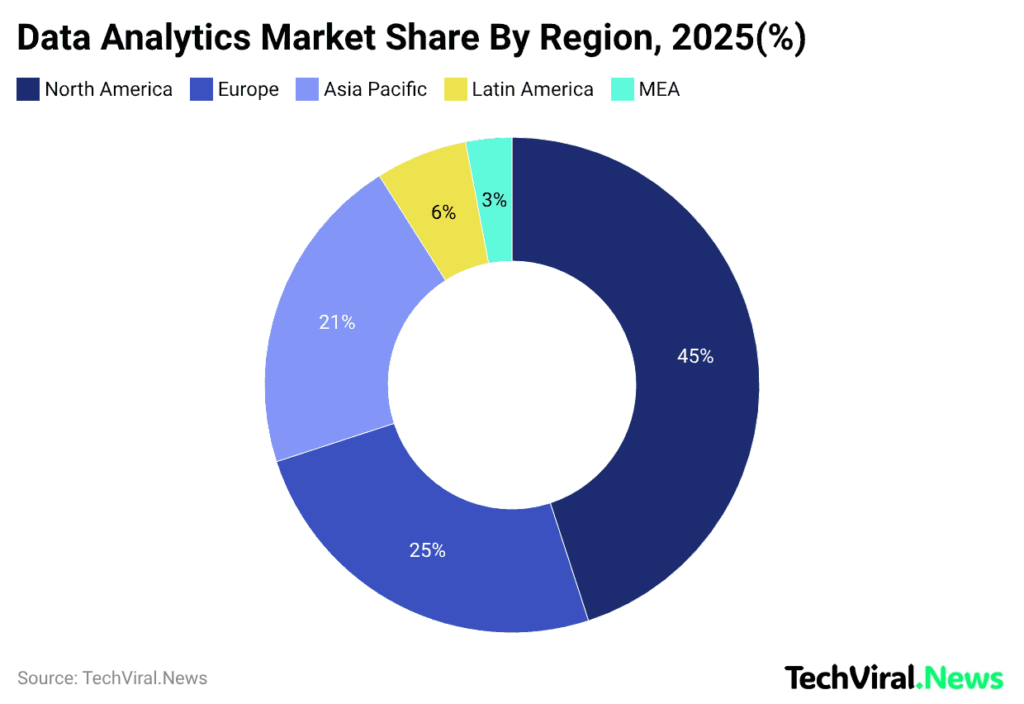
(Reference: precedenceresearch.com)
- As of 2025, the North American region accounted for the largest share of the data analytics market, at 45%.
- Europe is the second-largest region, accounting for 25% of the market, followed by Asia Pacific (21%), Latin America (8%), and MEA (3%).
U.S. Data Analytics Market Size
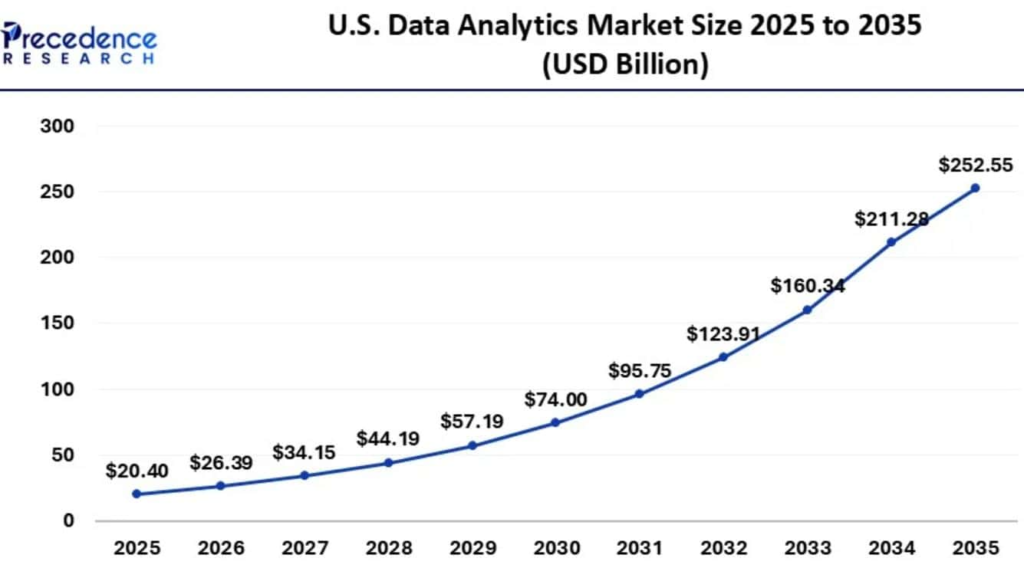
(Source: precedenceresearch.com)
- In 2025, the U.S. data analytics market was valued at USD 20.40 billion and is projected to reach USD 26.39 billion by 2026.
- Moreover, the market is projected to reach approximately USD 252.55 billion by 2035, growing at a CAGR of 28.61% from 2026 to 2035.
Big Data And Business Analytics Market Analyses
- According to Fundamental Business Insights, the Big Data and Business Analytics market grew from USD 313.04 billion in 2025 to USD 1.31 trillion by 2035.
- Between 2026 and 2035, the market is projected to grow at a compound annual growth rate (CAGR) exceeding 15.4%.
- The industry’s revenue is expected to reach USD 355.88 billion in 2026.
- In 2025, North America accounted for more than 38.85% of total market revenue.
- The Asia-Pacific region is expected to grow at a compound annual growth rate (CAGR) exceeding 15.8% over the forecast period.
- The cloud segment accounted for 60.77% of the market in 2025.
- In the same year, large enterprises made up 64.99% of the big data and business analytics market.
- The software segment accounted for approximately 36.96% of the market.
- Key companies leading the big data and business analytics market include IBM (US), Oracle (U.S.), SAP (Germany), Microsoft (U.S.), SAS (U.S.), Tableau (U.S.), Qlik (Sweden), Alteryx (U.S.), TIBCO (U.S.), and MicroStrategy (U.S.).
Industry-Specific Data Analytics Statistics By Retail and eCommerce
- Recent industry analysis from Folio3 Data Services indicates that approximately 92% of leading e-commerce companies now rely on AI-based personalisation tools.
- 80%-85% of shoppers reported being more likely to purchase from brands that offer personalised shopping experiences.
By Healthcare
- The global healthcare predictive analytics market is projected to reach approximately USD 74.62 billion by 2028.
- The compound annual growth rate (CAGR) at 27% from 2025 to 2032.
- In the United States, the healthcare predictive analytics market was valued at USD 4.88 billion in 2023.
- The U.S. market is projected to expand significantly, reaching nearly USD 53.16 billion by 2034.
- This growth in the U.S. market represents a CAGR of 24.2% over the forecast timeline.
By Banking and Finance
(Source: folio3.com)
- In 2025, about 91% of banks in the United States use AI-based big data tools to detect fraud.
- These systems help banks identify nearly 95% of high-risk transactions before they cause any financial loss in USD terms.
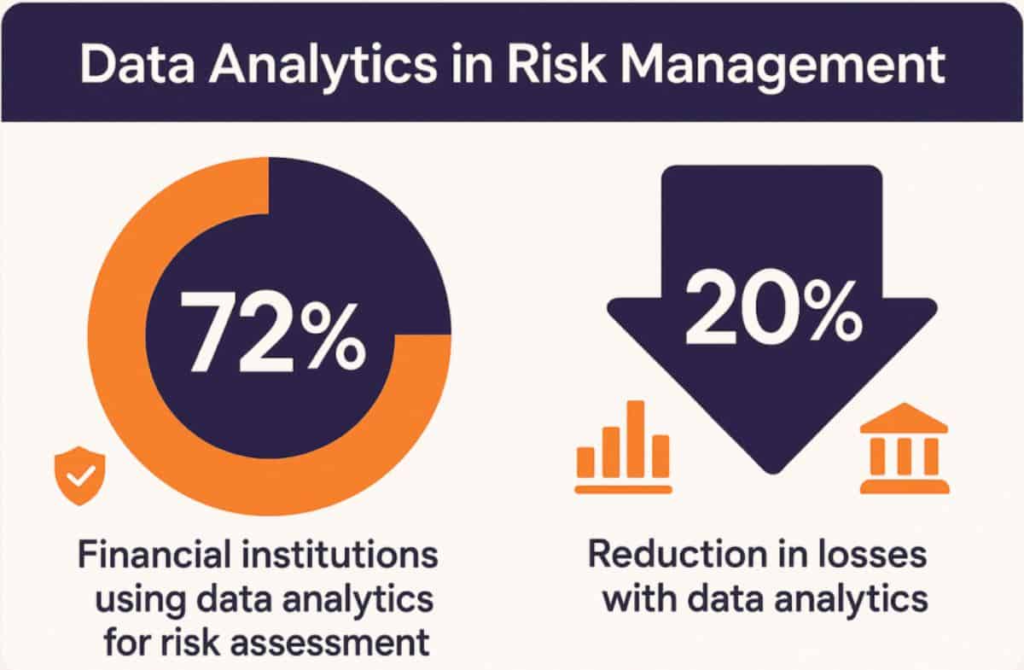
- Around 72% of financial institutions use data analytics for risk assessment and risk management.
- By using these analytical tools, banks and financial firms have reduced overall losses by up to 20%.
- In the United Kingdom, large banks and technology companies now share fraud data in real time.
By Telecom and Media
- Approximately 65% to 75% of telecom companies now use AI technologies to improve customer support and the overall customer experience.
- According to Folio3 Data Services, the content recommendation engine market is valued at USD 6.15 billion in 2025. It is projected to reach USD 26.21 billion by 2030, reflecting a strong compound annual growth rate (CAGR) of 33.6%.
By Manufacturing and Supply Chain
- The world’s 500 largest companies may lose up to USD 1.4 trillion annually due to unexpected equipment failures.
- Studies indicate that these solutions can reduce maintenance and service costs by up to 23% by avoiding unnecessary repairs.
- Large industrial and consumer companies, such as Coca-Cola and Siemens Energy, are employing predictive maintenance to enhance equipment reliability and manage operating costs.
By the Government and Public Sector
- Approximately 64% of municipalities in the United States now use AI-based urban analytics to improve the management of city operations.
- Around 58% of cities have adopted smart public safety systems that employ advanced technologies to enhance security and emergency response.
- Nearly 49% of municipalities are using real-time traffic management tools to reduce congestion and improve road efficiency.
- By 2025, more than 500 cities worldwide implemented digital twin technology to support climate resilience efforts.
- These digital twins will help cities monitor air quality, manage flood risk, and improve the performance of urban systems more efficiently.
Data Analytics Employess Salary Structure (United States)
Data Scientist:
- The average salary for a data scientist ranges from USD 120,000 to USD 180,000 per year.
- The role is projected to grow at an annual rate of 15%.
Data Engineer:
- The average salary for a data engineer ranges from USD 110,000 to USD 160,000 per year.
- The expected annual growth rate for this role is 20%.
Analytics Manager:
- The average salary for an analytics manager ranges from USD 130,000 to USD 200,000 per year.
- This role is projected to grow by 12% per year.
Machine Learning Engineer:
- The average salary for a machine learning engineer ranges from USD 140,000 to USD 220,000 per year.
- This role exhibits the fastest growth, with an estimated annual growth rate of 25%.
Data Analytics Adoption And Usage Statistics
- According to Zipdo.Co, 73% of enterprises reported that data analytics is a top priority for digital transformation.
- 80% of organisations report that analytics clearly improves the quality of their decision-making.
- Nearly 55% of companies believe that predictive analytics provides a strong competitive advantage.
- 90% of financial services organisations use analytics primarily for risk management.
- Roughly 45% of enterprises have fully embedded advanced analytics into core business processes.
- Companies that actively use analytics report an average revenue increase of 15% in USD terms.
- Approximately 70% of analytics projects are driven by the aim of improving the overall customer experience.
- Around 68% of global organisations view analytics as essential for long-term business growth.
- Organisations that use machine learning in analytics achieve 50% shorter decision-making cycles.
- Nearly 80% of businesses consider data-driven insights vital to operational efficiency.
- Approximately 58% of CEOs report that analytics helps them identify new revenue opportunities.
- The adoption of data visualisation tools has increased by 70% over the past three years.
- Around 25% of analytics tools are now integrated into ERP systems.
- 45% of organisations have in-house analytics teams, while 35% use consultants.
- On average, analytics-driven organisations reduce operational costs by 20%.
Data Generated Worldwide
- According to the Demand Sage report, approximately 3.81 petabytes of data are produced every second, corresponding to nearly 13.75 exabytes per hour.
- On a global scale, total data creation has already exceeded 120 zettabytes, indicating the massive scale of digital activity worldwide.
- Every day, approximately 2.5 quintillion bytes of data are created, recorded, copied, or used acrossplatforms and systems.
- This rapid growth means that nearly 90% of all existing data has been generated in just the last two years.
- When converted to simpler units, approximately 2.5 million terabytes of data are generated each day.
- Data creation per hour is approximately 104,000 terabytes, and 1,736 terabytes are generated every minute.
- On a per-second basis, global data generation amounts to approximately 29 terabytes.
- Global data volume is expected to reach 221 zettabytes by 2026, representing a 22.09% increase over the previous year.
AI In Data Analytics Market Size
(Source: shortpixel.ai)
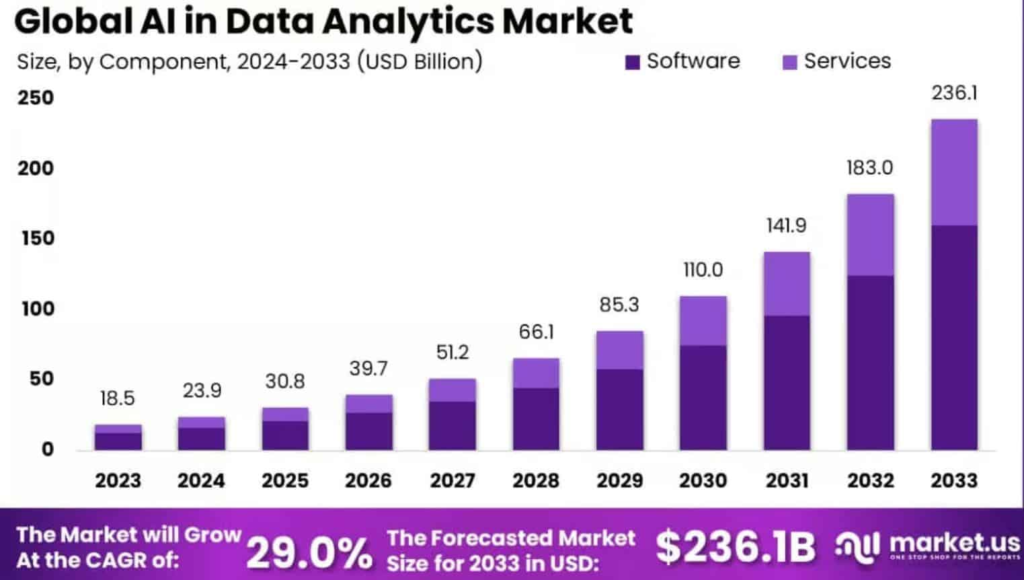
- In 2025, the global AI in data analytics market was valued at approximately USD 30.8 billion, and by 2026, it will increase to nearly USD 39.7 billion.
- By 2033, the market is expected to reach about USD 236.1 billion, growing at a strong 29.0% CAGR from 2024 to 2033.
- Artificial intelligence is expected to influence the global economy significantly, adding nearly USD 25.6 trillion by 2030, while the NLP market alone is projected to exceed USD 112 billion by then.
Recent Market Developments, 2025
| Date | Specification |
| February | At Next’25, Google Cloud presented new AI analytics tools, including job-specific agents and self-managing data systems. |
| March | Financial firm 9fin purchased Bond Radar to expand its market data and analytics strength. |
| May | IBM improved Watsonx by integrating hybrid tools, which increased the accuracy of unstructured data analysis by 40%. |
| IBM launched a Microsoft-focused practice with 33,000 trained specialists to speed up shared AI and cloud work. | |
| June | IBM bought Seek AI to add chat-based data search features to its Watsonx AI platform. |
| Snowflake introduced its Intelligence and Data Science Agent, allowing users to ask data questions in plain language and run automated machine-learning tasks. |
Conclusion
After completing the article, it is evident that data analytics plays an effective role in making sense of large volumes of data in global businesses. It allows researchers and organisations to convert data into reliable insights that support accurate decision-making. Through careful analysis of patterns and trends, risks can be identified early, and performance improved.
As data generation continues to increase, data analytics will remain essential for evidence-based research, strategic planning, and sustainable growth across industries.
FAQ
The main types include descriptive (what happened), diagnostic (why it happened), predictive (what may happen), and prescriptive (what should be done).
The main types include descriptive (what happened), diagnostic (why it happened), predictive (what may happen), and prescriptive (what should be done).
Industries such as healthcare, finance, retail, education, manufacturing, and technology.
Businesses use data analytics to study customer behaviour, improve operations, manage risks, and support strategic planning.
Key skills include data interpretation, basic statistics, problem-solving, and knowledge of analytical tools and programming languages.