







Introduction
AI-Powered Home Robots Statistics: Artificial intelligence is reshaping the modern home, and AI-powered robots are leading the way. Unlike early robots that followed fixed commands, today’s AI home robots can adapt to their surroundings, user habits, and interactions. From robot vacuum cleaners that map rooms to assistive robots that support daily tasks, these machines are becoming increasingly sophisticated and reliable.
As families seek greater comfort, safety, and convenience, AI-powered home robots are moving beyond novelty to become helpful companions. Using technologies such as machine learning, computer vision, and natural language processing, they are changing how everyday tasks are handled and creating smarter, more connected homes.
Editor’s Choice
- The global market for AI-powered home robots was valued at USD 14.54 billion in 2025 and is expected to reach USD 17.34 billion in 2026.
- In 2025, Vacuuming and mopping robots accounted for the largest market share, at 31.3%.
- As of 2026, North America holds 35% of the global household robots market.
- In 2025, household cleaning robot sales increased by 22% from the previous year, reaching approximately 37 million units.
- Ecovacs, Xiaomi, Roborock, Samsung, and iRobot dominate the home-robot market, collectively accounting for more than 52% of global market share in 2025.
- In 2026, overall household service robot sales are projected to increase to 44.8 million units, with total revenue projected at USD 20.1 billion.
- As of 2026, the global market size of AI-powered Humanoid Robots is expected to reach around USD 653.5 million, up from USD 479.8 million in 2025.
- The effective cost of robot labour has reached approximately USD 30 per hour, and the company aims to achieve practical human-robot collaboration by late 2025.
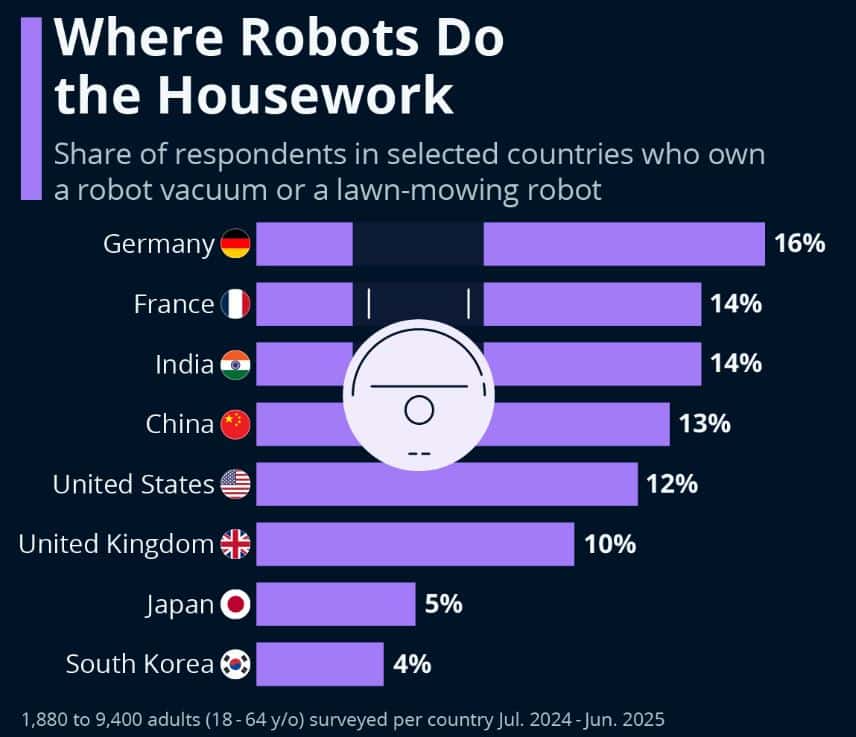
- Almost 16% of respondents in Germany reported owning a household robot.
- On average, people in the U.S. spend about 37 minutes per day cleaning their homes using AI-powered home Robots.
AI-Powered Home Robots Market Size
(Source: precedenceresearch.com)
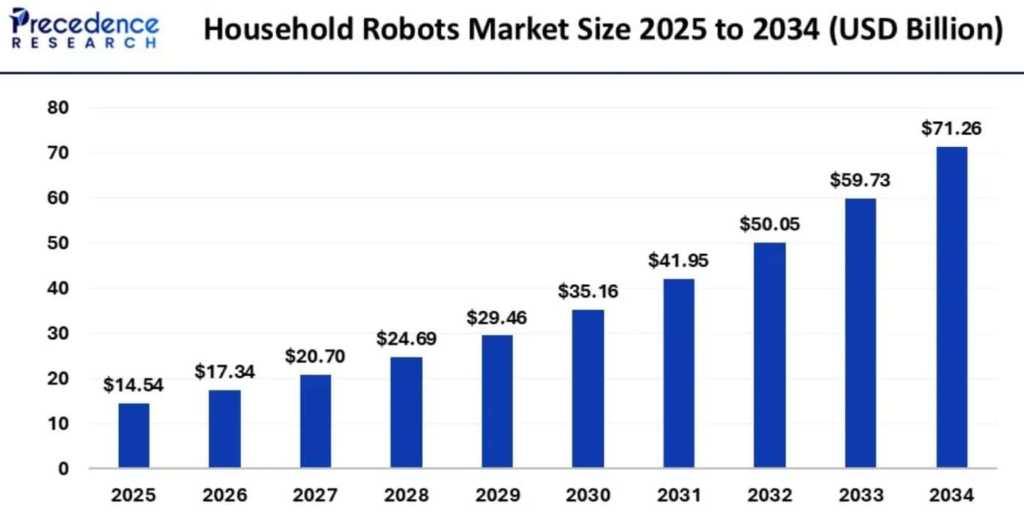
- The global market for AI-powered home robots was valued at USD 14.54 billion in 2025 and is expected to reach USD 17.34 billion in 2026.
- It could reach about USD 71.26 billion by 2034, growing at an average annual rate of 19.32% from 2025 to 2034.
Leading Companies In The Global Home Robot Market
- According to Global Market Insight, five companies, Ecovacs, Xiaomi, Roborock, Samsung, and iRobot, dominate the home-robot market, collectively accounting for more than 52% of global market share in 2025.
- Ecovacs Robotics leads the sector with around 15.5% market share.
- Moreover, Samsung accounts for approximately 8.3%, supported by its smart home ecosystem, while iRobot accounts for nearly 4.6%, primarily due to its well-known cleaning robots.
By Application
(Reference: precedenceresearch.com)
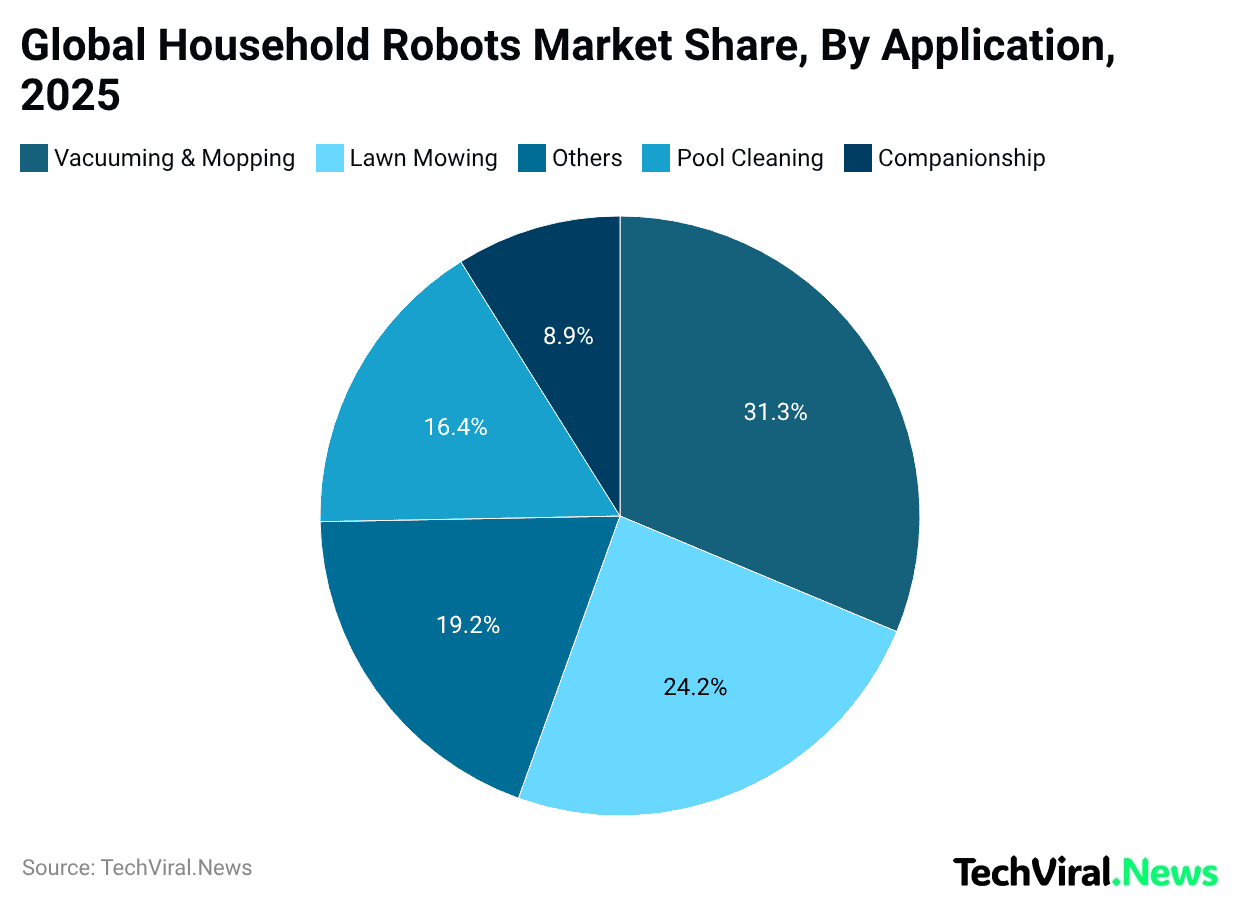
- In 2025, Vacuuming and mopping robots accounted for the largest market share, at 31.3%.
- Lawn-mowing robots lead in usage at 24.2%, followed by pool cleaning at 16.4%, companionship (8.9%), and others (19.2%).
By Component
- In the AI-powered home robots market, hardware accounted for 50.9% of the global market in 2025.
- The service robots market is projected to grow at a 20.1% CAGR from 2026 to 2035.
By Region
(Source: datainsightsmarket.com)
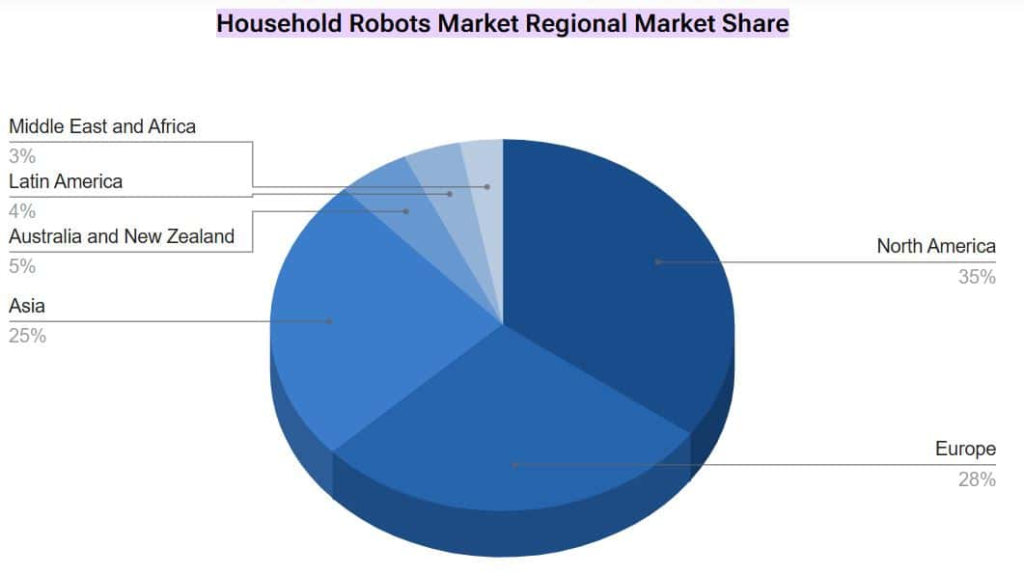
- As of 2026, North America holds 35% of the global household robots market.
- Moreover, Europe accounts for 28% of the household robots market, followed by Asia (25%), Australia and New Zealand (5%), and Latin America (4%).
Smart Home Robotics Statistics
(Source: techkv.com)
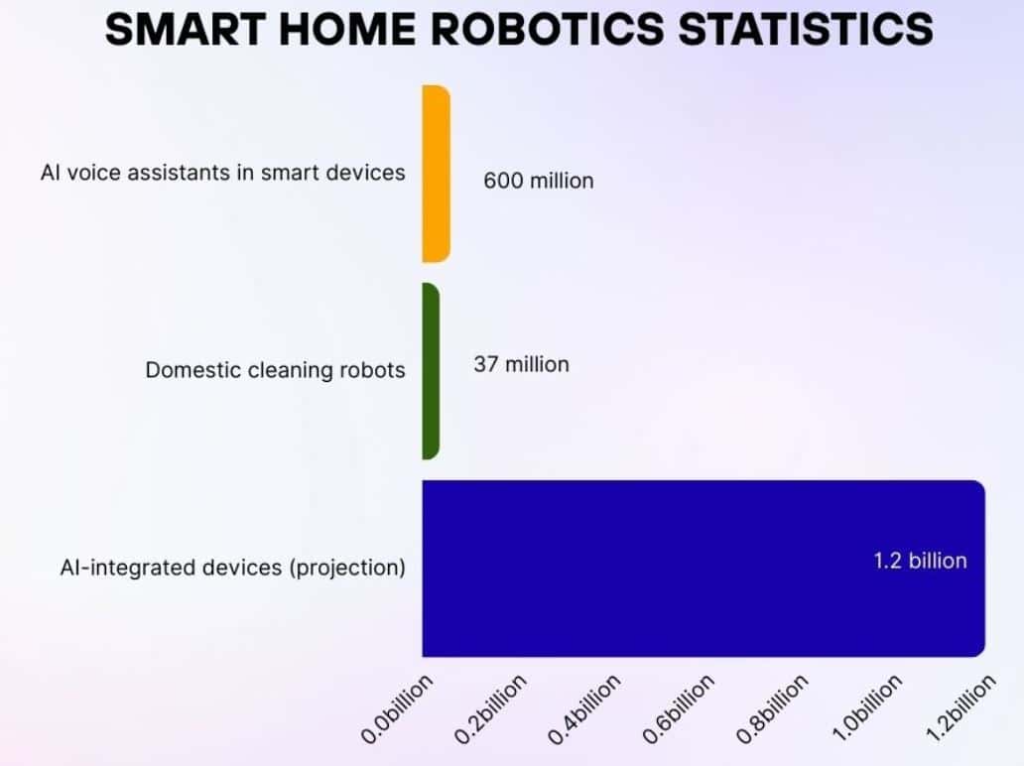
- Voice-based AI assistants such as Alexa and Google Assistant are now integrated into more than 600 million smart home devices globally.
- In 2025, household cleaning robot sales increased by 22%, reaching approximately 37 million units.
- The total number of smart home devices using AI technology is expected to be 1.2 billion active units by 2030.
- In 2025, global sales of smart home robots totalled USD 9.5 billion, and around 29% of these devices included AI-based features.
- Robots designed for home health support, including companion robots and monitoring systems, recorded a 45% growth rate.
- Only seven out of ten smart home consumers stated that AI features played a major role in their buying decisions.
- AI-powered pet care robots are becoming more popular, with startups in this space reporting a 280% rise in investment during 2024.
Global Household Service Robots Market
(Source: statcdn.com)
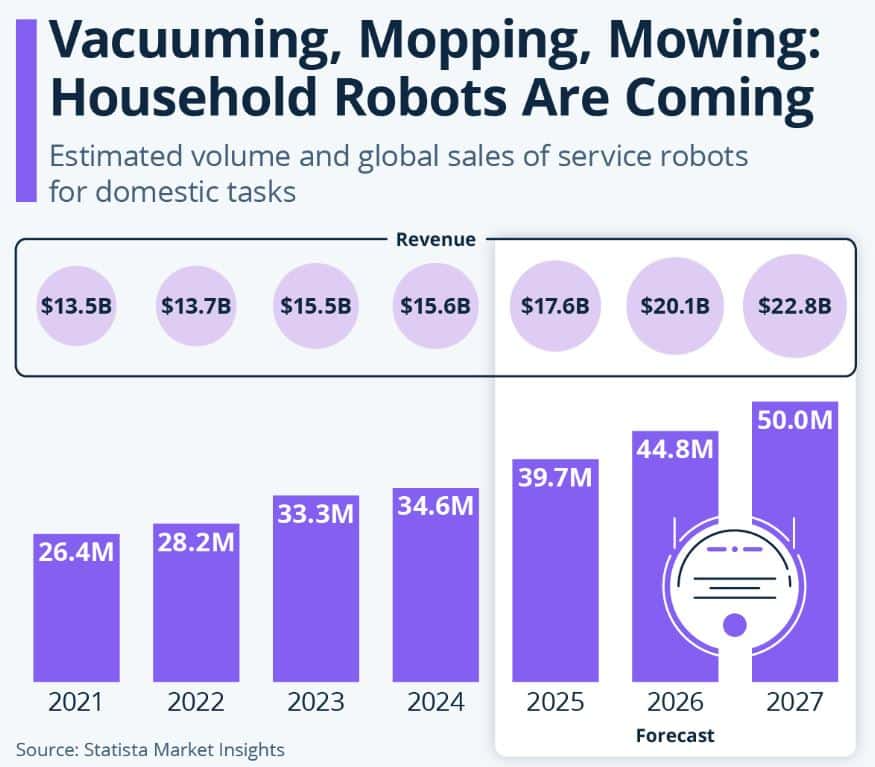
- As of 2025, the global sales of household service robots reached 39.7 million units, with a revenue of USD 17.6 billion.
- Moreover, household service robot sales are projected to reach 44.8 million units, valued at USD 20.1 billion, in 2026, and further increase to 50.0 million units, generating USD 22.8 billion, by 2027.
AI-Powered Home Robots Market Size
(Source: shortpixel.ai)
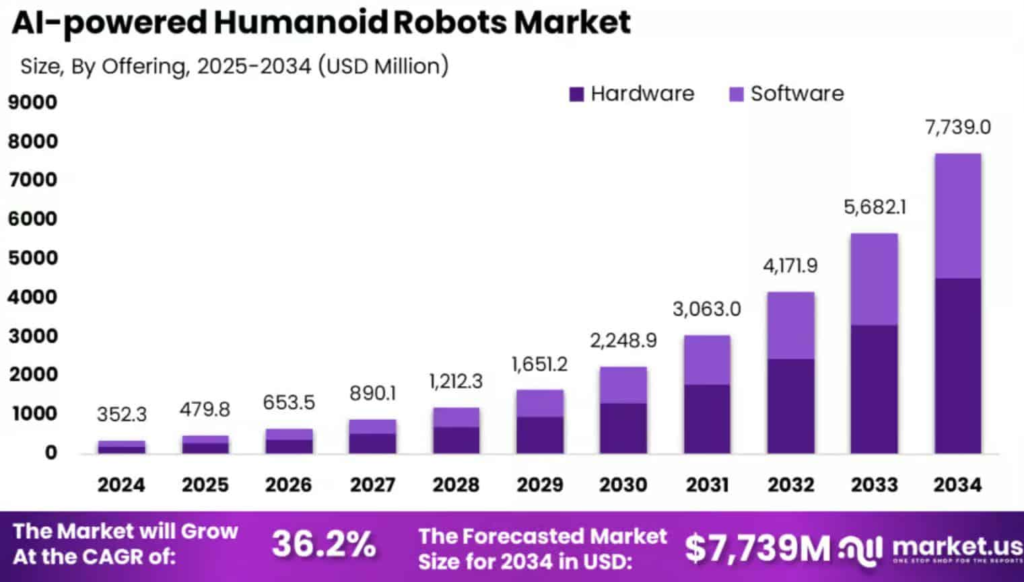
- As of 2026, the global market size of AI-powered Humanoid Robots is expected to reach around USD 653.5 million, up from USD 479.8 million in 2025.
- By the end of 2034, the market will reach USD 7,739 million, growing 36.2% from 2025 to 2034.
- As of 2026, the United States market size is approximately USD 307.7 million, and by 2034, it will be USD 3,354.1 million, with a 34.8% growth rate over the forecast period.
Robo Advisors Market Statistics
(Source: statcdn.com)
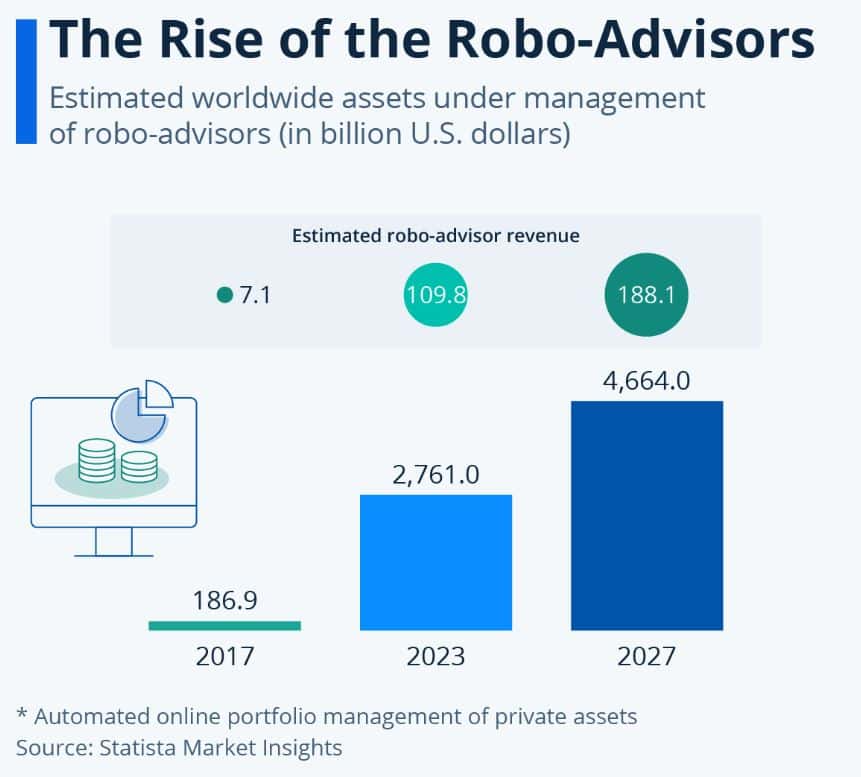
- The global assets managed by robo-advisors are projected to reach approximately USD 4,664.0 billion by 2027.
- In terms of revenue, robo-advisor platforms generated about USD 109.8 billion in 2023, and are expected to reach nearly USD 188.1 billion by 2027.
Ownership Of Household Robots Statistics By Country
(Source: statcdn.com)
- According to a Statista survey conducted from July 2024 to June 2025, almost 16% of respondents in Germany reported owning a household robot.
- In France and India, 14% of respondents own a household robot, followed by 13% in China, 12% in the United States, 10% in the United Kingdom, 5% in Japan, and 4% in South Korea.
Time Savings Report From Home Robotics
- A report published by Capella Solutions further stated that, on average, people in the U.S. spend about 37 minutes each day cleaning their homes.
- Using home cleaning robots could save more than 133 hours per year, equivalent to roughly 5.5 full days.
- Mowing a quarter-acre lawn typically takes approximately 45 minutes per week during the growing season, totalling approximately 24 hours per year.
- Automating lawn mowing would give homeowners back half a day each year for leisure or other activities.
- Doing laundry for a typical household, including washing, drying, folding, and sorting, takes around 5 hours per week.
- By using laundry robots, families could gain approximately 10.5 days annually to spend on more enjoyable or productive tasks.
Top Humanoid Robot Manufacturers
| Company | Robot Name | Height & Weight | Key Capabilities | Target Use | Availability & Price |
| 1X Technologies | Neo | 5’4″, 66 lbs | Household tasks such as vacuuming and fetching items; learns user behaviour using Redwood AI. | Home use | Trials in hundreds of homes; goal of 1,000 units by 2027.USD 200/month lease or USD 10,000 purchase. |
| 1X Technologies | EVE | – | Designed for physical tasks | Retail environments | Commercial-focused deployment. |
| Tesla | Optimus | 5’8″, 125 lbs | Can lift to 45 lbs; demonstrated food serving using AI and teleoperation | Industrial and home use | 5,000 units planned for 2025.Home use is expected from 2026.USD 20,000-30,000 |
| UBTech | Walke | 5’5″, 77 lbs | Waters plants, moves objects, controls smart devices, and provides companionship and security alerts. | Home use | Home integration expected by 2026. |
| Apptronik | Apollo | – | Designed for heavy and repetitive tasks | Warehouses, manufacturing, later retail, elder care, and delivery. | Phased industrial deployment planned. |
| Engineered Arts | Ameca | – | Advanced facial expressions, gestures, and conversational AI | Research and entertainment | Available for demonstrations and research use. |
| Sanctuary AI | Phoenix | – | Fast learning and adaptation using Carbon AI | Logistics, retail, and manufacturing | Trials planned for 2026. Estimated price around USD 30,000. |
| Unitree | G1 | – | Improved mobility and AI performance | Advanced robotics applications | Future release planned. |
| Hanson Robotics | Sophia | – | Lifelike facial expressions, social interaction, and educational use | Education and social research | Costs over USD 50,000 |
| SoftBank Robotics | Pepper | – | Emotion recognition, user interaction, and communication support | Education, healthcare, and customer service | Priced at approximately USD 10,000. |
Stages Of AI Home Robot Adoption
- At the starting stage, households employ basic robots such as vacuum cleaners and virtual assistants. Consumers learn how to control them and interact with them.
- Homeowners experiment with robots such as laundry bots and safety monitors. This stage focuses on evaluating usefulness and fixing any issues.
- Robots for lawn care and pet care are becoming more common. They begin to integrate into more areas of daily life at home.
- Sophisticated robots, such as cooking assistants and elderly-care robots, are deployed. This stage requires proper oversight and ethical considerations.
Recent Developments
- According to TechKV, RoboBallet, developed by University College London (UCL) and Google DeepMind, can plan complex workflows using eight robotic arms across 40 different tasks.
- The Atlas humanoid robot now operates using a single, unified AI model. This allows the robot to walk, manipulate objects, and recover dropped items through emergent behaviour, rather than relying on separate systems for each action.
- UBS forecasts strong growth in the global workforce of humanoid robots. The number of humanoid robots is projected to reach approximately 2 million by 2035 and to increase to around 300 million by 2050.
- The humanoid robotics market could reach USD 30-50 billion by 2035 and grow to USD 1.4-1.7 trillion by 2050.
- NVIDIA introduced Jetson Thor, a new robotics computing platform designed for next-generation autonomous machines. Compared to previous platforms, Jetson Thor delivers 7.5 times higher AI computing performance, 3.1 times faster CPU speed, and 2× greater memory capacity.
- Google DeepMind’s Gemini Robotics models enable robots to operate with greater dexterity and adaptability. These models enable robots to perform delicate tasks, such as folding origami, by closely linking perception, reasoning, and physical action.
- South Korea launched the K-Humanoid Alliance to accelerate the development of a commercial humanoid robot. The target robot is designed to lift to 20 kilograms and move at 2.5 meters per second, with a planned completion by 2028.
- Agility Robotics has deployed its Digit humanoid robots in logistics operations, including partnerships with GXO and Amazon. The effective cost of robot labour has reached approximately USD 30 per hour, and the company aims to achieve practical human-robot collaboration by late 2025.
- Advances in AI are enabling robots to adapt in real time, recognise patterns, and plan actions in complex environments, thereby significantly improving efficiency and flexibility in robotic systems.
Conclusion
AI-powered home robots are becoming a real part of everyday life. They use smart technology and sensors to support household tasks, enhance safety, and improve comfort. Although challenges such as cost, privacy, and ethical concerns persist, continuous improvements are reducing these issues.
In the future, home robots are expected to become reliable helpers that enable smarter, more efficient living.
FAQ
AI-powered home robots are intelligent machines designed for use within the home. They use artificial intelligence to complete tasks, support daily activities, and interact with people helpfully.
These robots can perform many household tasks, including cleaning floors, assisting with cooking, monitoring home security, supporting elderly care, and controlling smart home devices.
No, these robots are created to support people, not replace them. They primarily handle repetitive or time-consuming tasks, allowing humans to focus on more important or enjoyable tasks.
The cost of AI-powered home robots typically ranges from approximately USD 200 to USD 2,500, depending on the robot’s features, technological capabilities, and brand.
Many AI-powered home robots work best with an internet connection. Internet access enables them to receive updates, operate smoothly, and connect with other smart home devices.