







Introduction
iPhone vs Android: which is better? Statistics: Google and Apple both influence the worldwide smartphone market, the former with its exclusive iPhone and Android mobile operating system. While both iPhone and Android can efficiently store data and deliver apps to users, key factors, such as their distinct ecosystems, determine whether a device will fit within a company.
Android is presently the iPhone’s biggest rival in the smartphone market. Although there are many differences between the iPhone and Android, each has its benefits and disadvantages, which provide a better context for the iPhone-Android debate. Let’s shed more light on iPhone vs Android: which is better?
Editor’s Choice
- Nearly 42% of iOS users completed in-app purchases, whereas almost 29% of Android users made in-app purchases in 2021.
- Compared to 30% for iOS, Android’s mobile web share was high, at almost 68% in 2021.
- In 2020, the median install-to-registration transformation rate for Android applications was almost 50.56%, whereas the same rate for iOS applications was 49.58%.
- In 2020, approximately 8.23% of smartphone application users declined to install applications due to security concerns on Android devices, whereas the opposite was true for 5.39% of iOS users in the United States.
- Android device fragmentation is higher than that of iOS: there are nearly 31,000 Android devices from more than 600 brands, whereas there are only 16 iPhone models.
- According to 2021 data, almost 60.4% of smartphone users in the United States have iPhones, and just 39.4% have Android devices.
- Android is the leading operating system in the Indian mobile market, accounting for nearly 95.23%, whereas iOS accounts for 4.74%.
- iPhone devices account for approximately 75.19% of the smartphone market share in Japan, whereas Android accounts for 24.74%.
- Android devices account for almost 60.62% of the smartphone operating system market, whereas iOS accounts for 38.62% in Europe.
- iOS users spent almost three times as much on smartphone applications as Android users in 2020.
- The Google Play Store had more than three times the number of downloads as the Apple App Store, which typically has 47.4 billion application downloads versus 19.3 billion in 2021.
- Android users are more loyal to their OS, with a loyalty rate of nearly 89%, whereas iOS users have a loyalty rate of 87%.
- The iPhone accounts for approximately 48.36% of the smartphone market in the United States, whereas Android accounts for 51.64%.
- According to 2021 data, the iPhone App Store contained approximately 2.22 million applications, and the Google App Store contained nearly 3.48 million applications.
- Samsung ranks first with approximately 18.3% of the global smartphone market share, whereas Apple ranks second at 15.0%.
- In the global market, Android holds a 74.13% share, and iOS a 25.31% share.
Key Differences Between iPhone and Android
| Application Offloading: Simple setup of the new device.AirDropiMessage | iPhone | Android |
| Interface | There is a major difference in the home screen. iOS gives applications icons in a row on the home screen. | Android provides home screen applications with appropriate information in widgets. |
| Storage | iPhone users can’t expand their internal storage, as Apple users have internal flash memory.Cloud storage is free till 5GB. | Android users can extend their storage by inserting a microSD card, which can exceed 1TB.Unlimited cloud storage for videos and photos is available, but at low quality. |
| Privacy | When an iPhone user downloads an application it has a feature of rejecting the tracking permission pop-up and staying secure. | Android applications ask the users for their necessary permissions.Android users can lock certain permissions, but it is very time-consuming |
| Security | Apple’s operating system is more secure as it sends out only security updates regularly, so breaches in security are very rare. | Android handsets regularly send updates, but are at the same time distributed across all the devices. |
| Features | Application OffloadingSimple setup of the new device.AirDropiMessage | Split screenExpandable storageFile ManagementCustomised Home screen |
| Design | Not many, too different, but a slick and classy body. | Android has a design language that differs across manufacturers. |
iPhone vs Android Statistics
- In 2021, the median size of Android applications was approximately 14.8 MB, whereas the median size of iOS applications was 34.3 MB.
- The Apple App Store created almost twice as much value as the Google Play Store, despite having fewer application downloads in 2020.
- The iPhone accounts for nearly 58.62% of smartphone browsing traffic, while Android accounts for 40.87% in the United States.
- In 2021, the median sales price of an Android phone was almost $269, whereas the median sales price of an iOS phone was $729.
- The average iOS application user earns $85,000 annually, whereas the average Android application user earns $61,000 annually.
- In 2021, the highest-selling Android smartphone globally was the Xiaomi Redmi 9A, whereas the top-selling iPhone was the iPhone 12.
- Globally, the iPhone had a higher resale value than the Android phone.
- The iPhone receives software updates more frequently and for a longer period than Android phones.
- The Android smartphones give a customized experience, whereas iPhones focus on user-friendliness.
- 44.9% of people in the United States use iPhones.
- In 2021, Android devices accounted for nearly 69.3% of new mobile activations, whereas Apple devices accounted for 30.7% in the United States.
- Nearly 70% of applications on the Google Play Store are free, whereas 70% of applications on the iPhone App Store are free.
- Android users have downloaded approximately 2.8 million applications per day, whereas iPhone users have downloaded approximately 1.45 million applications per day.
- In 2021, iOS accounted for 12.4% of the global smartphone market share.
- In 2021, Android accounted for nearly 87% of the global smartphone market share.
iPhone vs. Android Demographics
When comparing iPhones and Android phones, there are important differences between the devices themselves and the users of them.
Device Differences:
- Android phones come in many different types, with various screen sizes, processors, features, and prices. On the other hand, iPhones are all made by Apple, so there’s less variety.
- Android phones typically have physical navigation buttons, whereas iPhones rely entirely on touchscreens.
- Android users can customize their home screens more than iPhone users can.
- Apple’s App Store has stricter rules for accepting apps, which means there are generally fewer buggy or low-quality apps compared to the Google Play Store.
User Differences:
- iPhone users typically earn more money than Android users. In one survey, iPhone users reported an average annual income of $53,251, whereas Android users reported $37,040.
- Apple dominates the market for expensive smartphones. They have a big share of phones that cost at least $400 and even more phones that cost $1,000 or more.
- Younger people are more likely to use iPhones, whereas older people are more likely to use Android devices.
- Both iPhone and Android users stick with their chosen brand, but Android users are more loyal.
- People switch from one type of phone to another for various reasons, like wanting a better user experience or a lower price.
- iPhones are generally better at protecting users’ privacy and data than Android devices.
- Android users interact more with push notifications than iPhone users do.
- iPhone users spend more on in-app purchases than Android users do.
- There are almost 3.3 times as many Android mobile users as iPhone users.
- In general, 51% of iPhone users are women, whereas 43% are men.
- Nearly 95% of adults aged 18-49 own a smartphone.
- Almost all iPhones are more popular than Android smartphones among people aged 18-34.
- Android is more popular than iPhones, and its users are between 35 and 54 years old.
- iPhone users are the largest in Japan, accounting for 70% of the total market share globally.
Overall, while both iPhones and Android phones have their pros and cons, they attract different user segments and have distinct strengths in the market.
Largest Android Phones Statistics
- Android accounted for more than half of smartphone operating systems in the United States in 2021.
- The worldwide phablet market has taken over the portable PC market.
- The Asus ROG Phone 5 is another large-screen Android smartphone with an almost 6.78-inch display.
- The Samsung Galaxy Note 20 Ultra is among the largest Android phones, with a 6.9-inch display.
- In 2021, Samsung held the largest market share in the global Android smartphone market.
iPhone vs Android Market Share Worldwide
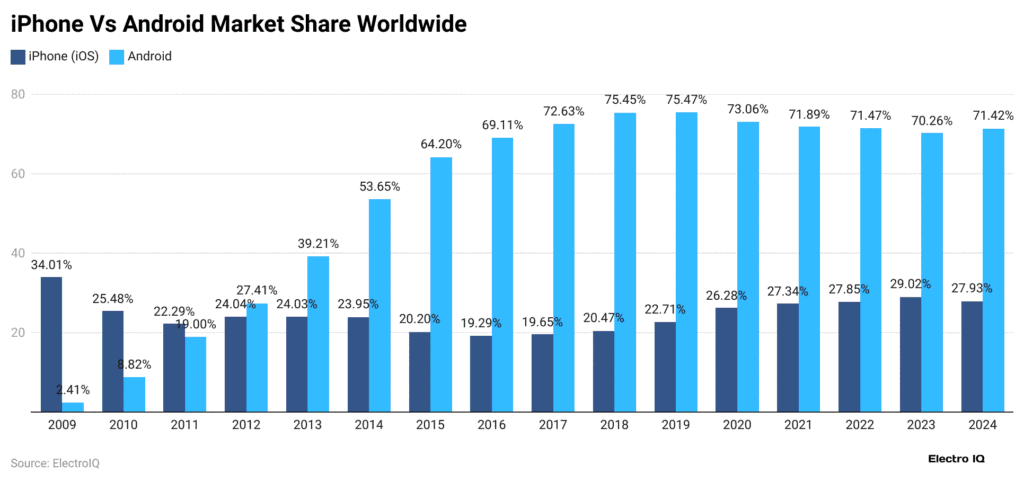
- According to the latest data, Android accounts for approximately 70.69% of the global mobile market, whereas the iPhone has approximately 28.58%.
(Reference: backlinko.com)
- Android has held nearly 50% of the mobile operating system market, reaching a peak of 53.65%, and remains the most widely used smartphone operating system globally.
- In 2024, the iPhone will dominate the smartphone market in the United States, with a market share of 60.77% vs. 38.81% for Android phones.
- Android has the highest market share, at approximately 46.42%.
- As predicted, 133.4 million individuals in the United States have Android devices, whereas the number of iPhone users is 118.1 million.
- In 2023, Android accounted for almost 56% of worldwide mobile sales, whereas iPhone accounted for 37%.
- Bangladesh has a high number of Android users globally, with almost 98% of smartphone users selecting Android.
- Japan has the lowest proportion of Android users, at 30%.
Android Usage Statistics
- In 2021, 70.93% of smartphone users in Europe used Android devices.
- Android accounted for nearly 86.6% of the global smartphone market in 2020.
- The median battery life of an Android phone was almost 10 hours and 14 minutes.
- 95% of smartphone applications on the Google Play Store are free, according to a 2021 survey.
- The most popular Android application category was communication, accounting for almost 94.12% in October 2021 in the United States.
- The Google Play Store was valued at almost $38.6 billion in 2020.
- 84.5% of Australia’s population uses the Android operating system.
- Roughly 47.9% of smartphone users in the United States use Android devices.
- Almost 2.87 million Android applications were available in the Google Play Store.
- The median sales price of an Android phone was $247.
- Android 10 launched and was the widely used Android, accounting for 41.2% of Android phones globally.
- India has the largest base of Android users, with nearly 600 million.
- By 2027, Android phone users are estimated to be 1.75 billion.
iPhone vs Android Applications
- Which is better: iPhone or Android? Statistics show that BeReal is currently the most famous application among iPhone users.
- According to Statista, TikTok is the most popular application among Android users. Instagram followed with nearly 21.17 million downloads worldwide, and WhatsApp had 20.72 million downloads worldwide.
- iPhone users pay substantially more for downloaded applications than Android users.
- Almost 94.1% of the applications on the Apple App Store are free, whereas 96.9% of the applications available on the Google Play Store are free.
- According to MacRumors.com, only 41% of iPhone users also have a Mac Computer, and most use Windows or Google Chrome devices.
- Samsung holds approximately 34% of the Android market.
- According to NetGuru, Android has an almost 91% consumer retention rate, whereas Apple is currently at a respectable but lower level of 86%.
Most Expensive iPhone Statistics
- The Goldstriker iPhone 3GS Supreme is a gold-plated iPhone that costs $3.2 million.
- The most expensive iPhone in India is the iPhone 12 Pro Max, which costs approximately Rs. 1,39,000 due to import duties and taxes.
- Apple accounts for nearly 50% of smartphone value worldwide, despite having the highest price in 2020.
- Despite its expensive price, the iPhone has a good reselling value of almost 58.8% within a year.
- Nearly 12% of worldwide mobile users use iPhones despite high prices.
- Apple has sold almost 217 million iPhones worldwide despite having the most costly iPhone X, with a selling price at $999.
- The Gold Genie iPhone 7 Diamond RockStar Limited Edition is a Falcon Supernova iPhone 6 Pink Diamond luxury iPhone made of real diamonds and priced at $14,300.
- The Falcon Supernova iPhone 6 Pink Diamond, one of the most expensive iPhones, is equivalent to purchasing nearly 44,863 basic-model iPhone 13s.
- iPhone X was the most expensive iPhone in recent years, valued at $999.
- The Caviar Zirconium iPhone 12 Pro Max is a luxury version of the iPhone 12 Pro Max, priced at $5,960.
- As of 2020, the iPhone 12 Pro Max has observed the highest pre-order sales.
- Stuart Hughes iPhone 4S Elite Gold is also a luxury iPhone model that costs almost $9.4 million.
- The Black Diamond iPhone 5 costs almost $15.3 million and is the third most expensive smartphone globally.
- The Gold and Co. iPhone XS Max is an altered iPhone model made of solid 24-karat gold and valued at almost $15,340.
- The Falcon Supernova iPhone 6 Pink Diamond is valued at approximately $48.5 million and is among the most expensive iPhones worldwide.
- The Apple iPhone 12 Pro Max was the best-selling smartphone in the United States despite its higher price.
- The Apple iPhone 12 Pro Max is priced at $1,099 and is the most expensive iPhone in 2021.
Conclusion
While Android is currently influencing the smartphone market with its wide range of devices, Apple’s popularity indicates that it is not declining in the United States. Although Android holds a larger global market share, Apple’s App Store contains more applications than Google Play. In addition, the Apple iPhone accounts for a higher share of smartphones than Android devices in the United States.
Android users exhibit very high loyalty, whereas iOS users tend to spend more on mobile applications and have higher median incomes.