







Introduction
Internet Addiction Statistics: Today, the internet is part of almost everything we do. With smartphones in our pockets, it is easy to keep scrolling, gaming, streaming, or checking social media all day. Because of this, internet addiction, also called problematic internet use, is becoming more common, especially among teenagers and young adults. Many surveys indicate that a substantial number of people struggle to manage their online time.
They may repeatedly check their phones, sleep less, or see their studies, work, and relationships suffer. The exact numbers are different in each country because researchers use different tests and definitions of addiction. Still, most studies point to the same idea: as screen time increases, the risk of unhealthy internet use also grows.
Editor’s Choice
- The global internet addiction rate in 2025 accounted for 17.9%.
- Internet users aged from 13 to17 have the highest addiction risk at 73%, and young adults aged 18-24 are close behind at 71%.
- Men had a higher internet addiction rate (19.6%) than women (16.3%).
- In 2025, 34.9% of U.S. high school students showed signs linked to internet addiction.
- The Middle East recorded the top internet addiction level at about 31%, while Southeast Asia is also very high, coming in at around 29%.
- From a 2025 meta-analysis of 96 samples (149,601 people aged 18-35), the pooled IGD prevalence was 6.1% (95% CI 5.03-7.40).
- Around 210 million people worldwide are affected by social media and broader internet addiction.
- A report shared by Slick Text states that teens who use electronic devices for more than 5 hours per day are 71% more likely to show suicide risk factors than teens who use devices for only 1 hour/day.
- A 2025 meta-analysis estimated pornography addiction accounted for 13% (95% CI 8%-19%).
- In a 2025 survey of Polish young adults, 2.6% screened positive for problematic online shopping.
- Great Britain (adults): 2.7% in the PGSI 8+ “problem gambling” range, 3.1% in PGSI 3-7, and 8.8% in PGSI 1-2.
- Microsoft’s 2025 Work Trend Index reports that 40% of people online at 6:00 a.m. were already checking email, and the average worker received 117 emails/day.
Global Internet Addiction Prevalence
- According to sqmagazine.co.uk, the global internet addiction rate in 2025 accounted for 17.9%.
- The Middle East (31.4%) and Southeast Asia (29.2%) report the highest regional levels of internet addiction, whereas Western Europe has the lowest at 8.7%.
- North America reports an internet addiction level of 15.2%, and the rate has increased steadily over the last five years.
- South America is now at 22.6%, and this increase is partly attributable to greater access to mobile broadband.
- Sub-Saharan Africa has relatively low internet addiction at 6.4%, while China records a national level of 24.9%.
- India reported 21.1% of users showing compulsive browsing and social media behaviour.
- In Japan, adults aged 45+ account for 12.3% of reported cases.
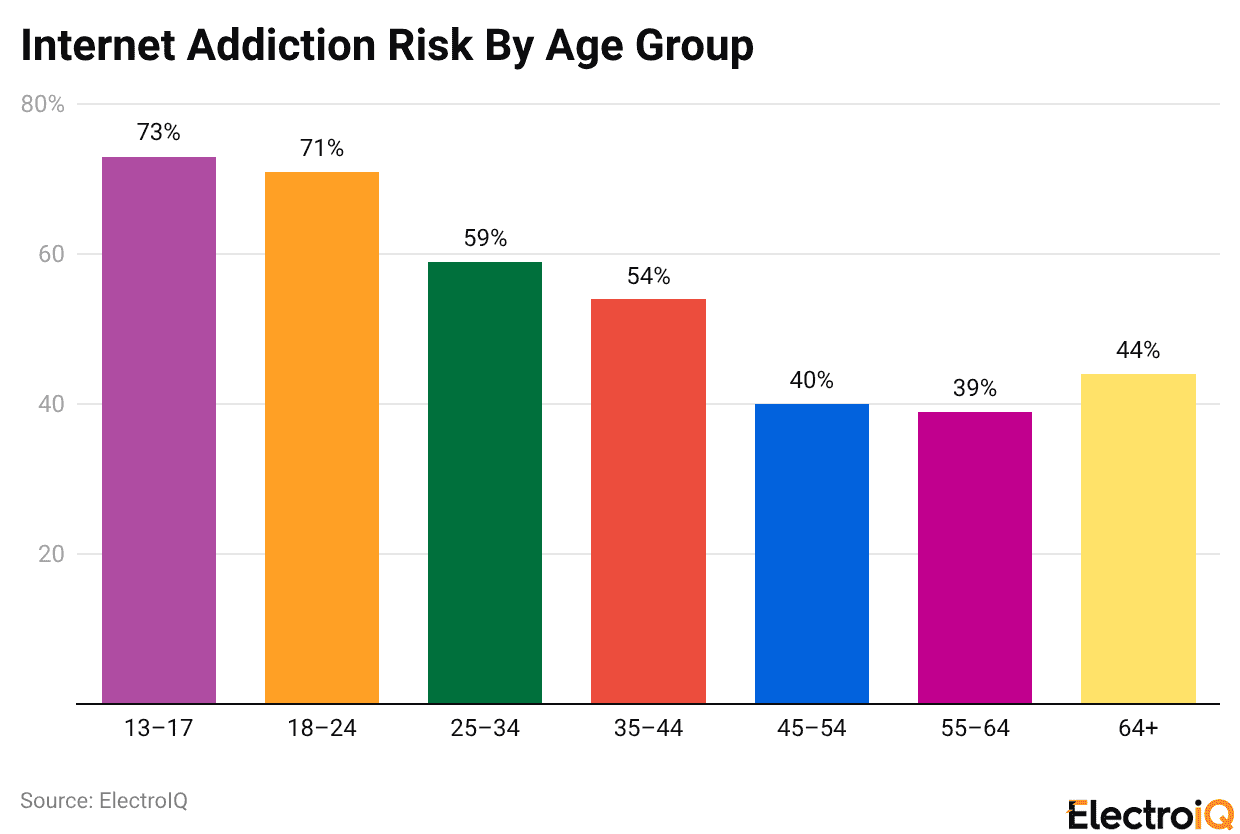
Internet Addiction Statistics By Age Group
(Reference: sqmagazine.co.uk)
- Internet users aged from 13 to17 have the highest addiction risk at 73%, and young adults aged 18-24 are close behind at 71%.
- Adults aged 25-34 and 35-44 have a lower addiction risk of 59% and 54%, respectively.
- Meanwhile, the internet addiction risk declined for people aged from 45 to 54 years at 40% and 55 to 64 years at 39%.
- For adults aged 64 and above, the internet risk rises slightly compared with ages 55-64, reaching 44%.
By Gender Differences
- Men had a higher internet addiction rate (19.6%) than women (16.3%).
- Men are 2.1 times more likely than women to develop internet gaming disorder.
- Among teenagers, boys reported an addiction rate of 32.8%, mostly due to gaming and streaming, whereas girls aged 13-19 reported 24.1%, primarily linked to social media.
- Women aged 30-45 more often report stress-related overuse, and 13.5% meet mild addiction levels.
- Men aged from 20 to 35 exhibit higher addiction rates of work-related overuse, with 22% checking online platforms compulsively daily.
- Only 26% of women stated staying online longer than intended due to social media platforms.
- Among married couples, 17% of husbands are more likely to use digital platforms to cope with stress.
By United States Students
- About 34.9% of high school students were highly addicted to the internet in 2025.
- In middle school students, the rate of internet addiction was 27.6%, while in college students aged 18-22, approximately 31.2%.
- 88% reported checking their phones during class, and 42% reported that this distracts from their attention.
- 51% of teens report mood shifts when they cannot go online.
- Students with addiction have an average GPA 0.6 points lower than others.
- Heavy gaming/streaming users spend 10.2 hours/day online, nearly 3 times the healthy average.
- 17% say screen time makes them skip meals or delay sleep.
- Phone use after 10 p.m. links to 45% higher insomnia rates.
- 25.3% of teen girls name social media as a key cause of anxiety and self-esteem problems.
By Regional and Country-Specific
- According to a report published by sqmagazine.co.uk in 2025, the Middle East recorded the top internet addiction level at about 31%, while Southeast Asia is also very high, coming in at around 29%.
- Internet addiction rates in other geographic regions are as follows: Southeast Asia (29%), South America (23%), North America (15%), Western Europe (9%), and Sub-Saharan Africa (6%).
- China accounted for around 25%, supported by heavy mobile use and social commerce activity.
- Besides, India and Japan secured an addiction rate of 21% and 12%, respectively.
Internet Gaming Disorder (IGD) Statistics
- From a 2025 meta-analysis of 96 samples (149,601 people aged 18-35), the pooled IGD prevalence was 6.1% (95% CI 5.03-7.40), with 8.1% (95% CI 5.91-11.01) in gamer-only samples and 5.47% (95% CI 4.33-6.90) in mixed samples.
- In a 2025 representative study of young adults in Singapore, IGD prevalence was 10.3%, including 14.6% in males (95% CI 11.5-17.7) and 6.2% in females (95% CI 4.1-8.3).
- In a large 2025 rural China adolescent cohort (N=13,931), IGD was 5.2% at baseline (725/13,931) and 5.0% after 1 year (692/13,931).
- In Croatia population (ages 15-64), IGD was 0.48% (95% CI 0.30-1.0) overall and 1.63% (95% CI 1.11-3.0) among video game players.
Social Media Addiction Statistics
(Source: demandsage.com)
- Around 210 million people worldwide are affected by social media and broader internet addiction.
- According to Demand Sage, social media use is now widespread, with 5.41 billion users, representing 63.8% of the world’s population.
- Social media users spend 2 hours 19 minutes per day scrolling and consuming content, and many use more than six platforms in their daily routines.
- In the United States, about 10% of people are estimated to be addicted to social media, with 33.14 million individuals.
- Globally, reported social media addiction rates remained highest among women at 36% and men at 6%.
- In the United States, the addiction appears strongest among users aged from 18 to 22 years, where 40% report being addicted.
- By generation, Millennials accounted for 37% of users, followed by Gen Z at 25%.
- Nearly 97% of teenagers use at least one major platform, and 36% admit to excessive use and addiction.
- Over 60% of U.S. college students also report social media addiction.
- Nigeria shows the heaviest daily use at 4 hours 49 minutes.
- Spending more than 3 hours per day is linked with more negative feelings about social well-being.
- Among people with an addiction, 26.1% report sleep problems, and 35.1% of their total online time goes to social media.
Smartphone Addiction Statistics
- A report shared by Slick Text states that teens who use electronic devices for more than 5 hours per day are 71% more likely to show suicide risk factors than teens who use devices for only 1 hour/day.
- In parent surveys, 47% believe their child is addicted to a smartphone.
- In teacher surveys, 67% report that students are distracted in a harmful way by mobile devices.
- About 89% of parents say they take responsibility for their child’s cell phone use.
- Among smartphone users aged 18-29, 22% report checking their phone every few minutes.
- Among millennials, 36% report spending over 2 hours per workday on personal phone use.
- Adults spend about 45 minutes/day on social media alone.
- Approximately 41% of teenagers report feeling overloaded by daily notifications.
- In the UK, 46% of parents say they feel addicted to their phones.
- Instead of face-to-face time, 33% of teens socialise more with close friends online.
- While socialising, 52% of adolescents sit silently on their smartphones for long periods.
Cybersex / Pornography Addiction Statistics
- pubmed.ncbi.nlm.nih.gov further stated that across 22 studies (N=31,566), a 2025 meta-analysis estimated pornography addiction accounted for 13% (95% CI 8%-19%).
- In Hungary, DSM-5 adapted pornography-watching disorder (PWD) was 4.4% among pornography users aged 18-35 (315/7,187).
- In Egypt, a 2025 study of medical undergraduates (N=614) found 23.3% screened positive for PPU using PPCS-6.
- In Egypt, a 2025 nursing-student sample (N=828) classified 5.6% as pornography addicts on a screening tool.
- In a 2025 community online survey, probable CSBD was 10.8% (32/296), including 10.1% (female) and 12.3% (male). (frontiersin.org).
- According to Springer, in Germany, around 62% reported engaging in 1 or fewer online sexual activities (in the last 12 months), with 51% viewing sexually stimulating material and 46% seeking sex-related information.
Online Shopping Addiction Statistics
- In a 2025 survey of Polish young adults, 2.6% screened positive for problematic online shopping.
- Among 457 university students in Sichuan (China), an online decision-tree model reached 79.45% accuracy; the average addiction score was 3.11 (SD 0.923), and one high-risk branch reached 57.14%.
- In Chengalpattu, Tamil Nadu (India), the online buying disorder occurred in 22.6% of medical students (68/300) in 2025.
- A large meta-analysis estimated the prevalence of compulsive buying at 4.9% in representative adult samples and 8.3% in university student samples.
- Across 15 countries, problematic online shopping ranged from 0.2% to 3.1%, with no cases observed in any country.
Online Gambling Addiction Statistics
- Great Britain (adults): 2.7% in the PGSI 8+ “problem gambling” range, 3.1% in PGSI 3-7, and 8.8% in PGSI 1-2; 38% gambled online in the last 4 weeks (or 16% online when lottery-only play is excluded).
- Great Britain (ages 11-17): Only 8% said they gambled online in the last 12 months; 1.2% screened as problem gambling and 2.2% as at-risk (DSM-IV-MR-J).
- Australia (Jan 2025): One national ANUpoll wave estimated that 19.4% of adults were risky gamblers, and 56.1% of gamblers reported primarily playing online in the past year.
- Switzerland (men 18-24): In 2025, 7.3% were gambling online-only, and 34.4% used both online and land-based gambling; 74.7% used a phone/tablet, and problem gambling was 2.1% overall (4.4% among past-year gamblers).
- UK self-exclusion: In H1 2025, ambling registrations increased 19% compared with H1 2024; May saw 10,344 sign-ups; registrations among ages 16-24 grew 44% year-on-year; and 40% of 16-24 registrants chose a 6-month exclusion.
Email Addiction Statistics
- Microsoft’s 2025 Work Trend Index reports that 40% of people online at 6:00 a.m. were already checking email, and the average worker received 117 emails/day.
- Only 29% of active workers checked their email again by 10:00 p.m., and meetings held after 8:00 p.m. rose 16% YoY.
- Weekend spillover was also evident in Microsoft’s data, with nearly 20% checking email before noon on weekends and more than5% returning to email on Sunday evening.
- Microsoft further estimates that workers are interrupted about every 2 minutes (approximately 275 times/day) by meetings, email, or notifications.
- A May 2025 consumer survey found 93% of people check their email daily.
- A June 2025 Gen Z work survey found that 53% report that email is stressful, 92% report that email overload reduces productivity, and 60% report using email to avoid conflict/anxiety at work.
Common Symptoms of Internet Addiction
- 67% of internet addicted users report continuing to check their phones or other devices even when there are no notifications.
- 44% of internet users reported feeling uncomfortable offline, exhibiting signs such as irritability or restlessness, and nearly 58% report losing track of time while browsing or gaming.
- Nearly 32% reported downplaying their screen time to family or partners, and about 72% reported sleep issues.
- Daily life performance declined by 36%, and mood swings increased by 29%.
- 48% used the internet to cope with stress or boredom, and only 20% neglected hygiene or chores because they stayed online for too long.
- In 2025, therapists noted that about 28% of diagnosed internet addiction cases were compulsive disorders.
Conclusion
Statistics on internet addiction articles show that use of the internet has become a regular habit. The overuse of the internet has become a serious addiction that can harm health, education, and employment, particularly among teenagers and young adults. The main causes of internet addiction are prolonged screen time, continuous application use, and algorithmically curated content, which are often associated with increased risk of sleeplessness.
As social media use has grown in recent years, millions have been affected yet seldom seek support; therefore, prevention should be prioritised over fear of stigma. Meanwhile, digital skills, safer app design, clear rules at home and at school, and easy access to counselling are needed to reduce the risk of internet addiction.
FAQ
Staying online too long, cannot stop, feel low offline, lose sleep, and neglect duties.
Anyone can be affected, but teens and young adults may face a higher risk due to school stress, gaming, and social media pressure.
Health experts widely recognise problematic internet use, and it can be linked with anxiety, depression, and poor sleep.
Many factors: stress, loneliness, boredom, mental health concerns, easy access to devices, and apps designed to keep users engaged.
It can reduce focus, harm grades or work performance, disturb sleep, increase conflicts at home, and lower physical activity.
Use time limits, silence extra alerts, keep phones away at night, enjoy offline hobbies, and monitor screen time.