Joseph D'Souza co-founded TechViral.News as a personal project to share his insights and experiences with tech gadgets. Over time, it has evolved into a respected tech blog, known for its in-depth coverage of technology trends, smartphone reviews, and app-related statistics. Joseph is also an expert in fintech, with a focus on AI applications in the industry, as well as blockchain and cryptocurrency technologies. His passion for technology drives him to explore emerging trends and provide valuable analysis for his readers.
Rohan Jambhale is a senior editor at TechViral.News, with a strong focus on digital marketing, SEO, and social media optimization. He is skilled in writing and editing in-depth articles that are rich in accurate statistics, ensuring the content resonates with readers. Rohan plays a key role in reviewing and confirming the quality of articles from other writers before they are published.
He also designs visually engaging infographics to help clarify complex data, making it easier for readers to understand. His commitment to delivering well-researched and informative content helps maintain TechViral.News’ reputation as a trusted source of valuable information. Rohan continuously keeps himself updated with the latest trends in digital marketing, further enhancing the content quality and relevance for the audience.
Generative AI companies are businesses that build computer programs able to create new things, like text, images, music, code, or videos, instead of just analyzing data. They train models on huge amounts of examples so the system can learn patterns and then produce original, human-like results when users type prompts or upload files. These companies may sell chatbots, writing helpers, image makers, coding assistants, or tools that speed up everyday work. They usually earn money by offering subscriptions, pay-per-use access, or by selling their technology to other organizations. Their products are reshaping how people work, learn, design, and communicate worldwide.
Navigation
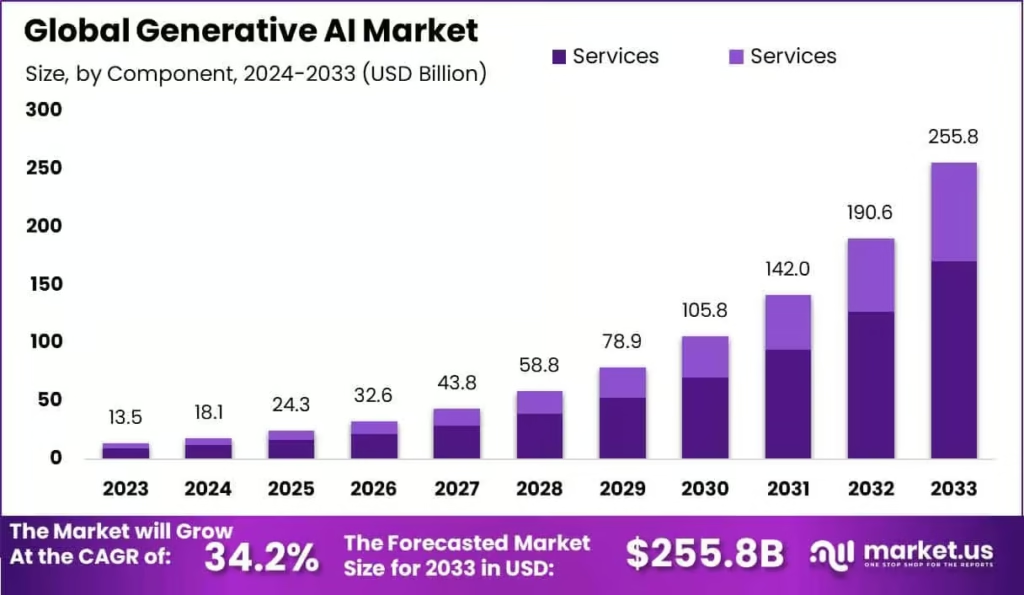
Generative AI Market Size
The global generative AI market generated about USD 13.5 billion in 2023 and is expected to reach around USD 255.8 billion by 2033, with a 34.2% CAGR over the forecast period.
The software segment led revenue in 2023, accounting for 66.7%, as enterprise demand was supported by rapid model upgrades and wider tool deployment across functions.
Transformer-based technology held the largest technology share at 45.1% and is expected to expand at about a 32.2% CAGR, driven by strong performance in text generation and image creation.
Large language models were positioned as the leading model category, with adoption driven by customer support, content generation, and workplace productivity use cases.
Natural language processing remained the largest application area in 2023, while computer vision is expected to expand faster as its use increases across transportation, monitoring, and security workloads.
Media and entertainment accounted for the largest end-user share at 24.3%, with generative AI widely used for image creation, video editing, and content enhancement.
North America held the leading regional position with a 42.1% share in 2023, supported by strong cloud infrastructure, high enterprise spending, and active model development.
Generative AI is projected to raise the United States’ GDP by about 21% by 2030, indicating material macroeconomic upside if adoption scales responsibly.
Consumer risk perception remains high, as over 75% of consumers report concern about AI-driven misinformation and manipulated content.
Adoption velocity has been demonstrated by ChatGPT, which reached about 1 million users within roughly 5 days of launch, reflecting unusually fast consumer adoption for a new digital product.
Productivity expectations are high, with 64% of businesses reporting productivity gains from AI deployment across workflows.
In China, 58% of companies report AI usage, and another 30% are considering adoption, compared with the United States, where 25% report usage and 43% report active exploration.
India shows very high reported usage: 73% of surveyed people report using generative AI, compared with 49% in Australia, 45% in the United States, and 29% in the United Kingdom.
User demographics skew younger, as Millennials and Gen Z account for 65% of users, and 72% of these users are employed, indicating strong workplace relevance.
Skill confidence is rising: nearly 6 in 10 users report being close to mastering generative AI tools, and 52% report using them more frequently over time.
The demand for work automation is clear: 75% of users want generative AI to automate work tasks and support professional communication.
Usage motivations remain mixed, as 38% of users report using generative AI for experimentation and fun, while 34% report using it to learn about topics of interest.
Marketing use cases are already well established: 76% of marketers use generative AI for basic content creation, 76% for copywriting, 71%for idea generation, 63% for market data analysis, and 62% for image asset creation.
Investment activity has remained strong, as generative AI startup funding was projected to reach about USD 6 billion in 2023, alongside rapid growth in generative AI tool downloads to more than 10.1 million by mid 2023 from 1.1 million in 2022.
Enterprise impact signals have been reinforced by research indicating employee productivity gains of up to 40%, while US labour productivity uplift has been estimated at 0.5 to 0.9 percentage points annually through 2030 under midpoint adoption conditions.
In banking, the annual value potential from enterprise generative AI tools has been estimated at USD 200 billion to USD 340 billion, driven by process automation, improved customer interactions, and enhanced risk workstreams.
Generative AI Companies Of The World
The companies listed are grouped into three main categories based on their roles in the generative AI ecosystem. Major AI developers are the organizations building the foundational, large-scale AI models and platforms that power many applications, such as OpenAI, Google, Microsoft, and Anthropic.
Hardware and infrastructure companies, like NVIDIA and Hugging Face, provide the computing power, tools, and platforms needed to train, deploy, and manage these models at scale. Specialised generative AI companies, including Cohere, Jasper, Synthesis AI, and Synthesia, focus on more targeted use cases, such as business-focused language models, marketing content creation, synthetic data generation, and AI-driven video built on or alongside these core technologies.
OpenAI
Title
Information
Company Type
Private AI research and deployment company; operates as a for-profit public benefit corporation (OpenAI Group PBC) overseen by the nonprofit OpenAI Foundation.
Parent Organization
OpenAI Foundation (nonprofit controller of the OpenAI public benefit corporation); Microsoft is a major strategic investor with a significant minority stake (around 27%).
CEO
Sam Altman, co-founder and chief executive officer.
Number of Employees
Approximately 3,000+ employees as of 2025 (public estimates vary slightly but are in this range).
Established Date and Year
Founded on 8 December 2015 as an AI research organization.
Subsidiaries / Key Entities
Includes internal entities such as OpenAI OpCo, LLC (formerly OpenAI L.P.), OAI Corporation, and Aestas Management Company LLC, as well as acquired companies like Global Illumination (AI design studio), Multi (remote collaboration platform), io Products, Inc. (AI hardware startup founded by Jony Ive), and Statsig (experimentation and product testing platform).
Products
GPT family of large language models (e.g., GPT-4, GPT-4o, GPT-5), ChatGPT (web and mobile apps), DALL·E image generation models, Sora text-to-video model, Whisper speech recognition, Codex/code models, and related APIs and tools.
Headquarters
1455 3rd Street, San Francisco, California, United States.
Geographical Presence
Global presence via cloud-delivered AI services and partnerships; products such as ChatGPT are used worldwide, with hundreds of millions of users, while core corporate operations are centered in San Francisco.
Website
Main corporate site: openai.com; primary consumer product access via ChatGPT at chatgpt.com.
OpenAI is currently valued at around USD 500 billion after an October 2025 employee share sale, making it one of the most valuable private companies in the world.
OpenAI is estimated to have surpassed USD 10 billion in annual recurring revenue from ChatGPT and related products and is projected to reach roughly USD 12–13 billion in ARR in 2025.
ChatGPT now has about 800 million weekly active users in 2025, roughly doubling from 400 million weekly users reported in February 2025.
ChatGPT receives around 5.8–6.2 billion visits per month and handles over 2 billion queries per day, underlining its position as the dominant consumer-facing generative AI service.
ChatGPT holds roughly 60–80% of the generative AI chatbot and AI search market, with one study giving it 61% of U.S. generative AI chatbot share and another estimating 81.13% of AI search market share in late 2025.
OpenAI employs more than 3,000 people as of 2025, over three times its headcount just two years earlier as the company scaled to meet generative AI demand.
OpenAI is the creator of several flagship generative models, including the GPT family of large language models, the DALL·E image generators, and the Sora text-to-video system, which together anchor much of today’s generative AI ecosystem.
In April 2025, OpenAI released GPT-4.1, GPT-4.1 mini, and GPT-4.1 nano, which offer context windows up to 1 million tokens and significantly improved coding and instruction-following performance compared with GPT-4o.
During 2025, OpenAI also rolled out new reasoning-focused models such as o3 and o4-mini across ChatGPT and Azure OpenAI, positioning them as more capable and efficient successors to earlier GPT-4-series models for complex problem-solving.
OpenAI’s Sora text-to-video model was first made available to ChatGPT Plus and Pro users in late 2024 and then upgraded to Sora 2 with an iOS app in September 2025, adding stronger world-simulation capabilities and triggering new safety measures around deepfakes and celebrity likeness.
In November 2025, OpenAI launched “ChatGPT for Teachers”, a secure version of ChatGPT that is free for verified U.S. K–12 educators through June 2027, designed to reduce administrative workload while keeping student data within district-controlled systems.
Throughout 2025, OpenAI expanded ChatGPT’s business and developer features, adding connectors to services like Google Drive, OneDrive, SharePoint, and Dropbox, as well as broader model options for Custom GPTs and more flexible enterprise pricing to embed generative AI more deeply into organizational workflows.
Google (Alphabet)
Detail
Information
Company Type
Alphabet Inc. is a public multinational technology conglomerate; Google LLC is its largest subsidiary, focused on internet services, cloud, advertising, devices, and artificial intelligence.
Parent Organization
Google LLC is a subsidiary of Alphabet Inc.
CEO
Sundar Pichai is CEO of both Alphabet Inc. and Google LLC.
Number of Employees
Alphabet has about 190,000 employees (190,167 reported for 2025), with Google representing the majority of this workforce.
Established Date and Year
Google Inc. was founded on 4 September 1998 in Menlo Park, California. Alphabet Inc. was created later through a restructuring on 2 October 2015 and became Google’s parent holding company.
Subsidiaries
Key Alphabet subsidiaries include Google, YouTube, Calico, CapitalG, Google Fiber, GV, Isomorphic Labs, Verily, Waymo, and Wing, along with many product- and region-specific Google entities.
Products
Core products include Google Search, Chrome, Android, Google Cloud, Google Workspace, Maps, YouTube, Pixel hardware, Nest, and Fitbit. Generative AI products include the Gemini model family (chat + API), Imagen (text-to-image), Veo (text-to-video), NotebookLM, LearnLM, and SynthID for watermarking AI content.
Headquarters
Googleplex, 1600 Amphitheatre Parkway, Mountain View, California 94043, United States.
Geographical Presence
Global: Google and Alphabet serve users and customers worldwide, with tens of offices across North America, Latin America, Europe, Asia-Pacific, the Middle East, and Africa; Google is described as serving a “worldwide” area in both Google and Alphabet company profiles.
Alphabet’s revenue passed USD 100 billion in a single quarter for the first time in Q3 2025, reaching about USD 102.3 billion, with analysts and the company itself crediting strong demand for AI-powered products like Gemini and Google Cloud’s Vertex AI as key growth drivers.
In Q2 2025, Alphabet’s revenue grew 14% year over year to USD 96.43 billion, while Google Cloud revenue surged 32% to USD 13.6 billion, and CEO Sundar Pichai said Cloud’s annual revenue run-rate has now passed USD 50 billion, largely thanks to AI infrastructure and generative AI services.
Google reports that AI Overviews in Search now reach about 2 billion users every month, the Gemini app has surpassed 650 million monthly active users, more than 70% of Google Cloud customers are using its AI, and 13 million developers have built with its generative models, underlining Google’s massive generative AI footprint.
Independent estimates indicate that Gemini powers about 21% of all generative AI search interactions globally in 2025 and holds roughly 13–14% of the generative AI chatbot market, placing Google firmly among the top three players in consumer-facing generative AI behind ChatGPT and Microsoft Copilot.
Within productivity tools, Gemini integrations in Google Workspace have already driven over 2.3 billion document interactions in the first half of 2025, and it is enabled in about 92% of Workspace accounts, with more than 1.4 billion Google Docs files edited using Gemini-assisted rewriting.
On benchmarks, Gemini 1.5 Ultra achieved 93.4% on the MMLU test, and newer models like Gemini 2.5 Pro and Gemini 3 lead or match the state of the art on multiple multimodal and reasoning leaderboards, positioning Google as a top-tier frontier-model developer.
Alphabet is backing its generative AI ambitions with huge infrastructure spending, having raised 2025 capital expenditure guidance to roughly USD 91–93 billion, after spending USD 52.5 billion in 2024, with a large share earmarked for AI-optimized data centers and custom chips to run Gemini at scale.
On the consumer monetization side, Google One reached 150 million subscribers by mid-2025, and the company says a new USD 19.99 AI-enhanced tier—which bundles premium generative AI features—has contributed “millions” of new paying users.
In November 2025, Google unveiled Gemini 3 as its “most intelligent” model so far, emphasizing deeper reasoning and multimodal understanding and making it available across the Gemini app, Google AI Studio, Vertex AI, and a new agentic development platform called Google Antigravity.
Google’s Vertex AI platform now offers a wide portfolio of Gemini models, including Gemini 2.0 Flash, which is designed for high-speed, multimodal generation with built-in tool use and context windows up to 1 million tokens, aimed at sophisticated enterprise and developer workloads.
Recent earnings commentary highlights that more than nine million developers have built with the Gemini 2.5 family, and users have already created around 70 million Veo 3 AI-generated videos, showing rapid adoption of Google’s generative image and video tools alongside its text models.
Google executives report that the Gemini app’s growth in 2025 has been boosted by viral multimodal features such as the “Nano Banana” image-editing tool, which helped push the app to about 650 million monthly active users and significantly increase engagement among younger users in markets like Thailand, Vietnam, and Indonesia.
Microsoft Corporation
Detail
Information
Company Type
Microsoft Corporation is a public multinational technology company (Big Tech) focused on software, cloud computing, hardware, and artificial intelligence, including generative AI.
Parent organization
None. Microsoft Corporation is an independent, publicly traded company and the ultimate parent of its global group of subsidiaries.
CEO
Satya Nadella is the Chairman and Chief Executive Officer of Microsoft (CEO since 2014, Chairman since 2021).
Number of Employees
About 228,000 full-time employees worldwide as of June 30, 2025.
Established date and year
Founded on April 4, 1975, in Albuquerque, New Mexico, USA, by Bill Gates and Paul Allen.
Subsidiaries
Selected major subsidiaries include LinkedIn, GitHub, Activision Blizzard, Mojang Studios (Minecraft), Skype, Nuance Communications, ZeniMax Media, and several game studios such as Double Fine Productions and Obsidian Entertainment.
Products
Key products and services include Windows, Microsoft 365 (Word, Excel, PowerPoint, Outlook, etc.), Microsoft 365 Copilot / Microsoft Copilot (generative AI assistant), Azure & Azure AI, Dynamics 365, Xbox & Game Pass, Surface devices, Bing, Teams, LinkedIn, and GitHub.
Headquarters
Global headquarters at the Microsoft Redmond campus, One Microsoft Way, Redmond, Washington, United States.
Geographical Presence
Worldwide operations and customers, with offices in more than 100 countries and roughly 125,000 employees in the U.S. and 103,000 internationally, reflecting a broad global footprint.
Microsoft’s family of Copilot apps and AI agents has surpassed 150 million monthly active users across products like Microsoft 365 Copilot, GitHub Copilot, and Security Copilot, and the company reports around 900 million monthly active users of AI features overall across its products.
GitHub Copilot now has more than 20 million users and is used by about 90% of the Fortune 100, making it one of the most widely adopted AI coding assistants in the world.
Microsoft’s Azure AI Foundry platform is used by roughly 80% of the Fortune 500, and its AI APIs processed over 500 trillion tokens in fiscal 2025, more than seven times the volume from the previous year.
More than 14,000 customers are already using Azure AI Foundry’s Agent Service to build AI agents that automate complex workflows, showing how deeply Microsoft’s generative AI stack is being embedded into enterprise processes.
In fiscal 2025, Microsoft is on track to invest about USD 80 billion in AI-enabled data centers, and in the first quarter of its 2026 fiscal year it spent a record USD 34.9 billion in capital expenditure, driven largely by AI infrastructure for Azure and Copilot workloads.
Microsoft’s strong AI push helped drive a record quarter, with revenue reaching around USD 76–78 billion, Azure cloud revenue growing close to 40% year over year, and Microsoft Cloud exceeding USD 49 billion in quarterly revenue.
Microsoft now operates more than 400 data centers across 70 regions worldwide, positioning its cloud and AI infrastructure as one of the largest platforms for training and running generative AI models.
Microsoft has launched its first internally trained frontier models, including MAI-1-preview (a large language model), MAI-Voice-1 (for speech generation), and MAI-Image-1 (a text-to-image generator), marking a shift from relying solely on OpenAI models to developing its own core generative AI stack.
MAI-1-preview was trained as a mixture-of-experts model on roughly 15,000 NVIDIA H100 GPUs and is currently being evaluated on public leaderboards like LMArena, while MAI-Image-1 is already integrated into Bing Image Creator and Copilot, competing directly with models from OpenAI, Google, and Midjourney.
Through its updated partnership with OpenAI, Microsoft now holds roughly a 27% equity stake in OpenAI’s for-profit entity, in a deal valued at about USD 135 billion and tied to a long-term USD 250 billion Azure cloud commitment, reinforcing Microsoft’s central role in the generative AI ecosystem.
Microsoft reports that over 230,000 organizations are using Copilot Studio to extend Microsoft 365 Copilot or build their own AI agents, and it has rolled out a major Copilot update that unifies chat, search, document creation, notebooks, and role-specific agents in a single experience.
Recent updates to Microsoft 365 Copilot include a new Agent Mode, which lets users give a single prompt (such as asking for a full analysis of sales data) and have Copilot orchestrate multi-step tasks to produce complete documents, spreadsheets, and visualizations, showing Microsoft’s push toward more autonomous “AI coworkers.”
Anthropic
Detail
Information
Company Type
Private artificial intelligence research and product company structured as a Public Benefit Corporation (PBC) focused on AI safety.
Parent organization
None – Anthropic is an independent, privately held company; it has major strategic investors such as Amazon, Google, and others but no corporate parent.
CEO
Dario Amodei, co-founder and Chief Executive Officer.
Number of Employees
Roughly 1,300–1,500 employees as of 2025 (public estimates differ: ~1,300 on Wikipedia and 1,500 on Forbes, with earlier counts around 1,035 in 2024).
Established date and year
Founded in 2021 by former OpenAI researchers, including siblings Dario and Daniela Amodei.
Subsidiaries
No major publicly reported subsidiaries; Anthropic mainly operates as Anthropic PBC and related corporate entities focused on AI safety and frontier models. (Most profiles and filings list only Anthropic itself.)
Products
The Claude family of frontier large language models and chatbot (e.g., Claude 3/4 series, including Opus, Sonnet, Haiku), Claude APIs for developers, enterprise integrations (e.g., with major cloud and consulting firms), and learning/resources like Anthropic Academy.
Headquarters
San Francisco, California, United States, with its main listed headquarters at 548 Market Street, San Francisco, CA 94104.
Geographical Presence
Serves customers and enterprise partners globally, with a strong base in the United States and growing deployments through major cloud providers and multinational clients (e.g., Deloitte and others).
Anthropic is now valued at USD 183 billion after a USD 13 billion Series F round completed in September 2025, more than doubling its valuation from March 2025.
The company’s annualized revenue run-rate grew from about USD 1 billion at the start of 2025 to over USD 5 billion by August 2025, reflecting extremely rapid commercial adoption of its Claude models.
Anthropic has raised roughly USD 20 billion in 2025 alone, including a USD 3.5 billion Series E at a USD 61.5 billion valuation, an additional USD 1 billion investment from Google, a USD 2.5 billion credit facility, and the USD 13 billion Series F in September.
As of mid-2025, Anthropic employs around 1,100 people, up from about 50 employees in 2021, showing how quickly its workforce has scaled with demand for generative AI.
Claude AI has surpassed 30 million monthly active users for the Claude 3.5 generation and now handles over 25 billion API calls per month, with about 45% of that traffic coming from enterprise platforms.
Claude’s share of the enterprise AI assistant market is estimated at about 29%, putting Anthropic in a strong competitive position against other leading generative AI providers.
The Claude 3 family (Haiku, Sonnet, Opus) introduced in 2024 supports 200,000-token context windows and can handle inputs exceeding 1 million tokens, enabling analysis of very long documents and complex workflows.
In February 2025 Anthropic launched Claude 3.7 Sonnet, a frontier model designed to “think” for extended periods on difficult tasks, and in May 2025 it unveiled the Claude 4 family, with Opus 4 presented as one of the world’s strongest coding and long-running agentic models.
Amazon has committed a total of USD 8 billion to Anthropic and designated AWS as its primary cloud and training partner, with projections that AWS could earn over USD 1.2 billion in 2025 and several billion annually in later years from Anthropic’s workloads. (Anthropic)
Google has separately invested around USD 3 billion in Anthropic and, in October 2025, agreed to provide access to up to one million Google TPUs, a deal expected to bring more than one gigawatt of AI compute capacity online by 2026.
In November 2025, Microsoft and NVIDIA announced plans to invest up to USD 15 billion in Anthropic, with Anthropic committing to purchase USD 30 billion worth of Azure capacity running on NVIDIA AI systems, and some reports suggesting this alliance could imply a future valuation approaching USD350 billion.
Anthropic reports serving over 300,000 business customers, with the number of large enterprise accounts (those spending more than USD 100,000 per year) increasing sevenfold, and its developer tool Claude Code already contributing more than USD 500 million in revenue after a tenfold increase in usage.
As part of its safety and policy stance, Anthropic announced in September 2025 that it will stop selling AI services to entities that are majority-owned in China, Russia, Iran or North Korea, citing national-security concerns.
NVIDIA Corporation
Detail
Information
Company Type
Public multinational technology company specializing in semiconductors, accelerated computing, and artificial intelligence (including generative AI).
Parent organization
None – NVIDIA Corporation is an independent, publicly traded parent company of its global group of subsidiaries.
CEO
Jensen Huang (founder, president, and chief executive officer).
Number of Employees
About 36,000 employees worldwide as of FY25 (January 26, 2025).
Established date and year
Founded on April 5, 1993, in Sunnyvale, California, United States.
Subsidiaries (selected)
Includes Mellanox Technologies, Bright Computing, Cumulus Networks, DeepMap, various NVIDIA Semiconductor entities, and numerous regional operating companies.
Products
Key lines include GeForce and RTX GPUs (gaming), data center and AI GPUs (e.g., A100, H100, Blackwell platform), NVIDIA DGX systems and DGX Cloud, CUDA platform, NVIDIA Omniverse, NVIDIA AI Enterprise, and generative AI platforms such as NVIDIA NeMo and NVIDIA AI Foundry services.
Headquarters
Santa Clara, California, United States; main campus address commonly listed as 2788 San Tomas Expy, Santa Clara, CA 95051.
Geographical Presence
Serves customers worldwide, with offices, R&D centers, and facilities across North America, Europe, the Middle East, and Asia-Pacific (including a large and expanding presence in Israel).
NVIDIA controls about 92% of the global data-centre GPU market, in a segment worth roughly USD 125 billion in 2024, making it the dominant hardware provider for training and running generative AI models.
In the first quarter of fiscal 2026 (reported May 2025), NVIDIA posted USD 44.1 billion in revenue, of which USD 39.1 billion came from its data-center business that is largely driven by AI and generative AI workloads.
In its most recent reported quarter, NVIDIA generated about USD 57 billion in total revenue, with USD 51–51.2 billion coming from data centers, up 66% year over year and about USD 10 billion more than the prior quarter, mainly due to demand for AI server chips such as the Blackwell family.
Across the first half of fiscal 2026, NVIDIA’s data-center segment has already produced just over USD 80 billion in revenue, highlighting how generative-AI compute has become the company’s primary growth engine.
Earlier, for the quarter ended January 26, 2025, NVIDIA reported $39.3 billion in revenue, up 78% year over year, with about USD 35.6 billion of that coming from data-center sales, which grew 93% driven by AI GPU demand.
Industry analyses estimate that NVIDIA GPUs power more than 90% of cloud-based AI workloads and hold an 80–90% share of AI training accelerators, underlining its central role in the generative AI compute stack.
According to IoT Analytics and related market studies, NVIDIA’s 92% share of data-center GPUs is a key reason the U.S. leads global generative-AI infrastructure, with U.S. players dominating semiconductors and cloud platforms.
NVIDIA’s Blackwell architecture (B100, B200 and newer Blackwell Ultra GPUs) is described by the company as defining “the next chapter in generative AI”, with chips packing around 208 billion transistors and targeting data-centre-scale generative AI workloads.
NVIDIA’s 2025 sustainability report notes that Blackwell Ultra GPUs are over 50× more energy-efficient than traditional CPUs for large-language-model inference, helping reduce the energy cost per token as generative AI scales.
NVIDIA’s NeMo framework is promoted as a scalable, enterprise-grade toolkit for building and deploying generative AI models and AI agents, covering large-language, multimodal, and speech AI, and is released as open-source software for researchers and developers.
NVIDIA’s AI Enterprise software suite, which includes NIM and NeMo microservices, is positioned as the building block for enterprise generative-AI applications, providing pre-built GPU-optimised inference services to deploy the latest models in data centres, clouds, or at the edge.
The NVIDIA AI Foundry service lets enterprises build custom generative-AI models (for example, based on Llama 3.1), and its NIM inference microservices can deliver up to 2.5× higher throughput for Llama-based production inference, with early adopters including Accenture, Aramco, AT&T, and Uber.
Recent earnings guidance from NVIDIA projects next-quarter revenue of around USD 65 billion and mentions an AI-chip order pipeline exceeding USD 500 billion through 2026, reflecting sustained hyperscaler and model-developer demand for generative-AI infrastructure.
Hugging Face
Detail
Information
Company Type
Private French-American artificial intelligence and software company focused on machine learning and open-source generative AI tools and platforms.
Parent organization
None – Hugging Face, Inc. is an independent, venture-backed private company with no corporate parent (backed by investors including Salesforce, Google, Amazon, Nvidia, AMD, Intel, IBM and Qualcomm through its Series D).
CEO
Clément Delangue, co-founder and Chief Executive Officer.
Number of Employees
Around 250 employees as of 2025.
Established date and year
Founded in 2016 in New York City, United States, by Clément Delangue, Julien Chaumond and Thomas Wolf.
Subsidiaries
Gradio (open-source ML app library, acquired in 2021) and Pollen Robotics (French humanoid-robotics startup behind Reachy, acquired in April 2025).
Products
Hugging Face Hub (models, datasets, Spaces), Transformers library, Datasets, Tokenizers, Diffusers for generative image/audio, Gradio for ML apps, Inference APIs/endpoints, Spaces hosting, and newer embodied-AI/robotics tools via Pollen Robotics and the LeRobot initiative.
Headquarters
Manhattan, New York City, New York, United States.
Geographical Presence
Global platform serving users and organizations worldwide; the company lists its area served as “Worldwide,” and reports that more than 50,000 organizations use Hugging Face.
Hugging Face’s Hub currently hosts over 2 million machine-learning models, 500,000 datasets, and 1 million demos, making it one of the largest open repositories for generative AI assets in the world.
The platform is used by more than 50,000 organizations, including major tech companies such as Microsoft, Google, Intel, AWS, and Grammarly, and some reports now estimate over 100,000 organizations and 5 million users collaborate on the platform.
Hugging Face’s revenue has climbed from USD 10 million in 2021 to USD 15 million in 2022, around USD 70 million in 2023, and about USD 130.1 million in 2024, representing several hundred percent growth in just a few years.
The company is valued at roughly USD 4.5 billion, based on its USD 235 million Series D funding round in 2023, and has raised close to USD 400 million in total funding from strategic investors such as Google, Amazon, Nvidia, IBM, Intel, and Salesforce.
Hugging Face has more than 1,000 paying enterprise customers, including Intel, Qualcomm, Pfizer, Bloomberg, and eBay, and analyses project that its base of active paying users will increase by roughly 1,500 additional accounts by 2025.
A separate revenue analysis estimates that Hugging Face serves around 50,000 total customers (free plus paid) as of 2024, underlining how widely its generative AI infrastructure is used across companies of all sizes.
The Hugging Face Hub passed the milestone of 1 million AI models listed in 2024 and has since doubled that number, reflecting exponential growth in open-source generative AI and transformer-based models.
Industry observers frequently describe Hugging Face as the “GitHub” or “app store” for AI models, emphasizing its central role in hosting and distributing open-weight generative AI models for text, images, audio, and more.
As of 2025, Hugging Face is cited as hosting one of the largest collections of open generative AI models, with at least 1.5 million AI offerings highlighted in rankings of major AI companies shaping the global generative AI landscape.
In April 2025, Hugging Face announced that it had acquired Pollen Robotics, the French startup behind the open-source humanoid robot Reachy 2, marking its entry into physical robotics as a new frontier for generative AI.
Following the Pollen Robotics acquisition, Hugging Face began selling open-source humanoid robots and positioning robotics as the “next frontier unlocked by AI,” with Reachy 2 intended as a lab partner for embodied-AI research and education.
Hugging Face’s LeRobot initiative, launched in 2024, provides pretrained models, datasets, and tools for robotics and has quickly become a widely used open hub for AI-powered robotics and embodied generative AI experiments.
Recent commentary from Hugging Face’s CEO stresses that while there may be a “bubble” around large language models, the company sees long-term, multi-domain potential for generative AI in areas such as biology, chemistry, and multimodal media, and is aligning its open-source roadmap accordingly.
Cohere
Detail
Information
Company Type
Private Canadian multinational artificial intelligence company focused on natural language processing and large language models for enterprises and regulated industries.
Parent organization
None – Cohere Inc. is an independent, venture-backed private company (no corporate parent).
CEO
Aidan Gomez, co-founder and Chief Executive Officer.
Number of Employees
Hundreds of employees; sources report about 300 employees in 2024 and around 800 employees by 2025, indicating a fast-growing workforce.
Established date and year
Founded in 2019 in Toronto, Canada, by Aidan Gomez, Ivan Zhang, and Nick Frosst.
Subsidiaries
No widely reported traditional subsidiaries; key related entities include Cohere Labs (non-profit research lab, formerly Cohere for AI) and Ottogrid, a Vancouver-based market-research platform acquired by Cohere in 2025.
Products
Enterprise LLM platform and APIs; Command A model family (including Command A Vision and Command A Reasoning), Aya / Aya Vision models, Cohere North (ChatGPT-style workspace and “North for Banking”), and embeddings / NLP tools offered via Cohere’s cloud and partner platforms.
Headquarters
Dual headquarters in Toronto, Ontario, Canada and San Francisco, California, United States.
Geographical Presence
Described as a Canadian multinational with offices in Toronto and San Francisco plus Montreal, London, New York City, Paris, and Seoul, serving enterprise customers worldwide across finance, healthcare, manufacturing, energy, and the public sector.
Cohere is valued at about USD 7 billion as of September 2025, after extending its latest funding round with an additional USD 100 million on top of an earlier USD 500 million raise at a USD 6.8 billion valuation.
Cohere’s annualized revenue reached around USD 100 million by May 2025 and increased further to about USD 150 million by October 2025, showing rapid growth in its enterprise-focused generative AI business.
Estimates put Cohere’s ARR for 2025 at over USD 200 million, up from roughly USD 30–35 million in 2024, indicating several-fold revenue growth in just one to two years.
Cohere has raised a total of roughly USD 1.5–1.6 billion in funding since its founding in 2019, with major investors including Radical Ventures, Inovia, Nvidia, Salesforce, Cisco, AMD and Canadian pension funds.
The company employs around 500–600 people worldwide, with recent headcount trackers listing about 572 employees in mid-2025 and “500+ employees” in investor profiles.
Cohere specializes in enterprise and regulated-industry generative AI, focusing on sectors such as finance, healthcare, manufacturing, energy and the public sector rather than consumer chatbots.
Cohere’s flagship Command A model is a 111-billion-parameter large language model with a 256,000-token context window that is optimized for tool use, retrieval-augmented generation, agents and multilingual use cases, and can run on just two A100 or H100 GPUs.
Internal and third-party benchmarks show that Command A performs on par with or better than models like GPT-4o and DeepSeek-V3 on many enterprise “agentic” tasks while offering significantly higher throughput and lower deployment cost.
In January 2025, Cohere launched North, a secure enterprise AI workspace and agent platform, along with North for Banking, which is co-developed with the Royal Bank of Canada (RBC) to handle sensitive financial data and automate workflows across the bank.
Reuters reports that around 85% of Cohere’s business now comes from private, secure deployments (rather than public cloud APIs), and these deployments achieve profit margins of roughly 80%, underscoring its focus on “sovereign” and on-prem enterprise AI.
Cohere serves “hundreds of enterprise customers”, with long-term contracts in regulated sectors and key reference clients such as Fujitsu, Oracle, Notion, RBC and LG using its models for domain-specific generative AI.
In 2025, Cohere expanded globally with offices or hubs in Toronto, San Francisco, Montreal, London, New York City, Paris and Seoul, and it partnered with the governments of Canada and the United Kingdom to support public-sector AI projects.
Recent partnerships with SAP, Dell, Ensemble Health Partners and Bell Canada integrate Cohere’s models and the North platform into enterprise software, on-prem infrastructure and healthcare and telecom workflows, further cementing its role as an enterprise generative-AI provider.
Jasper (Jasper, Inc.)
Detail
Information
Company Type
Private, venture-backed generative AI / SaaS company providing an AI copilot and automation platform for marketing teams.
Parent organization
None – Jasper, Inc. operates as an independent private company (no corporate parent, backed by multiple VC investors).
CEO
Timothy Young, formerly President of Dropbox and VP at VMware, appointed CEO in September 2023 and listed as CEO through 2025.
Number of Employees
Roughly 900–1,000 employees as of 2025; data platforms report around 837–985+ staff and ~967 employees in 2025, indicating rapid growth.
Established date and year
Commonly reported as founded in 2021 as an AI copilot/marketing platform (launched February 2021), though some databases list a 2020 corporate start.
Subsidiaries
Clipdrop – AI image creation and editing platform acquired from Stability AI in February 2024; Clipdrop continues as a product/team inside Jasper and expands its European presence.
Products
Jasper AI marketing copilot & content automation platform (Content Pipelines, Agents), Jasper IQ (brand and context layer), tools like Canvas, Studio, Jasper Art (text-to-image), Jasper Everywhere browser extension & API, plus integrated AI Apps and workflows for enterprise marketing.
Headquarters
Austin, Texas, United States – HQ in downtown Austin (e.g., addresses such as 300 W 6th St and 98 San Jacinto Blvd are both cited in recent profiles).
Geographical Presence
Serves a global customer base in 180+ countries, operating as a largely remote/distributed company with employees across the US, Europe, and Australia.
Website
jasper.ai – main corporate site and access point for the Jasper AI platform.
Jasper has grown rapidly in the generative AI marketing space, with revenue rising from about USD 45 million in 2021 to roughly USD 80 million in 2022 and around USD 120 million in 2023, followed by a sharp drop in 2024 and a projected rebound to about USD 88 million in 2025.
The company has raised roughly USD 131 million in total funding, including a USD 125 million Series A round at a USD 1.5 billion valuation, giving Jasper unicorn status in the generative AI sector.
As of mid-2025, Jasper reports more than 70,000 paying customers and over 1 million users who have tried the platform via free trials, indicating a large and active funnel of generative-AI users.
External analyses estimate that over 50,000 businesses worldwide are using Jasper, and that the platform supports around 100,000 teams and receives roughly 4.2 million website visits per month as of early 2025.
Customer studies show that 67% of Jasper users save at least five hours per week on content tasks, and that the tool can generate up to 10,000 words in a single session, cutting editing time by around 60% and improving SEO rankings by roughly 30%.
Satisfaction metrics are strong, with 95% of agencies reporting good outcomes using Jasper and about 80% of users saying Jasper-generated content improves their social-media engagement.
In leadership terms, Jasper underwent a major change in September 2023, when co-founder Dave Rogenmoser stepped back and Timothy Young (former Dropbox president) became CEO to steer the company’s enterprise-focused generative-AI strategy.
A key recent development came in February 2024, when Jasper acquired the AI image platform Clipdrop, bringing in a product with around 15 million users and expanding Jasper from text generation into multimodal, image-centric generative AI.
In October 2025, Jasper announced that it is available on Salesforce AppExchange, integrating its AI marketing copilot directly into Salesforce Marketing Cloud so enterprise teams can generate and personalize on-brand content inside their existing CRM workflows.
Jasper’s current platform strategy focuses on full-stack marketing automation: it now offers AI agents, Jasper Grid, AI Studio, Canvas, and an AI Image Suite, all tied together by its Jasper IQ context layer to help teams automate entire content pipelines rather than just individual copywriting tasks.
Jasper’s internal data shows that launching 80+ AI workflows and agentic features in 2025 has helped drive a fourfold increase in enterprise annual recurring revenue (ARR) as larger marketing organizations adopt domain-specific generative AI instead of general-purpose tools.
Synthesis AI
Detail
Information
Company Type
Private, for-profit software company specializing in synthetic data and generative AI for computer vision.
Parent organization
None – Synthesis AI, Inc. operates as an independent startup with venture backing but no corporate parent.
CEO
Yashar Behzadi, founder and Chief Executive Officer.
Number of Employees
A small team of roughly 30–50 employees (variously reported as 11–50 employees and 32 staff in recent company directories).
Established date and year
Founded in 2019 by Yashar Behzadi, based in San Francisco, California.
Subsidiaries
No major publicly reported subsidiaries; it mainly operates as a single synthetic data platform company under Synthesis AI, Inc.
Products
Synthetic data / generative AI platform for computer vision, generating photorealistic images and videos with pixel-perfect labels; key offerings include on-demand synthetic data, Synthesis Humans (highly configurable human avatars) and Synthesis Scenarios (multi-human simulations in complex environments) for training advanced vision models.
Headquarters
77 Geary St, San Francisco, California 94108, United States. (Craft.co)
Geographical Presence
Headquartered in San Francisco and primarily US-based, serving computer-vision and AI customers across sectors such as automotive, biometrics/security, and consumer devices in the U.S. and abroad.
Synthesis AI is estimated to generate about USD 9.7 million in annual revenue, with an average of roughly USD 250,000 in revenue per employee, highlighting a high-value niche position in the synthetic data and generative AI market.
The company has a relatively small but specialized team of around 30–40 employees, with recent estimates listing 39 employees and noting that headcount has fluctuated slightly over the last year.
Synthesis AI was founded in 2019 and is headquartered in San Francisco, California, positioning it inside the core U.S. AI and deep-tech ecosystem.
Public funding trackers show that Synthesis AI has raised roughly USD 25–26 million in total funding, including a USD 17 million Series A round in April 2022 led by 468 Capital, as well as earlier seed rounds totalling about USD 4.5–5 million.
UpMarket and PitchBook data suggest a valuation in the USD 70 million range following the 2022 funding, with Dealroom citing an estimated enterprise value band of USD 68–102 million.
Synthesis AI’s platform focuses on synthetic data for computer vision and perception AI, generating photorealistic human images and videos with perfect labels to serve industries such as automotive (ADAS and autonomous driving), biometrics and security, consumer electronics, robotics, and public-sector applications.
In May 2023, Synthesis AI launched an enterprise synthetic human faces dataset on Snowflake Marketplace, giving customers direct access to about 5,000 high-quality synthetic face images with detailed labels (e.g., facial landmarks, segmentation, and surface normals) for training advanced computer-vision models.
The company’s HumanAPI and Synthesis Humans offerings enable customers to generate millions of configurable digital humans on demand, supporting diverse demographics, lighting, clothing, and environments to reduce bias and privacy risk in training datasets.
In November 2022, Synthesis AI released Synthesis Scenarios, which it describes as the first synthetic-data technology that allows complex multi-human simulations in varied 3D environments, aimed at applications like driver-monitoring systems and crowd analysis.
In April 2023, the company unveiled Synthesis Labs, showcasing high-resolution text-to-3D generative AI capabilities that can create detailed digital humans from simple text prompts, enabling the generation of 3D avatars with controllable attributes for use as synthetic training data.
Recent overviews describe Synthesis AI as an “industry-leading synthetic data platform” that combines generative AI, procedural generation, and cinematic VFX techniques to produce large-scale, automatically labeled datasets, reducing the need for costly manual annotation and accelerating the development of computer-vision models.
Market research firms regularly list Synthesis AI among the key vendors in the global synthetic data market, alongside large cloud providers and other specialist startups, reflecting its role as a notable generative-AI infrastructure provider for computer vision.
Synthesia
Detail
Information
Company Type
Private British multinational artificial intelligence company specializing in synthetic media and AI-generated video.
Parent organization
None – Synthesia Limited is an independent, venture-backed startup (no corporate parent).
CEO
Victor Riparbelli, co-founder and Chief Executive Officer.
Number of Employees
Approximately 400–600 employees worldwide as of 2025 (Reuters reports 400+; company/market profiles list around 550–600).
Established date and year
Founded in 2017 by Lourdes Agapito, Matthias (Matt) Niessner, Victor Riparbelli, and Steffen Tjerrild.
Subsidiaries
No major publicly reported operating subsidiaries; Synthesia mainly operates as Synthesia Limited with multiple international offices rather than separate branded subsidiaries.
Products
Synthesia AI video platform / Synthesia STUDIO for text-to-video; AI video communications platform with realistic digital avatars, multi-language voice/avatars, templates, and tools for corporate training, communications, and marketing.
Headquarters
London, United Kingdom – corporate HQ at/around 20 Triton Street, Regent’s Place, London NW1 3BF as per privacy policy and HQ announcement.
Geographical Presence
Serves customers worldwide, with offices across at least seven countries including the UK, US, Denmark, Germany, the Netherlands and others.
Synthesia has grown into one of the leading generative AI video companies, reporting revenue of USD 42.8 million in 2023, USD 62 million in 2024, and an estimated USD 100 million in 2025, which represents about 45% year-on-year growth from 2023 to 2024 and continued strong demand.
As of 2025, Synthesia serves around 60,000 customers worldwide, and its platform is used by more than 60% of Fortune 100 companies for training, internal communications, and marketing videos.
The company employs roughly 500–550 people globally in 2025, reflecting rapid headcount growth from earlier years as adoption of AI video accelerates.
Synthesia was founded in 2017 in London, United Kingdom, and positions itself as an enterprise AI video communications platform that replaces traditional video shoots with AI-generated presenters and avatars.
Financially, Synthesia reached “unicorn” status at a USD 1 billion valuation after a USD 90 million Series C in 2023, then doubled its valuation to USD 2.1 billion with a USD 180 million Series D round in January 2025, and most recently raised USD 200 million at a USD 4 billion valuation in late 2025, bringing its total funding to over USD 500 million.
Dealroom and other investor databases now estimate Synthesia’s enterprise value at around USD 4.0 billion, underlining its status as one of Europe’s most valuable generative-AI application startups.
According to Synthesia’s own sustainability analysis, its platform generated 136,120 hours of AI video over 2023–2024, and a minute of video created with Synthesia emits about 0.00025 kg of CO₂e, which the company calculates is roughly 200× more carbon-efficient than boiling a kettle and up to 160,000× more efficient than a traditional video shoot.
Internal user research cited by Synthesia shows that employees who previously spent around 45 hours per month producing training videos with traditional methods can save up to 34% of that time when switching to AI video production on Synthesia.
In 2024, Synthesia became the first AI video company to achieve ISO/IEC 42001 certification for AI management, with case studies noting that over 55,000 businesses and about half of the Fortune 100 were already using its platform at that time.
A key recent development is Synthesia’s licensing deal with Shutterstock announced in 2025, which gives Synthesia access to a large corporate video library to train its next-generation workplace avatars while explicitly avoiding direct reuse of footage as avatars and compensating human actors whose likenesses are used.
In 2025, Synthesia also entered a strategic partnership with Adobe, which took an equity stake in the company; reports say Synthesia later rejected a USD 3 billion acquisition offer from Adobe, preferring to remain independent while collaborating on AI-video workflows.
Across 2023–2025, Synthesia reports that its platform has been used to create millions of AI-generated videos for enterprises, and external commentators consistently rank it among the top AI video generators in the market, particularly for lifelike multilingual avatars used in corporate training and communication.
Joseph D'Souza co-founded TechViral.News as a personal project to share his insights and experiences with tech gadgets. Over time, it has evolved into a respected tech blog, known for its in-depth coverage of technology trends, smartphone reviews, and app-related statistics. Joseph is also an expert in fintech, with a focus on AI applications in the industry, as well as blockchain and cryptocurrency technologies. His passion for technology drives him to explore emerging trends and provide valuable analysis for his readers.