







Introduction
Small Business Cybersecurity Statistics: By 2025, cybersecurity will not be an issue solely for the IT department anymore. Instead, it will be a survival issue of the utmost importance for small businesses worldwide. Despite the transition to digital, the hacking of online security systems is very much in play. This makes small enterprises, which are mostly short of funds, have less manpower and are overconfident, the most likely targets.
The statistics portray a dire situation: the number of cyberattacks has gone up in terms of occurrence, seriousness, and cost. The economic losses of unprepared companies can even amount to a total wipeout. The present piece is a study of 2025’s small business cybersecurity statistics. It explores the reason why small business leadership must consider security now as its priority.
Editor’s Choice
- Small businesses still remain the main target of nearly 43% of all cyberattacks, which can be attributed mainly to their weaker defences and limited security measures.
- Around 60% of small businesses are said to have closed down within half a year after being hit by a major cyberattack because of the financial burden, disruption of operations, and loss of customer confidence.
- On average, a small business experiences a cyberattack every 11 seconds; nevertheless, almost 80% lack formal cybersecurity policies.
- About 75% of small firms were the victims of successful cyberattacks at least once in the past year.
- Only 20% of small businesses carry out regular security assessments; therefore, vulnerabilities stay in place undetected.
- In 2025, a small business will incur an average cost of a data breach of US$120,000, which will threaten its long-term viability.
- Ransomware incidents can cost small firms up to US$35,000 each, while phishing attacks are around US$70,000 in terms of damages on average.
- The yearly global losses caused by cybercrimes are expected to be as high as US$10.5 trillion, and among the victims, small businesses will be one major group.
- It is reported that a data breach leads to a loss of customers for about 29% of businesses, while cyber insurance premiums have increased by 40% in just two years.
- Almost 70% of owners of small businesses claim that it is harder to recover from a cyberattack than from a natural disaster.
- In 2025, around one-third (37%) of small businesses experienced ransomware attacks, with average ransom demands of US$88,000.
- Payment of ransom does not ensure recovery because 58% of businesses that paid still ended up losing data.
- Victims were put under more pressure as double extortion tactics were used in 66% of ransomware cases.
- The downtime caused by ransomware attacks was on average 16.2 days, which was a huge setback for both operations and revenues.
- Human mistakes accounted for 41% of security breaches, and among the staff, 68% admitted to using the same passwords for different accounts.
- There is a presence of shadow IT in 43% of small businesses, while the use of unsecured personal devices is a cause of data leaks in 20% of the organizations that have BYOD policies in place.
- Only 17% of small businesses opt for Identity and Access Management systems that are centralized and are capable of regulating and monitoring access to sensitive data.
- It is estimated that 4% of small businesses completely lack any kind of cybersecurity tools, while others depend on the most basic protection measures like firewalls (14%) or antivirus software (14%).
- Advanced security solutions like Managed Detection and Response (MDR), encryption, and network monitoring are only used by less than 10-18% of SMBs.
- A mere 34% of small businesses have a written cybersecurity policy in place, and only 47% of them implement multi-factor authentication.
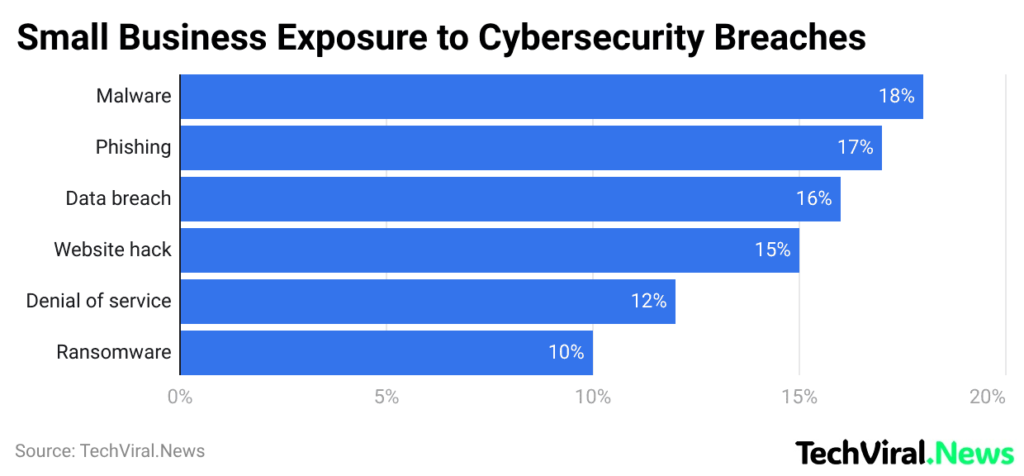
Small Business Exposure To Cybersecurity Breaches
(Reference: sqmagazine.co.uk)
- The cybercriminals’ arsenal has versatile tools, and small enterprises are no exception since they get attacked with all kinds of such threats, albeit malware is the most frequent.
- Almost one-fifth (18%) of the small business sector mentions malware as the reason for their disruption, and its infiltration can take place via a wrong software download, a hacked website, or even just an opened file from a harmful e-mail.
- Malware generally causes the system to slow down, data loss, or unauthorized access to the system.
- Then, phishing scams come in second position, doing harm to approximately 17% of small companies.
- Such assaults are on human errors that often involve misleading e-mails, messages, or layouts imitating legitimate ones meant to entice employees into sharing their login credentials or even disclosing their financial matters.
- Data leaks are a danger for 16% of small enterprises, which points out the vulnerabilities in the storage, access, and sharing of sensitive customer and company data.
- Just one leak may lead to the imposition of regulatory sanctions, a decrease in customer trust, and huge expenses for recovery.
- The hacking of websites hampers around 15% of the small businesses, thus stressing the need for secure web hosting, frequent site maintenance, and authentication that is hard to crack.
- Denial-of-service attacks are the cause for 12% of small businesses to discover that their operations are being disrupted to the extent that they can not provide online services and that their websites are constantly being overwhelmed, thereby losing sales and productivity at the same time.
- Ransomware, on the other hand, causes damage to only a smaller part of the industry at 10%, yet it can be extremely devastating when businesses cannot access their vital data and systems.
Small Businesses Are Prime Targets
- Small businesses have become the obvious and favourite prey of cybercriminals, and the main reason for this is that they are very often unprotected with security defenses that are very weak or non-existent.
- The year 2025 saw approximately 43% of cyberattacks in total aimed at small businesses, which was a clear indication of attackers’ choice of the path of least resistance—lower-profile, less-risky targets rather than heavily defended large firms.
- The digital tools and cloud-based platforms that are still mainly relied upon by many small organizations are left without adequate cybersecurity solutions, resulting in their vulnerability to intrusion.
- The consequences of such attacks might be extremely drastic and insoluble. Around 60% of small firms are closed down within six months of a major cyber incident.
- This is often the case because of the limited financial resources, small IT teams, and a lack of organized recovery plans that make it so hard for them to install or maintain systems, recover data, and win back the trust of their customers.
- A small business is, on a daily basis, under an attack approximately every 11 seconds.
- While this level of risk is significant, almost 80% of entrepreneurs still operate without any formal cybersecurity strategies, thus not giving workers instructions on how to avoid or react to a threat.
- Most worryingly, around 75% of small firms suffered at least one successful attack in the last year, partly fuelled by growing dependence on e-service and remote working tool facilities.
- A staggering 30% of data breaches are a direct result of the attackers being able to use stolen or hacked usernames and passwords, the main reason being that the passwords were weak and not very secure.
- Furthermore, it is a startling fact that 45% of small firms choose not to implement endpoint protection, which leaves laptops, desktops, and mobile devices unprotected.
- Only a small percentage of organizations, that is 20% only, perform regular security assessments. This results in the vulnerabilities not being discovered until they are purposely exploited.
Cost of Cyber Attacks
- Cyberattacks have a severe and sometimes even unbearable financial impact on small businesses.
- In 2025, the average loss by a small business due to a data breach was around US$120,000, which includes not only lost revenues but also legal fees, regulatory fines, and costs of repairs.
- Ransomware infections are among the worst scenarios because they not only block access to the data but also demand a ransom for unlocking it.
- These incidents can bring about costs of US$35,000 or even more for a small business, and some of them prefer to unconditionally pay the ransom just to be back in operation.
- Moreover, phishing attacks are also quite costly, being around US$70,000 per event on average, and at the same time eradicating customer trust and brand reputation.
- Globally, the threshold for annual losses caused by cybercrime is estimated to reach US$10.5 trillion by the year 2025, where small businesses will be among the most affected.
- In addition to the financial loss, there is a loss of reputation, which is hefty; about 29% of companies will no longer operate with the customers they had before the data breach.
- Adding to the problems, the price of cyber insurance has increased by 40% over the last two years, making the protection costlier.
- The statistics are such that almost 70% of small business owners consider it worse to recover from a cyberattack than from a natural disaster. This goes to show the extent of disruption and the magnitude of the devastation that such incidents could cause.
Ransomware Attacks And Small Business Vulnerability
- Ransomware still ranks high among the most serious cyber threats for small enterprises, and its repercussions were even more pronounced in 2025.
- Ransomware attacks affected more than one in three small businesses—roughly 37%—and this fact demonstrates how far-reaching and pervasive this danger has become.
- The ransom demand was a very heavy financial pressure. In 2025, the average ransom demand soared to nearly US$88,000.
- As a matter of fact, 58% of small businesses that paid still reported partial or total data loss, proving that the attackers either do not restore the systems completely or intentionally do not release the data.
- The small healthcare and financial services sector was the most affected, mostly due to the nature of their business, which includes dealing with sensitive personal and financial data, and the speed of the operations.
- Moreover, attackers relied on known vulnerabilities very heavily: Remote Desktop Protocol (RDP) exploits were involved in one in five ransomware infections, often when systems were internet-facing and strong authentication controls were lacking.
- Double extortion tactics—where hackers first encrypt the data and threaten to publicly disclose it—were the main technique employed in 66% of ransomware cases, thereby putting more pressure on the victims to pay.
- The chances of recovering the data turned out to be pretty low for the majority of the organizations, as only a quarter (24%) of the small businesses managed to get back their data completely without the need for external assistance.
- Backup systems were also unreliable at times; backups got compromised in 18% of the cases, especially when they were not cut off or air-gapped from the principal systems.
- The ransomware attacks resulted in an average downtime of 16.2 days in 2025, which had a large negative effect on productivity, revenue, and customer trust.
- The increasing use of ransomware-as-a-service (RaaS) tools has made matters worse, as even non-skilled attackers can carry out complex attacks with little effort.
Cybersecurity Risks Related To Employees In Small Businesses
- Human mistakes remain the main cause of cybersecurity incidents in the case of small businesses.
- The mistakes of employees represented 41% of all security incidents in the year 2025, which shows the enormous importance of staff behaviour in overall security.
- The problem of poor password practices is still very common; 68% of employees use the same passwords for different platforms, which makes it easy for attackers to get in through credential theft.
- The cybersecurity training in small businesses is only once a year for 31% of the total, so that leaves employees not ready to catch the creeping threats.
- This is seen in the results of phishing simulations, where the staff scored an average of 38% on tests, with the majority clicking on malicious links or giving out sensitive information.
- Access control problems are also part of the picture. Poorly managed user rights, which include giving employees a wider access range than necessary, led to 14% of the internal data leaks.
- Using personal devices was another risk factor, because one in five companies that had bring-your-own-device (BYOD) policies experienced data leaks as a result of insecure phones and laptops.
- Shadow IT, when employees use unauthorized applications and tools, was discovered in 43% of small businesses, which resulted in security teams having blind spots.
- Social media scams targeting employees increased by 21%, and in many cases, the attackers pretended to be HR or finance personnel in order to trick the employees into revealing their passwords or making unauthorized payments.
- A weak control system for external users contributed to this, as contractor or freelancer accounts accounted for 11% of the breach incidents.
- Nevertheless, only 17% of small businesses have centralized identity and access management systems, thus increasing the possibility of security failures that could have been avoided.
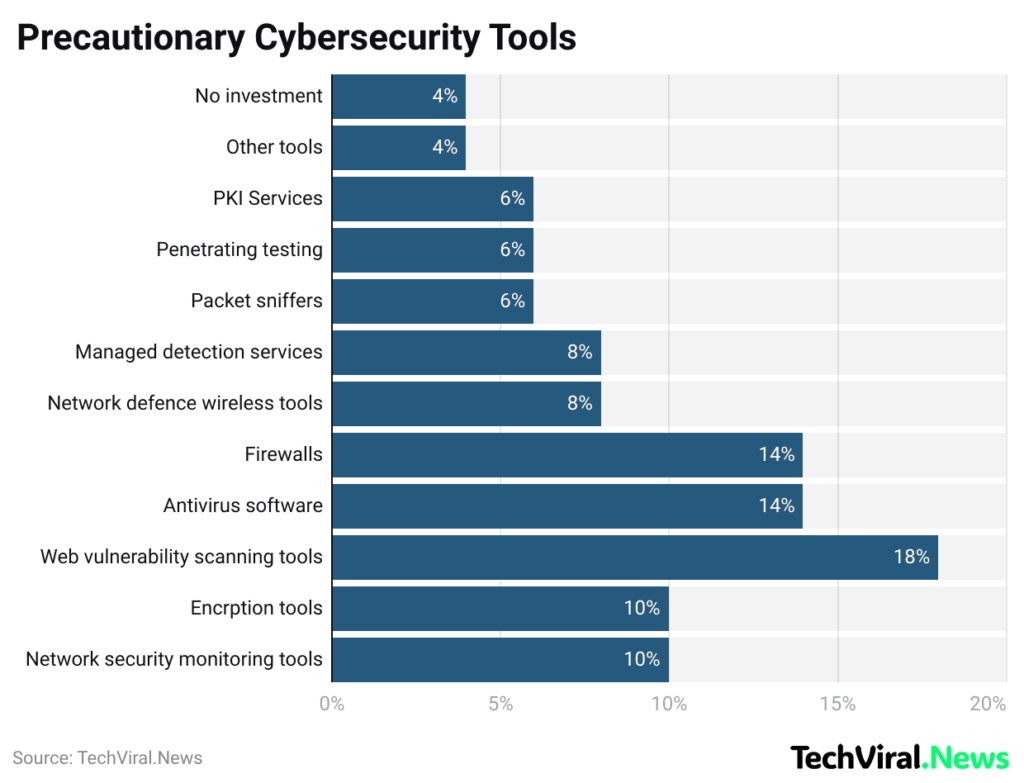
Small Business Precautionary Cybersecurity Tools
(Reference: electroiq.com)
- According to Zinnov’s data, small and medium-sized businesses are at very different levels of maturity in terms of cybersecurity tools, with some encouraging progress and others being simply unprotected.
- A few SMBs are investing heavily in security measures, while the majority are still at the mercy of cyber threats due to their inadequate or inconsistent defenses.
- At the very weakest point of the scale, 4% of small businesses do not even bother to invest in any cybersecurity tools.
- These businesses are practically defenseless against the most common types of attacks, such as malware, phishing, and ransomware.
- Another 4% have unspecified or other tools in place, which usually means the absence of a viable cybersecurity policy or the use of outdated, poorly integrated solutions that, in fact, provide very limited protection.
- The majority of small and medium-sized businesses (SMBs) concentrate on the primary security measures.
- Firewalls, which are critical for preventing unauthorized access by filtering incoming and outgoing network traffic, have been put in place by around 14% of the companies, thus acting as a crucial first line of defense.
- Another 14% of businesses make use of antivirus programs, which are still considered the most effective solo means of identifying and getting rid of malware, although by themselves they are no longer adequate against the advanced threats.
- Nearly 8% of the SMBs are availing of the service of MDR that supports external cybersecurity experts to look over the systems continuously, spotting threats, and reacting to incidents.
- This strategy of having external experts is particularly beneficial for small companies with no in-house security staff.
- Another 8% are spending on wireless network safety tools to safeguard their Wi-Fi networks against unauthorized access, rogue devices, and attacks carried out via the network.
- Small companies account for about 18% of the total market, using web vulnerability scanning tools that regularly examine their websites for potential security holes that attackers can exploit.
- Besides, SMBs are employing encryption tools for the 10% of their data that is sensitive and needs protecting; the data is safe during transmission as well as when it is idle on the system, the risk of exposure is there anyway through intrusion.
- Likewise, 10% have installed network security monitoring applications that are always running, analyzing the data that is moving over the network, thereby spotting any strange behaviour earlier.
Small Biz’s Cybersecurity Measures Adoption Rates
- Cybersecurity adoption by small companies was still limited and inconsistent in the year 2025.
- Only a third of small businesses have a written cybersecurity policy, so most of them are left with no specific guidelines for data and systems protection.
- Five out of ten small companies use endpoint protection software, which is an indication of little growth, but at the same time, a large number of devices remain unprotected.
- The practice of using multi-factor authentication (MFA) has increased to almost half, which is a good measure against account takeovers, but still, more than 50% of small businesses trust passwords only.
- Only 29% of the companies with fewer than 20 employees have firewalls or network monitoring tools.
- Cybersecurity awareness training is very rare, and only 9% of small companies offer training sessions to their employees every quarter.
- To counteract phishing, 42% of small businesses rely on email filtering tools, but the number still leaves a lot of employees at risk of getting hurt by harmful emails.
- Only 22% of organizations, mainly in regulated sectors, do vulnerability scanning regularly.
- Only one of five small enterprises performs annual penetration testing to mimic cyberattacks in the real world.
- Patch management is still a problematic area, and companies keep delaying critical software updates or performing none at all in the case of almost 40%.
- Even though they have been making some progress, a quarter of small businesses are still using obsolete or unsupported software, which significantly raises the risk of them getting hacked through vulnerabilities that are already known.
The Significance Of Cloud Security In IT Environments Of Small Businesses
- Cloud technology will have a great impact on small business operations in 2025, as cloud-based applications are used daily by 71% of companies.
- Nevertheless, cloud security is still a great concern. Improper cloud settings account for 27% of data breaches in small businesses; thus, this risk factor is improper configuration.
- There are cases of Google Drive and Dropbox, which are the most famous storage sites, being used in phishing-related breaches, where the malicious file links are the most common way of doing it.
- Security reviews revealed that in 35% of cases, shared passwords were the reason for easy access to the accounts, thereby increasing the risk of an organisation’s account being compromised completely.
- Besides, 11% of incidents related to the cloud were due to unauthorized integration of third-party services.
- A mere 22% of small businesses conduct regular reviews of cloud access logs; thus, it is difficult to spot unusual activities.
- The number of attacks with ransomware based on cloud technology increased by 14%, and the major cause of this was the continuous use of email attachments that are auto-synced to cloud storage.
- The data privacy and compliance issues were the reasons why 19% of small companies have switched over to domestic cloud providers.
- Serverless cloud environments do provide advantages in terms of flexibility and cost-saving; however, at the same time, they also carry risks—misconfigured access permissions were responsible for 28% of the cloud breaches.
- To put it differently, the state-of-the-art cloud security solutions, like Cloud Access Security Brokers (CASBs), are being employed by merely 6% of small businesses, and that too, predominantly among the technology-inclined startups.
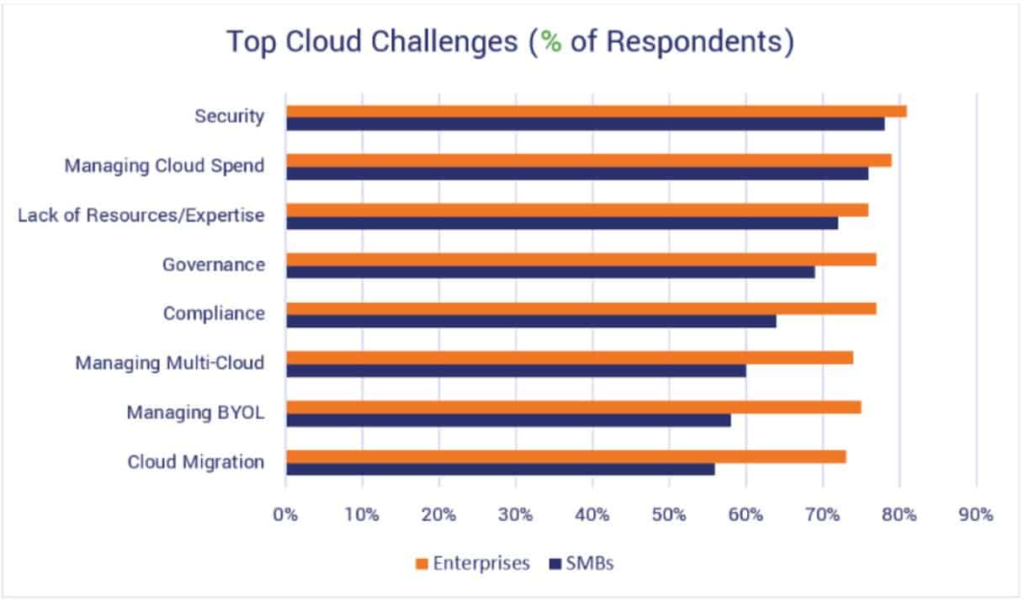
Top Cloud Challenges Faced By Enterprises Vs SMBs
(Source: thesslstore.com)
- For both, security is the biggest problem in the cloud, with 51% of the enterprises and 49% of the SMBs stating it as a major problem.
- Cloud spend management is also pointed out as a trouble by almost the same number of companies, being 51% for enterprises and 49% for SMBs.
- The lack of resources or in-house expertise is more evident in enterprises, as it is acknowledged by 52% of them as opposed to 48% of SMBs.
- Issues related to governance are also more burdensome for enterprises, as 52% of them report facing difficulties, while only 48% of SMBs do.
- Compliance issues are a lot more difficult for enterprises, as 55% report facing such issues, while only 45% of SMBs are in the same situation.
- The problem of managing multi-cloud environments still follows in the same way, with 55% of enterprises and 45% of SMBs being challenged.
- BYOL complications are reported more often by enterprises at 53% versus 47% of SMBs.
- Cloud migration continues to be a major issue affecting 54% of the enterprises and 46% of the SMBs altogether.
Conclusion
Small Business Cybersecurity Statistics: In 2025, the security of data is of utmost importance in deciding the fate of small businesses. It determines their survival and even growth. The evidence is very clear that the cyber threats are not occasional risks anymore, but everyday events. These events have a high impact and can cause disruptions to operations, take over finances, and even ruin trust. The incidents are caused mainly by ransomware, phishing, cloud misconfigurations, and human error. These incidents have made it impossible for small businesses to continue using the old or merely defensive strategies. The situation is still alarming. The small-scale use of security tools, bad policies, and a lack of training lead to more vulnerabilities in the system.
It is already a necessity for business continuity and competitiveness in the long term to treat proactive cybersecurity strategies, employee training, and modern protection measures as a full part of their operations rather than an extra cost.
FAQ
Small businesses are the ones who get attacked the most, owing to the fact that they usually do not have proper security measures, such as an IT team and a formal cybersecurity policy. Cybercriminals’ perception of small businesses as easy and low-risk targets has led to small businesses being the victims of 43% of all cyberattacks in 2025, as opposed to large companies that have effective security measures in place.
Malware (18%), phishing (17%), data breaches (16%), and website hacks (15%) are among the classic threats. Cyber extortion cases are fewer in number (causing only 10% of attacks), but their impact in terms of financial and operational losses is most severe.
A cyberattack can wipe out the financial resources of a company. The average cost of a data breach for a small business in 2025 is approximately US$120,000. The cost of a ransomware event can reach US$35,000, while phishing incidents can average US$70,000, which can often lead to the small business going out of business.
People’s mistakes are the cause of 41% of the cybersecurity problems. The most common problems are users having the same password for different accounts, being tricked by phishing emails, using personal devices for work and not being trained. Only one out of three small companies provides regular cybersecurity training, which is a much bigger risk.
Although on average 71% of all small businesses use cloud services every day, cloud security practices are often inadequate, making these businesses more vulnerable. According to a report, misconfigured cloud settings are responsible for 27% of security breaches; shared passwords stand for 35% of cloud-related risks, and only a tiny fraction of firms are utilizing sophisticated cloud security technologies like CASBs.